



Rising gas costs on the Ethereum network have spurred competition among projects developing scaling solutions.
Earlier this year, Binance Smart Chain recorded robust growth. This EVM-compatible platform offers fast and inexpensive transactions, but its major drawback is a high degree of centralisation.
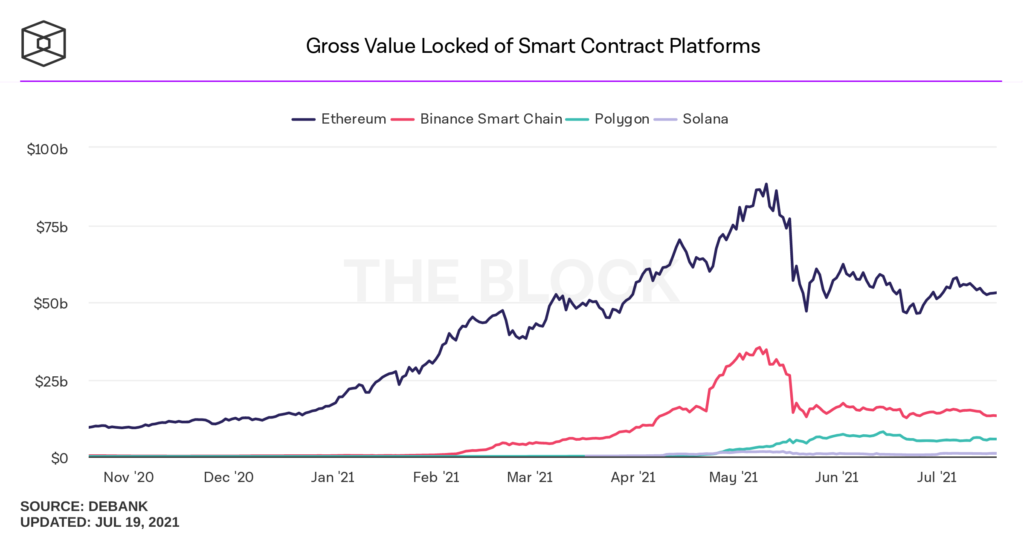
Soon the Polygon ecosystem (formerly Matic Network) gained traction, committed to cutting-edge innovations and positioning itself as the “Internet of Blockchains”. Thanks to near-instant transactions and extremely low fees, the project entered the top three protocols by total value locked (TVL) in a matter of months.


ForkLog examined the reasons behind the ecosystem’s growth and the architecture of Polygon.
- In recent months, the Polygon ecosystem has shown robust growth, expressed in higher on-chain activity, a rise in the native token price, and the emergence of numerous DeFi projects and integrations.
- The Polygon PoS Chain system has distinctive features that set it well apart from a simple sidechain.
- Developers will need to add support for Optimistic rollups, ZK-Rollups and Validum, ultimately becoming an aggregator of scaling solutions.
Explosive growth of Polygon
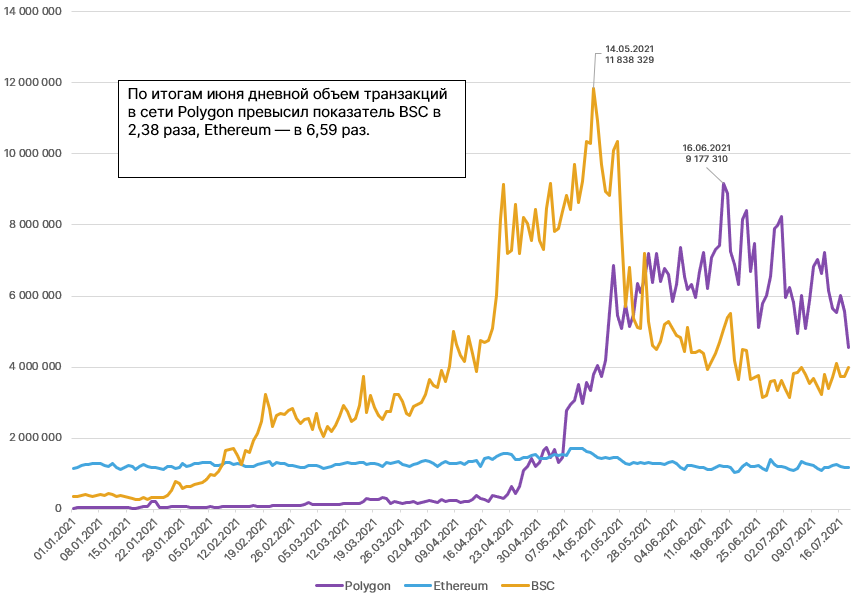
Despite the ecosystem’s youth, Polygon’s daily transaction volume significantly exceeded that of Binance Smart Chain and Ethereum.


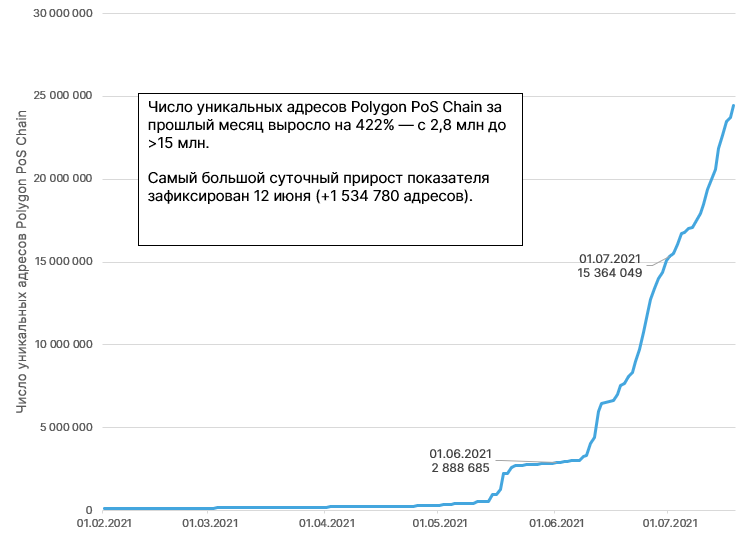
In June, the number of unique Polygon addresses rose fourfold, signalling a growing user base and greater activity in the ecosystem.


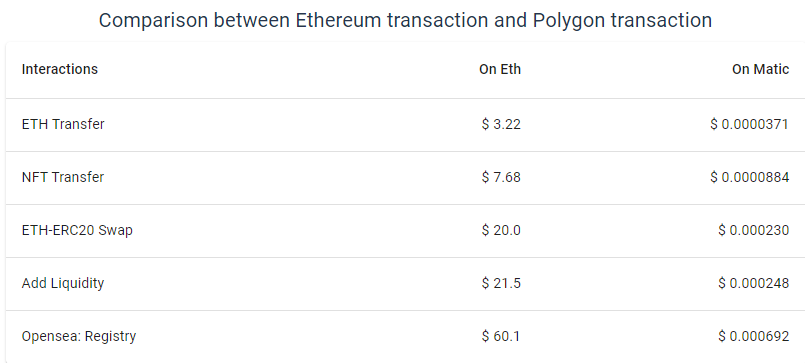
High on-chain activity is driven by fast and cheap transactions. The average transaction cost on the Polygon network is hundreds of times lower than on Ethereum — an indisputable competitive advantage. A comparison is shown in the table below.


Polygon’s success is further aided by network effects from integrations with SushiSwap, Aave, Curve, 1inch and many other DeFi platforms. The total TVL of the Polygon-based ecosystem, comprising more than 350 projects, exceeds $5 billion.


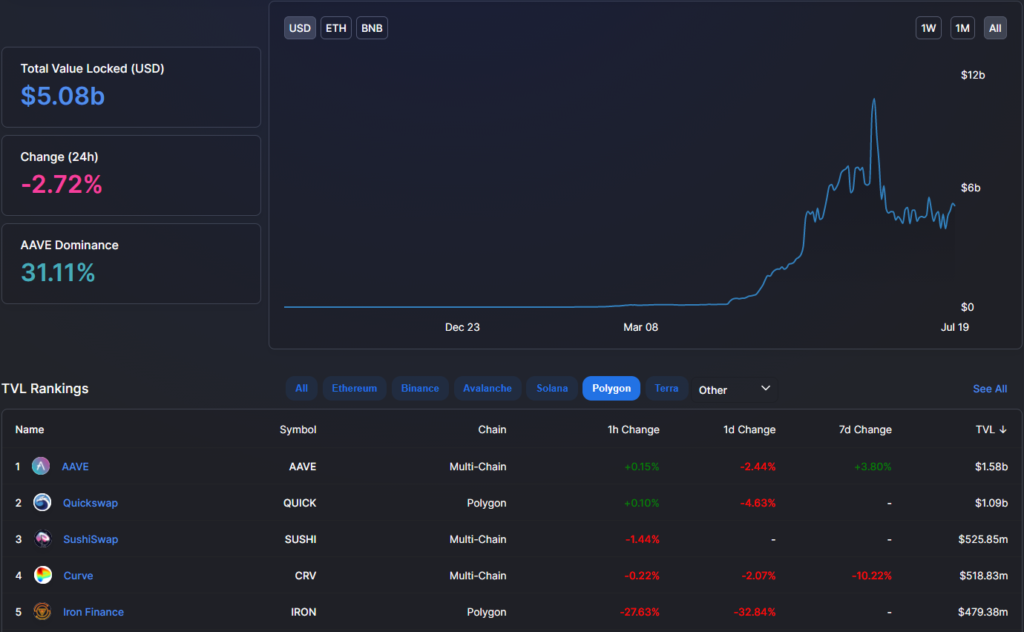
Aave — a lending protocol, also leading in the Ethereum ecosystem, according to DeFi Pulse.
QuickSwap — Uniswap-like and the leading DEX on Polygon.
IRON Finance — a protocol operating on Binance Smart Chain as well, with a partially collateralised stablecoin IRON, softly pegged to the US dollar. In June the project, which included billionaire Mark Cuban, faced a “bank run”.
Curve — a stablecoin-focused platform built on the automated market maker (AMM) model.
SushiSwap — a DEX known as the “vampire” fork of Uniswap.
Dfyn — a platform positioning itself as a decentralised exchange network, including on the basis of Layer-2 solutions.
Beefy Finance — yield-farming optimiser on the Binance Smart Chain.
Balancer — a non-custodial portfolio manager and AMM platform.
Kyber — “a hub for targeted liquidity protocols for various DeFi use cases”.
Autofarm — a DEX aggregator and yield optimiser, also supporting BSC, Huobi ECO Chain.


Many of the above projects originally operated on Ethereum (for example, SushiSwap, Kyber and Balancer) or Binance Smart Chain (Autofarm). The Polygon integration helped them solidify their positions in the DeFi space. A shining example is Aave, which has been leading in TVL in recent months. DeFi Pulse.
Below is a chart showing Polygon’s share of total TVL across different protocols. June also saw a drop in BSC’s share as Ethereum’s segment grew.


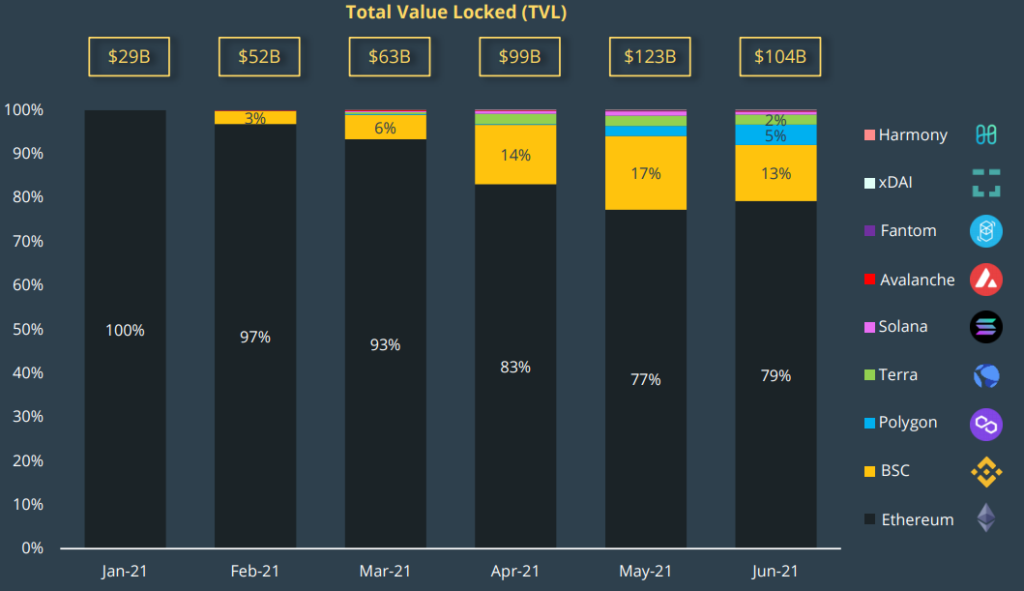
“Polygon has done well lately — it is accessible while most Layer-2 solutions remain in development. Aave was deployed on Polygon in April, and market-tested Curve and SushiSwap soon followed suit,”
— noted Messari analyst Rashid Saleuddin.
Developers of the “Internet of Blockchains” are continuing to expand the ecosystem beyond Layer-2 solutions. In July the project introduced a Polygon Studios unit focused on blockchain games and the NFT ecosystem NFT. The new structure aims to bring together major brands, popular content creators and investors interested in the space.
NFT marketplace OpenSea, which recently attracted $100 million at a valuation of $1.5 billion, added the ability to buy Polygon assets with a debit or credit card. The integration with the protocol helped reduce potential transaction costs for users paying gas in Ethereum.
In April, the Polygon team launched a fund with $100 million in assets intended to make decentralized finance more popular, accessible and scalable. According to Sandeep Nailwal, the #DeFiForAll Fund will allocate up to 2% of the total supply of native tokens (200 million MATIC).
What’s under the hood at Polygon?
The project started in October 2017. Before the rebrand, Polygon was known as Matic Network. Its co-founders Jainti Kanani, Sandeep Nailwal, Anurag Arjun and Mihailo Beli set out to solve Ethereum’s scaling problem.
Initially the team worked on Plasma Chains — a second-layer solution based on its own Plasma implementation. Faced with data-availability problems and long withdrawal times, the project pivoted to developing the PoS Chain — a sidechain to Ethereum using a Proof-of-Stake consensus mechanism.
The result of more than two years of work was the launch of the Matic Network mainnet. The project began to attract growing attention as Ethereum’s gas prices rose, underscoring the urgent need for reliable and efficient scaling solutions. In February 2021, Matic Network renamed to Polygon. The rebranding aligned with a vision of an ecosystem capable of integrating various scaling solutions—from autonomous sidechains to L2 options such as Plasma, Optimistic Rollups and ZK-rollups.


Polygon supports two main types of Ethereum-compatible networks:
- standalone (autonomous) networks;
- secured (secured) networks, using the model “security as a service”.
Autonomous networks rely on their own security, and may have their own consensus model such as Proof-of-Stake (PoS) or Delegated-Proof-of-Stake. Such networks are independent and flexible, but those qualities can hinder achieving a high level of security. For example, PoS requires a large number of reliable validators. This model is typically suited to enterprise networks and established projects with strong communities.
Secured networks use a model of “security as a service.” Their operation is provided either directly by Ethereum, for example via fraud proofs used in Plasma, or via a pool of validators. Secured networks offer the highest level of security, at the cost of some independence and flexibility.
So far, Polygon uses only Plasma as an L2 solution, though work is underway on other Layer-2 scaling technologies. They are difficult to integrate with the existing infrastructure since Plasma and PoS frameworks are not directly compatible with Rollups or Validium.
The changes outlined in the lite paper aim to make Polygon a popular scaling tool for EVM-compatible applications, offering developers a high degree of flexibility and broad options to tailor the infrastructure for different service types.
In the Polygon ecosystem there are 100 validators, available to various projects. This concept is similar to a security-sharing model like Polkadot.
Polygon’s architecture comprises four abstract, composable layers.


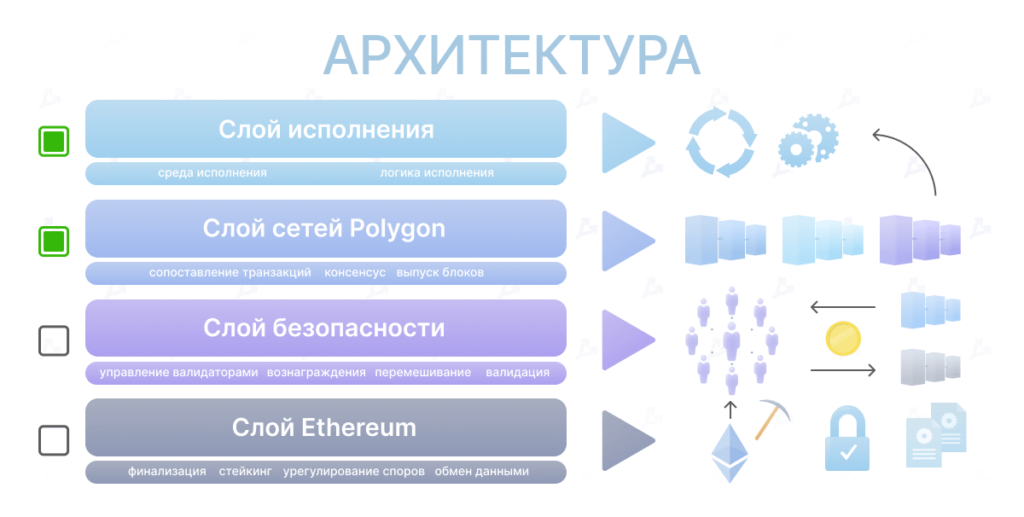
Ethereum Layer. Polygon networks can use Ethereum as a base layer, which carries a high degree of security. This layer is implemented as a set of smart contracts and is used for such operations as finalisation, checkpointing, staking, dispute resolution and data exchange. It is optional — networks on Polygon are not required to use it.
Security Layer — another optional level that provides a model of “validators as a service.” It enables Polygon networks to use a set of validators who periodically verify the state of systems in exchange for fees.
This layer is typically implemented as a meta-blockchain running alongside Ethereum, responsible for registration, reward distribution, shuffling and validation of Polygon networks. It is abstract and may have multiple implementations with different properties. The layer can be implemented directly on Ethereum using miners as validators.
Network Layer. This is the first mandatory layer in Polygon’s architecture. It consists of sovereign blockchains, each capable of mapping transactions, achieving local consensus and producing blocks.
This layer provides system interoperability. Developers can either build their own network layer or use the Heimdall PoS-validators layer to run their applications.
Execution Layer. It is responsible for the interpretation and execution of transactions in Polygon networks. The layer comprises sublayers of the execution environment and execution logic. It is an EVM-compatible layer, designed to simplify application integration.
Thus, Polygon can offer different system configurations — focusing on security, transaction speed, cost minimisation and sovereignty. Given the enduring scalability trilemma, projects can choose the approach best suited to their use cases and migrate between solutions.
This architecture also enables different Polygon-based scaling solutions to interact with one another, preventing the creation of fragmented, isolated systems.
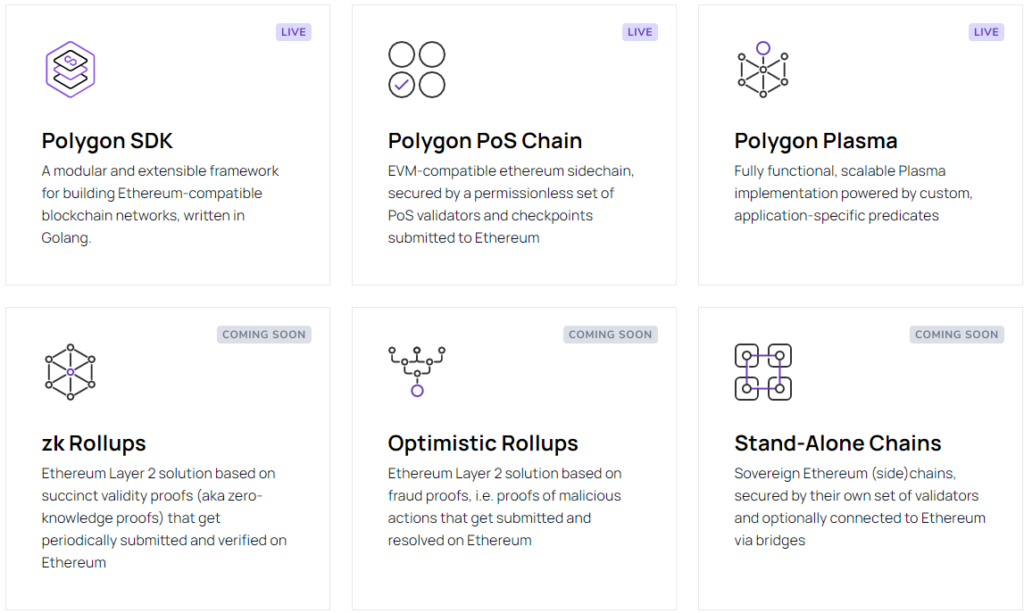
As of writing, Polygon offers only PoS and Plasma networks. The project also provides a development kit (SDK) to help new projects create flexible and customizable scaling solutions.


Matic Plasma Chains is a second‑layer solution based on the Plasma scalable DApps framework, proposed by Joseph Poon and Vitalik Buterin.
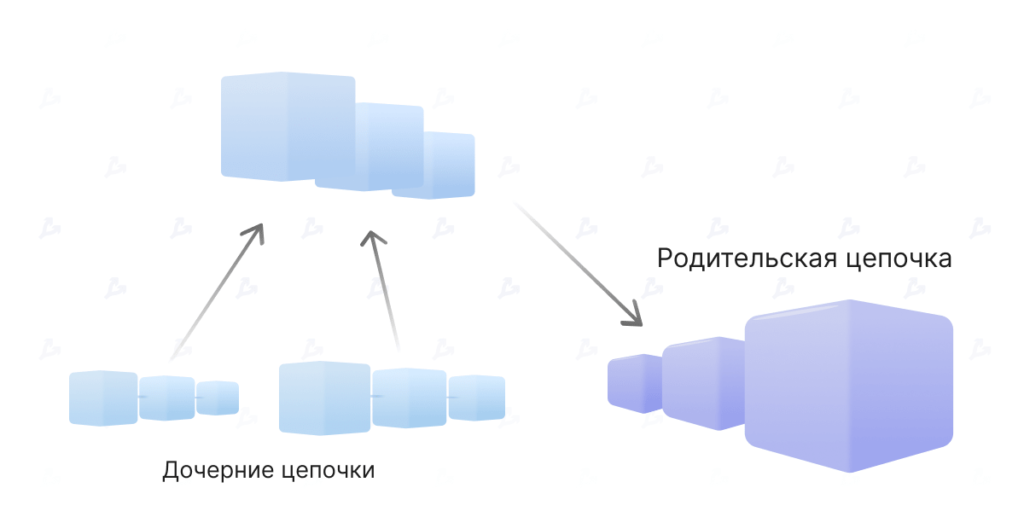
Plasma uses smart contracts and Merkle trees to create an unlimited number of child chains — copies of the parent Ethereum network. The main blockchain is relieved by the child chains, enabling fast and inexpensive transactions.
One drawback of Plasma is the lengthy withdrawal period from L2 — about a week. Plasma cannot be used to scale applications built on complex smart contracts. The solution supports only simple functions such as transfers and exchange operations.
Matic PoS Chain is a public (permissionless) sidechain operating in parallel with Ethereum. Its security is provided by the Proof-of-Stake consensus mechanism with its own set of validators.
Matic PoS Chain also relies on Ethereum’s security for checkpoints and staking. This sidechain is EVM-compatible, enabling Ethereum projects to integrate with it easily and seamlessly.
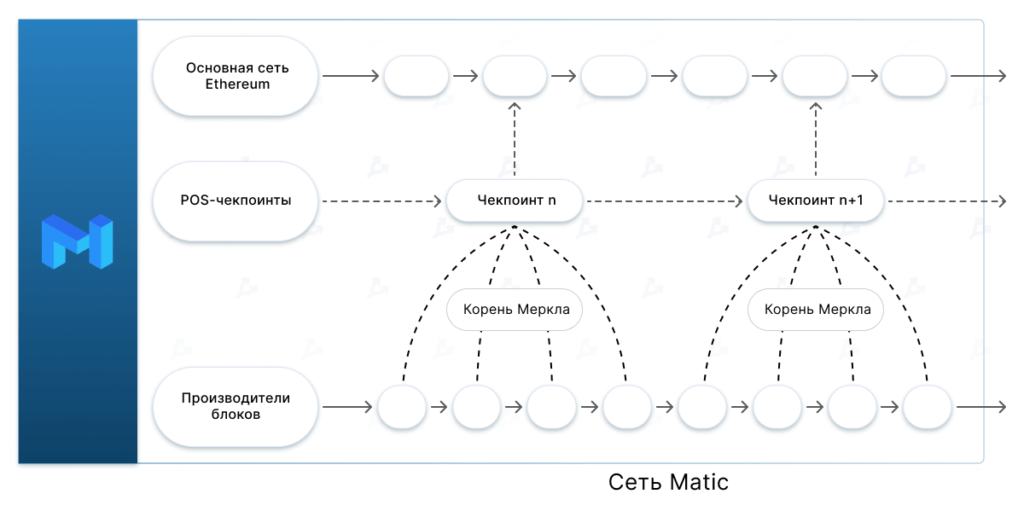
During the consensus process, Polygon validators stake MATIC. The chains include a slashing mechanism for staked funds. It prevents stakers from proposing invalid blocks, validating blocks or transacting in violation of network rules.
Matic PoS Chain comprises two levels:
- Block production Bor — responsible for aggregating transactions into blocks;
- Heimdall PoS-validators level — supports all validating nodes (stakers) that operate alongside the staking contracts of the Matic Network and manage validator accounts, perform slashing and issue rewards.
Block producers Bor form a subset of network participants who are periodically shuffled by Heimdall validators. These groups are drawn from the pool to validate only a defined set of blocks, called a span (section).
Heimdall runs on the Tendermint engine, with altered data structures and signature schemes. It validates blocks, runs the block-creator selection committee and oversees the process of inserting sidechain blocks into Ethereum (checkpointing).
This level aggregates Bor blocks into a Merkle tree. The finalised data are sent to the main Ethereum network as a commit, recording the latest state of the Polygon system.
The above mechanism is similar to Optimistic rollups, where users trust the latest state of the Ethereum network unless fraudulent activity is detected. However, Polygon uses a sidechain architecture, which carries certain risks. For example, there may be malicious actors among validators, and there may be bugs in the consensus algorithm.
Validators on Heimdall are required to stake MATIC on Ethereum before they can verify and secure their network. Checkpointing occurs roughly every 34 minutes. The result of this process must be confirmed by at least two-thirds of validators. Only then are the data sent to Ethereum.
Rewards are distributed to validators in MATIC tokens. They include staking rewards and user transaction fees.
Anyone can participate in validation — you need to own at least one token of the Polygon network. As of writing, more than 28% of the token supply is staked. It is worth noting that MATIC is not a governance token — voting is limited to changes to validator-related parameters.
A key function of Heimdall validators is the synchronization of data between networks.
“State Sync — a native mechanism for reading Ethereum data from the Matic EVM chain. Heimdall-level validators receive StateSynced events and pass them to Bor,”
as stated in the Matic Network documentation.
This event implies that Ethereum’s mainnet state has to be conveyed to Polygon. The reverse process is achieved via checkpointing.
Thanks to its architecture, Polygon offers very short block intervals — 2–4 seconds. This enables high throughput.
Not quite a sidechain
Jakub, a developer and founder of the Finematics portal, regards Polygon’s PoS Chain as more than just a sidechain. He calls this system a Commit Chain.
“When it comes to Polygon Commit Chain, it should be distinguished from a sidechain, because it has a number of additional functions that rely on the security of the main Ethereum network,”
in his article on Finematics.
Jakub notes that in the past it was common to classify L2 solutions not only as Plasma and Rollups, but also as sidechains, since all are built on top of the main network.
“Over time the Ethereum community began drawing distinctions between L2 solutions fully secured by the Ethereum mainnet and other scaling options with their own consensus mechanisms — sidechains.”
According to him, many sidechains use a consensus mechanism that limits the number of entities able to verify data. For example, with Delegated-Proof-of-Stake only 21 validators typically operate, a small number for systems based on Proof-of-Authority.
“In Polygon PoS Chain anyone can join the network and start validating its state. This matters because any participant can become a validator and verify the correctness of processing transactions, — explained Jakub. — This model lets anyone participate in securing the network with any amount of MATIC tokens.”
As noted earlier, validation is performed by a subset of Bor’s block producers. The latter are periodically shuffled by Heimdall validators. Selected network participants validate only certain blocks (a span). A new selection process then begins. This is a distinctive feature of Polygon.
“This does not come at the expense of transaction speed, since not all validators need to continuously validate blocks,” — emphasised the founder of Finematics.
Which bridges lead to Polygon?
Heimdall validators enable decentralised cross-chain transfer of tokens between Ethereum and Polygon. There are two types of bridges — Plasma and PoS.
Initially only the Plasma bridge was used, characterised by a high level of security. Its main drawback is a seven-day withdrawal period, which many users may find too long.
Subsequently, the PoS bridge was introduced to address the withdrawal delay problem. This instrument is much faster but less secure — it relies on user trust in validators.
There are also bridges from third-party projects. For example, Zapper Bridge, functioning only from Ethereum to Polygon. Connext’s xPollinate enables transfers of crypto assets between xDai, Polygon, Fantom and Binance Smart Chain ecosystems. A bridge from yield aggregator EVOdefi provides similar functionality.
When interacting with bridges, users send crypto assets into them and receive equivalent coins on the other network.
Numerous decentralised systems have been developed to date, with significant technical differences. Such bridges play a vital role — they render the DeFi space more liquid, active and less fragmented.
Conclusions
The Polygon team is actively developing cutting‑edge scaling solutions and investing multi‑million sums into DeFi. The result is evident — many well‑known projects, including Aave, Curve and SushiSwap, have integrated with the new ecosystem. This has helped them become more liquid and strengthen their market positions.
A plethora of new apps has been created, relying on cheap and fast transactions with MATIC. The token’s price, buoyed by demand and network effects, has risen by more than 5,000% over the year. https://www.coingecko.com/en/coins/polygon.
Polygon enables industry participants with limited resources to experiment, moving funds between platforms like Lego bricks. Fast and exceptionally cheap transactions enable users to pursue sophisticated investment strategies on platforms like StakeDAO, leveraging a range of protocols.
The team faces a challenging task — to be among the first to implement ZK‑rollups, Optimistic Rollups and other frontier developments. If successful, the project could become a central element of EVM‑compatible L2 solutions and prove itself as an “aggregator of scaling technologies.” This should be driven by the pioneer advantage and clear DeFi‑segment development directions toward interoperability, lower transaction costs and maximum speed.
On the other hand, competitors are not resting — viable alternatives such as Binance Smart Chain and Solana are attracting substantial sums. These ecosystems also show impressive TVL metrics — $8.57 billion and $1.1 billion, respectively (as of 25 July 2021).
Who will win this arms race remains to be seen. In any case, competition will not hinder the industry’s ongoing development.
Subscribe to ForkLog news on Telegram: ForkLog Feed — the full news stream, ForkLog — the most important news, infographics and opinions.