



Analysts Examine USDe Stablecoin Vulnerabilities Amid Market Volatility
- In a bear market, rewards from shorts on derivatives may be insufficient to maintain USDe’s stability.
- Concerns arise over the diversification of centralized partners.
- The growth of the “synthetic dollar” could limit the capacity of the crypto derivatives market.
To gain trust, USDe from Ethena Labs must demonstrate resilience in adverse market conditions. Experts outlined Cointelegraph conditions for such stress testing.
The capitalization of Ethena Labs’ CDP stablecoin surpassed $2 billion faster than any similar asset in cryptocurrency history.
Its rapid ascent and attractive yield of 17.2% per annum have heightened fears that USDe might replicate the high-profile collapses of similar projects.
Unlike the infamous UST from Terra, Ethena’s stablecoin architecture is based on a TradFi strategy of delta-neutral trading and portfolio management, commonly used in options markets to manage risks associated with changes in the underlying asset’s price.
To issue USDe, users deposit Bitcoin, Ethereum, stETH, or USDT into the protocol. The collateral assets are used to open equivalent short positions on perpetual contracts.
According to Keyrock’s Justin d’Anethan, delta-neutral trading has proven itself over decades as a type of Cash–and–Carry trading in TradFi. It is considered safe under favorable market conditions.
Risks of Negative Funding Rates
During a cryptocurrency market rally, fewer investors are willing to risk falling prices. This allows Ethena to provide returns in USDe through rewards received from long holders in the form of funding rates.
In a bear market, the situation changes — the issuer will have to pay funding rates to long position holders.
“Shorts [become] costly to maintain, potentially leading to a depeg if expenses exceed manageable levels,” explained Julia Palamarchuk, co-founder of Aqua Protocol on the TON network.
Ethena can cover fees with income received in stETH from staking. The token accounts for 16% of the collateral assets, according to the project’s website.
Currently, stETH yields 3.3% per annum, which may be insufficient to cover obligations during periods of sustained negative funding rates, the publication noted.
During heightened geopolitical risks in the Middle East on April 13, funding rates turned sharply negative. Consequently, USDe briefly deviated from its peg, reaching $0.995.
According to Ethena’s Head of Growth, Seraphim Cheker, the “synthetic dollar” has passed its first stress test.
The team does not expect prolonged periods of negative funding rates to occur frequently.
In February, Ethena’s founder Guy Young, citing internal analysis, stated that in 2022, during a bear market, the average funding rate was zero. The worst periods included a metric close to -3% for a week.
“When the interest rate is too low, the market indicates that the supply of USDe is too large compared to the system’s overall needs. This means we need to reduce it,” explained the entrepreneur.
The invisible hand may also play a role in maintaining the “synthetic dollar” peg during market collapses. To protect their interests, users should redeem their USDe, leading to a reduction in shorts, aiding in the recovery of funding rates.
“No TradFi market offers a zero-risk situation, and certainly not in DeFi. Ethena’s strategy makes sense and should ensure stability alongside yield. The latter will depend on the demand for derivatives. Therefore, it may not remain as high as it is now, but it should not create serious problems,” noted d’Anethan.
Risks of Centralized Counterparties
In recent years, several platforms have imposed withdrawal restrictions or become insolvent, raising significant concerns about USDe’s reliance on CEX.
The team partially mitigates this risk by involving over-the-counter custodians. These custodians hold Ethena investors’ cryptocurrencies and use them to open perpetual contract positions on behalf of clients.
If a centralized platform faces insolvency or other risks, the project’s derivative position will close, but the collateral assets will remain safe, as they were never on exchanges initially.
However, the risk of USDe depegging remains if the perpetual contract position is not transferred to another platform.
“Ethena’s current centralized operational model, including custodial wallets for fund management, creates significant security risks and contradicts the decentralized ethos of DeFi,” explained Palamarchuk.
According to observations by Jaewoo Cho, an associate professor in the Department of Social Sciences at Hansung University in South Korea, a significant portion of Ethena’s wETH went directly to Bybit, and USDT to Copper.
“This creates the impression that the risk is not very well diversified,” commented the specialist.
According to Ethena data: Copper holds $1.28 billion of the project’s collateral assets, Ceffu $1.07 billion, and Cobo $4.87 million.
Ethena’s Derivatives Model May Limit Supply
USDe is unlikely to match the capitalization of centralized counterparts like USDT.
“The size of the derivatives market and maximum open interest (OI) limits on exchanges may constrain the asset’s growth potential,” explained Palamarchuk.
USDe’s growing capitalization increases the volume of short positions in derivatives, pushing negative funding rates upward. Theoretically, such a reduction in profits encourages investors to close shorts and liquidate the “synthetic dollar.”
If USDe’s volume becomes too large for long positions to stabilize funding rates, the asset’s expansion may be limited.
As of April 11, OI on Ethereum contracts was estimated at $9.75 billion. 12% of the amount was related to issuer positions.
The project addresses scalability issues by expanding collateral assets, recently adding Bitcoin. OI on digital gold-based contracts is $37 billion.
CryptoQuant CEO Ki Young Ju expressed concerns about the risks to Bitcoin posed by the inclusion of the asset in USDe’s collateral. The expert drew parallels with the collapse of Terra (LUNA) and its associated algorithmic stablecoin UST.
Unlike stETH, Bitcoin does not generate staking income. The same applies to USDT and ETH.
This means the safety cushion capable of mitigating the impact of negative funding rates will be smaller compared to other collateral assets like stETH.
As a result, the prospect of using the insurance fund by the team may arise. Currently, it holds cryptocurrencies worth $32.7 million.
Specifically, Ethena holds $15.2 million sDAI in Maker and $11.3 million in USDe and USDT pairs on Uniswap. Another $5.1 million is in USDT and $1 million in the “synthetic dollar” itself.
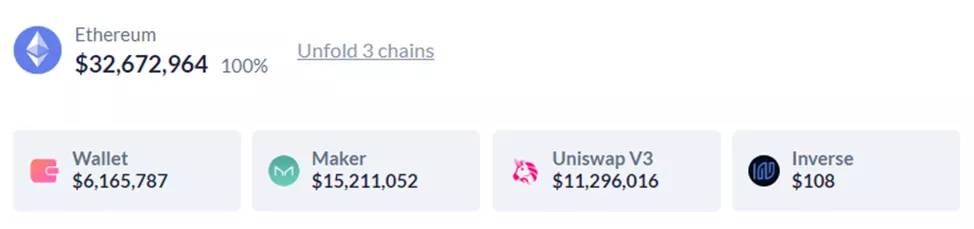
The reserve is mainly formed from derivative income, considered excessive, as USDe holders prefer to hold the asset rather than stake it for rewards.
“In a scenario where Ethena uses DAI in its insurance fund, and Ethena and MakerDAO face market downturns, interdependence can indeed pose risks,” noted Palamarchuk.
A hypothetical threat also lies in stETH deviating from ETH, although such a scenario seems unlikely.
As a newcomer to the market, Ethena must bear the heavy burden of past stablecoin failures. However, experts assert that the likelihood of a depeg is not significant.
“Barring operational mishaps or execution errors, the trading itself is virtually risk-free,” stated d’Anethan.
In conclusion, the specialist added that users should weigh custodial risks and market conditions against the “convenience and attractiveness” of the stablecoin and its yield.
In April, Ethena Labs increased rewards for those locking a large volume of ENA in staking.
Рассылки ForkLog: держите руку на пульсе биткоин-индустрии!