




- After “Liberation Day,” it is important for bitcoin to hold above $76,500 through 15 April, says Arthur Hayes.
- Anticipation of retaliatory steps against US trade tariffs is injecting uncertainty into markets.
- The new tariffs will hit the US bitcoin-mining industry.
If bitcoin holds $76,500 through US tax day on 15 April, the market will shed the uncertainty and volatility triggered by US trade tariffs, according to BitMEX cofounder Arthur Hayes.
Mrkt no likey “Liberation Day”, if $BTC can hold $76.5k btw now and US tax day Apr 15, then we are out of the woods. Don’t get chopped up!
— Arthur Hayes (@CryptoHayes) April 2, 2025
“The market doesn’t like ‘Liberation Day’,” he wrote.
On April 2, US president Donald Trump announced new tariffs for trading partners. A 10% minimum for all countries will take effect on April 5. For a number of partners, “reciprocal tariffs” roughly half the level those countries levy on American goods will be introduced. These measures will start on April 9.
Retaliatory tariffs for China will be 54%, for the EU — 20%, Vietnam — 46%, Taiwan — 32%, Japan — 24%, India — 26%, and South Korea — 25%.
Markets reacted negatively
During Trump’s remarks, the market capitalisation of the S&P 500 index fell by more than $2 trillion in just 16 minutes, noted The Kobeissi Letter.
This clip will go down in history:
At 4:25 PM ET, S&P 500 futures were trading +1.7% higher.
At 4:26 PM ET, Howard Lutnick handed a poster outlining “reciprocal tariffs” to President Trump.
Stock market futures fell REAL-TIME as Trump read off tariffs name by name.
By 4:42 PM… https://t.co/8vehJNDgBn pic.twitter.com/odOkvY5ubD
— The Kobeissi Letter (@KobeissiLetter) April 2, 2025
“Nasdaq 100 futures are currently trading 850 points lower after a 400-point rally earlier in the day. That puts us on track for the biggest daily reversal in 2025. Buckle up for more volatility,” the site’s authors said.
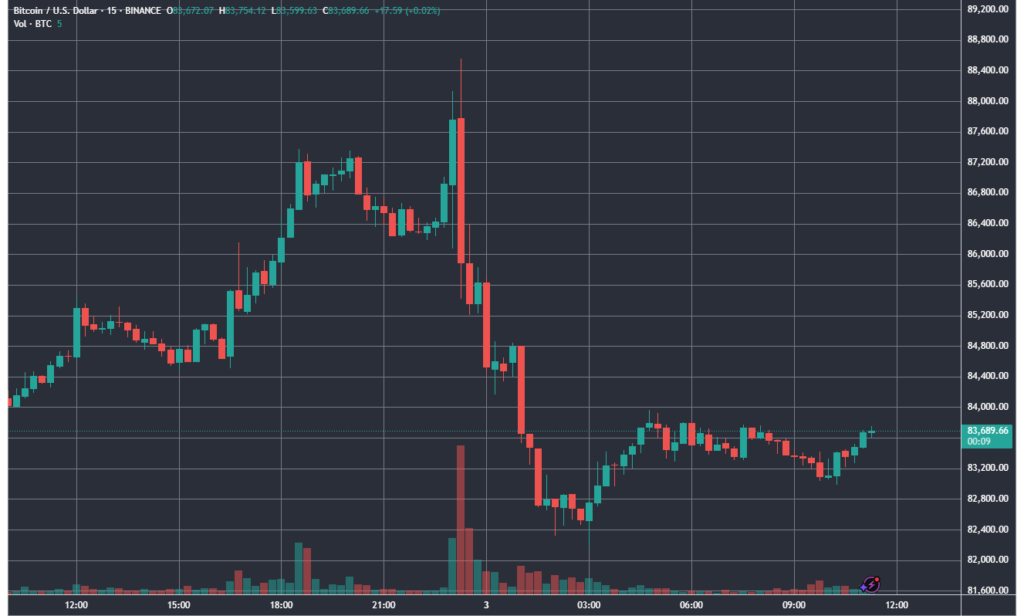
After the president’s briefing began, bitcoin rose to around $88,550, then fell alongside traditional markets. Prices approached $82,300; after a bounce, the asset is trading around ~$83,700.


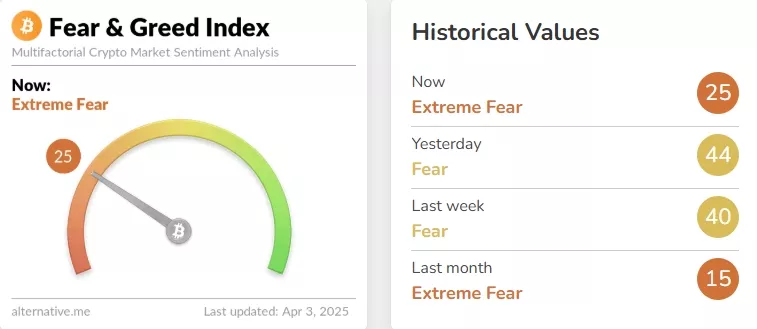
The crypto Fear and Greed Index plunged to 25, into the “extreme fear” zone, over the past day. On the eve of “Liberation Day,” the metric had been edging higher.


Economic uncertainty will fuel volatility
Rachel Lucas, an analyst at BTC Markets, told Cointelegraph that the brief price spike in bitcoin was driven by “reduced uncertainty.” But once the full tariff details emerged, selling followed. The platform recorded a 46% rise in trading volumes.
In her view, if economically strong players respond with tariffs, it could trigger another wave of panic selling.
US Treasury secretary Scott Bessent urged the country’s trading partners in a Bloomberg interview to refrain from retaliatory steps. Doing so, he said, would provide a “ceiling” and certainty for markets.
Treasury Secretary Scott Bessent urged US trading partners against taking retaliatory steps against Trump’s new set of retaliatory tariffs https://t.co/FXcbsWiFBY
— Bloomberg (@business) April 2, 2025
China, Canada and the European Union have already announced countermeasures.
Nansen’s chief analyst, Aurélie Barter, noted the forthcoming results of negotiations on reciprocal trade tariffs as the key factor for crypto-market dynamics. By her estimate, the toughest part of the talks will be over by June, and during that period digital assets have a 70% chance of bottoming.
US miners under pressure
Alexander Blum, CEO of Two Prime Digital Assets, told The Block about a less obvious dimension of the decision’s impact on crypto.
“The bitcoin-mining industry relies exclusively on ASIC chips that are supplied from China. Higher tariffs on this product will increase miners’ production costs and reduce business profitability. As a result, firms may be unable to compete with non-US peers,” the expert said.
In the view of Hive Digital’s CFO, Darcy Daubaras, high equipment prices in the US will likely squeeze out less efficient miners. That would lower network difficulty and boost profitability for players with lower operating costs, she added.
Blum believes economic uncertainty will shift investment strategies — with more money flowing into stores of value such as bitcoin and gold.
He also suggested that additional tariff revenues give the US government the opportunity to acquire more of the first cryptocurrency.
“Trump signed an order to consider the possibility of acquiring bitcoins, if this is done in budget-neutral ways. This new source of federal income could be the answer,” he said.
In March, CryptoQuant founder and CEO Ki Young Ju said that the bull market for digital gold had ended. He forecast that over the next six to 12 months, prices would fall or move sideways.