



Binance Explores Modular Blockchains as a Solution to Scaling Challenges
The Binance Research team has released a report addressing scaling issues in L1/L2 networks and explaining how modular blockchains aim to resolve these challenges.
The modular ecosystem is fast growing and set to push the frontier of blockchain scaling this year.
Our new #Binance report explores these developments among the wider scaling landscape, featuring Celestia, Eclipse, Manta Pacific, and Monad.
Read on ⬇️https://t.co/1T5QVsiFUp
— Binance Research (@BinanceResearch) February 29, 2024
Main Obstacles
Modular blockchains aim to optimize one or more of four primary functions by delegating responsibilities to a separate layer:
- execution — processing transactions to update the blockchain state;
- settlement — resolving disputes, verifying transactions, and ensuring their finality;
- data availability (DA) — ensuring the transmission of transaction information across the network;
- consensus — achieving agreement among validators or miners on the order of transactions.
Monolithic blockchains like Ethereum and Solana perform all these tasks at a single level in a generalized manner. Modular protocols seek to distribute functions across several different networks.
Such ecosystems, by sending data to a separate availability layer, can ensure fast and cost-effective transaction execution without additional computational load.
“The modular environment has witnessed the emergence of various solutions, including shared sequencers, new proof systems, interoperability protocols, abstraction projects, and infrastructure providers like rollup frameworks and RaaS,” analysts highlighted.
Over the past year, the dominance of L2 networks has also surged — second-layer solutions account for 79.7% of transactions in the Ethereum ecosystem.
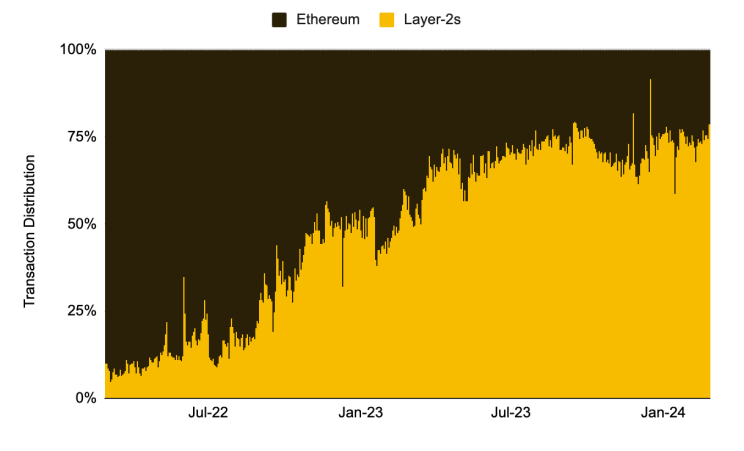
However, one of the critical obstacles to realizing the full scaling potential of second-layer solutions is DA. Thus, the focus of modular solutions has shifted in this direction, as evidenced by the emergence of blockchains like Celestia.
Throughput in L2 is limited by the capabilities of their data availability layers and how they interact with the main network. If the DA layer cannot accommodate the volume of information the sequencer intends to send, transaction processing in the network becomes difficult.
This not only increases rollup fee costs but also imposes additional load on nodes. More than 90% of L2 transaction fees periodically consist solely of publishing transmitted data, the study notes.
Delegating Responsibilities
The upcoming Dencun upgrade in Ethereum, particularly EIP-4844, and the emergence of alternative data availability layers (alt-DA) are intended to address many of these issues.
“Celestia specializes in DA, not directly supporting general-purpose blockchain computations. Instead, the protocol delegates smart contract execution to other L2s. This shift to a modular architecture at the execution and availability levels is designed to enhance throughput while maintaining network security and decentralization,” Binance explained.
Many second-layer solutions use Ethereum for DA as the most typical approach. However, a new industry trend is that L2s employ other protocols for data transmission while maintaining a bridge to the main network.
The implementation of full danksharding will take several years, so demand for alt-DA is growing, experts believe. Even with the launch of EIP-4844, the Ethereum mainnet and second-layer networks will lag behind TPS compared to modular protocols.
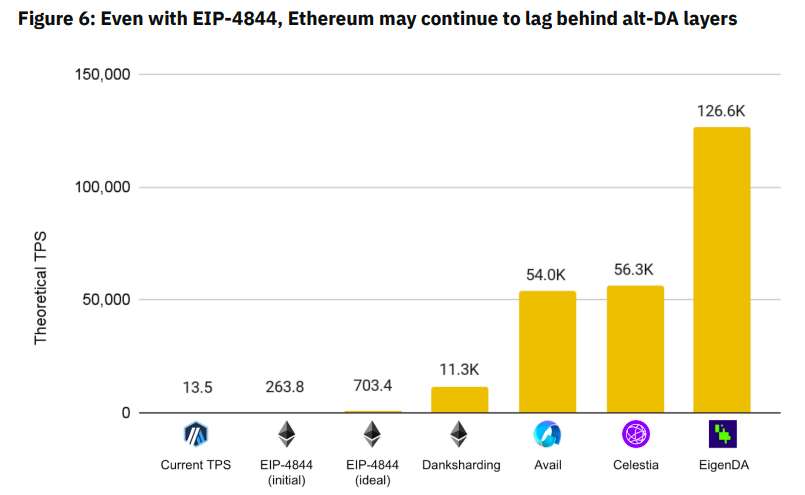
“While alt-DA solutions do offer economic benefits, they do not necessarily inherit all of Ethereum’s security properties. Ultimately, no data availability solution, except for EIP-4844 or danksharding itself, can fully inherit the security of the main network,” experts emphasized.
Binance predicts the growing popularity of such protocols until a more economical and scalable solution emerges.
Celestia’s Scalability
Celestia is the first public network optimized for DA, offering dedicated space for L2s intended for the temporary publication of batched transaction data.
The project’s availability layer uses a Proof-of-Stake consensus mechanism and is built on the Cosmos SDK.
“Essentially, Celestia assumes the roles of district attorney and consensus, transferring the load of transaction execution and settlement to other networks. It lacks the ability to execute transactions through its own smart contracts and does not support cross-aggregation or dispute resolution mechanisms,” researchers clarified.
One of Celestia’s features is the data availability sampling (DAS) mechanism. It allows standard nodes to verify DA without needing to download all the data for a block.
Celestia’s competitive advantage lies in its ability to be more productive, especially at the execution and settlement levels.
According to Binance, the modular blockchain processed over 12.4 million transactions with a cumulative large binary object size of 4.28 GB for more than 970,000 accounts.
“Celestia has benefited from its early market entry and now boasts a large and diverse ecosystem, which is expected to significantly contribute to network expansion,” Binance noted.
Among the projects already integrated with the ecosystems are Eclipse, Dymension, AltLayer, and Saga.
Eclipse’s Modularity
Eclipse is the first Ethereum second-layer network supporting the Solana Virtual Machine (SVM). The platform aims to provide high speed and low cost on Solana, using the blockchain of the second-largest cryptocurrency by market capitalization.
Eclipse combines the best parts of the modular stack, utilizing SVM as the execution environment, sending data to Celestia, and executing transactions on Ethereum.
“The key distinguishing factor is undoubtedly the use of SVM, especially in a sector where all other L2s largely represent general-purpose EVM. […] This approach allows Eclipse to maintain a high level of TPS while reducing congestion during peak demand periods,” the report’s authors explained.
Eclipse becomes particularly attractive to Ethereum ecosystem developers seeking Solana-like advantages. Additionally, compatibility with another ecosystem provides access to greater liquidity.
Among significant modular solutions, Binance also highlighted Manta Pacific and Polymer.
In February, the Fuel project, positioned as “the world’s fastest modular execution layer,” introduced the Rollup OS solution.
Previously, StarkNet and Celestia partnered to enhance data availability in the Ethereum ecosystem for L3 networks.
Рассылки ForkLog: держите руку на пульсе биткоин-индустрии!