



Bitcoin mining difficulty falls amid Chinese miner outages
Based on the latest adjustment, Bitcoin mining difficulty fell by 5.30% to 19.93 T. BTC.com forecasts a further drop of 5.46%, to 18.84 T.
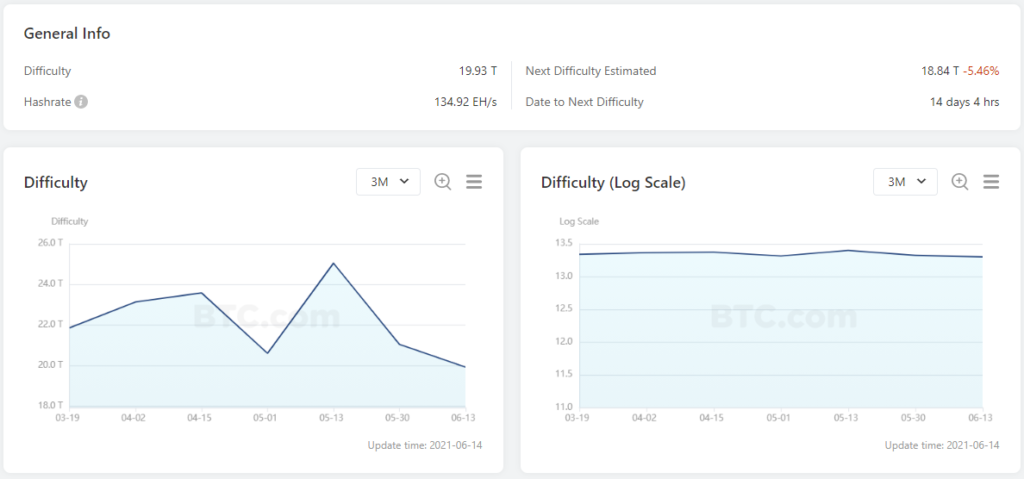
Bitcoin’s difficulty depends on the network’s hash rate, which over the past month fell by 21% to 135 EH/s, according to BitInfoCharts.
The drop in hash rate may be linked to the shutdown of mining facilities in China. The indicator for the country’s largest mining pool, AntPool, fell by more than 25% on June 9. Hashrates of other Chinese pools declined by 11-30%.
Against this backdrop, on June 11 the the interval between two blocks mined in the network of the first cryptocurrency was almost two hours.
On June 9, miners at the Shandong Economic and Technological Development Park, based in Changji Prefecture (Xinjiang), were ordered by local authorities to shut down immediately.
Joining the crackdown on Bitcoin mining were Inner Mongolia, the province Qinghai and Sichuan. Last week, media reported plans by the Yunnan provincial administration to also ban mining.
Journalist Colin Wu debunked the latter information. He said circulating media documents were false and that miners had not left the region, as Yunnan largely uses renewable energy.
This is inaccurate and should be verified by multiple miners in China. The government documents circulating on the Internet today are false. Yunnan mainly uses green hydropower, and the miners have not stopped all of them for the time being. https://t.co/5twaWS55LY
— Wu Blockchain (@WuBlockchain) June 11, 2021
According to China Star Market, the Yunnan Energy Bureau has asked subordinate agencies to conduct inspections of miners by the end of June to identify individuals illegally using electricity.
Some hydropower plants in the province supply energy directly to enterprises, bypassing the municipal grid. This reduces operating costs for farms, sparing them from paying an additional tax.
According to the notice cited by the publication, authorities will cut power to miners who evaded paying bills or used electricity illegally.
According to the South China Morning Post, Yunnan is the fourth-largest contributor of hash rate in China.
Earlier, Colin Wu reported that three associations under the People’s Bank of China issued a joint notice prohibiting companies from supporting cryptocurrency-related businesses.
On May 21, Vice-Premier Li He announced plans to take action against digital-asset mining and Bitcoin trading.
On May 24, Xinhua News Agency criticized digital gold and cryptocurrency mining.
Рассылки ForkLog: держите руку на пульсе биткоин-индустрии!