




The nearly 25% drop in the price of the leading cryptocurrency from its ATH near $126,000 is considered short-term and does not signal the onset of a major downtrend, according to researchers at Bernstein, reports The Block.
The team led by Gautam Chhugani noted that the correction reflects investor anxiety around the traditional four-year cycle, with peaks in 2013, 2017, and 2021.
Many participants are preemptively locking in profits in anticipation of market weakness in the fourth quarter and a repeat scenario in 2025, effectively creating a “self-fulfilling prophecy”.
However, analysts are confident that the current situation is “fundamentally stronger.” Data suggests a “relatively shallow correction” with the formation of a new local bottom, rather than the usual 60-70% drop typical of past bear phases.
Supporting this thesis, researchers highlighted the active absorption of Bitcoin’s “long-term” supply. They estimate that about 340,000 BTC (approximately $38 billion), sold by investors who held the coins for at least a year and sold them in the past six months, have been largely offset by an inflow of around $34 billion into spot ETFs and corporate treasuries.
“This is Not the Cycle Peak”
According to analysts, the share of institutional investors in Bitcoin ETFs has risen from 20% at the end of 2024 to the current 28%.
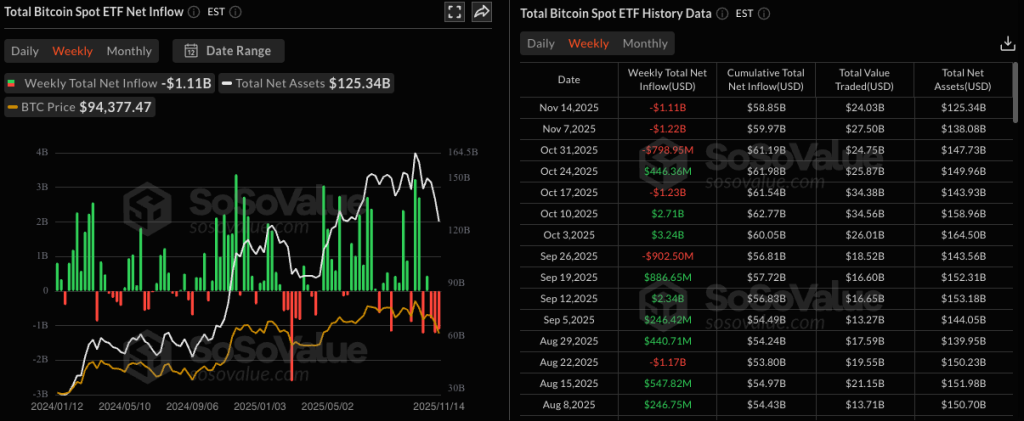
The total assets under management of the funds have reached $125 billion, despite an outflow of $3 billion over the past three weeks. This shift, they believe, indicates a “higher quality and more stable ownership structure” and reduces the risk of a deep collapse.


Bernstein also addressed market concerns that Strategy, whose shares trade slightly below the value of the Bitcoins on its balance sheet, might begin selling assets if the correction continues.
Analysts reminded that the company does not sell and does not plan to sell any coins. They noted that the issuer’s debt burden remains moderate—about $8 billion in debt against $61 billion in crypto assets. Meanwhile, dividends are “well covered” by both the current treasury and access to additional capital through at-the-market stock placement programs.
“We expect Strategy to continue buying digital gold during this correction,” the experts noted.
Structural growth factors remain, the analysts added. Among them:
- strong political support for the crypto industry from the administration of U.S. President Donald Trump;
- expectations for the advancement of the CLARITY Act bill by the end of 2025 or early 2026;
- a “favorable liquidity environment” as rates decline.
Better-than-expected results from public companies like Coinbase, Robinhood, Figure, and Circle also point to high institutional interest in tokenization and stablecoins. These areas were identified by analysts as “two megatrends of the current crypto cycle.”
In their view, the market is unlikely at the cycle’s peak—rather, it is a continuation of a long-term trend shaped by institutional participation and periodic moderate corrections. The current dip is seen by experts as a potentially attractive entry point into digital assets and related company stocks.
At the time of writing, the leading cryptocurrency is trading around $95,750. Over the past 30 days, it has decreased by 10.5%, according to CoinGecko.
Earlier, Bernstein researchers predicted Bitcoin would rise to $200,000 by 2027.