


BitMEX unveils liability verification solution
The cryptocurrency exchange BitMEX has unveiled a Proof-of-Liability feature. It enables users to verify the platform’s liabilities to them within the total balance.
[1/4] BitMEX’s PoL System Now Live & Operational
All BitMEX depositors can now verify their individual liability is included in the total exchange liability balance. This self verification process can be conducted without a third party auditor.https://t.co/1z5MJ2nlVK
— BitMEX Research (@BitMEXResearch) December 1, 2022
The company updates the data twice a week: on Tuesdays and Thursdays.
The solution uses a cryptographic algorithm called Merkle tree. To view the information, clients can use the accountNonce value to obtain multiple snapshots, or enter one-time codes for each account snapshot.
Following FTX collapse, the largest exchange by volume, Binance, first disclosed data on its own crypto reserves, and then launched the Proof-of-Reserves feature. The latter allows Bitcoin holders to verify that their funds on the platform are backed by corresponding asset volumes.
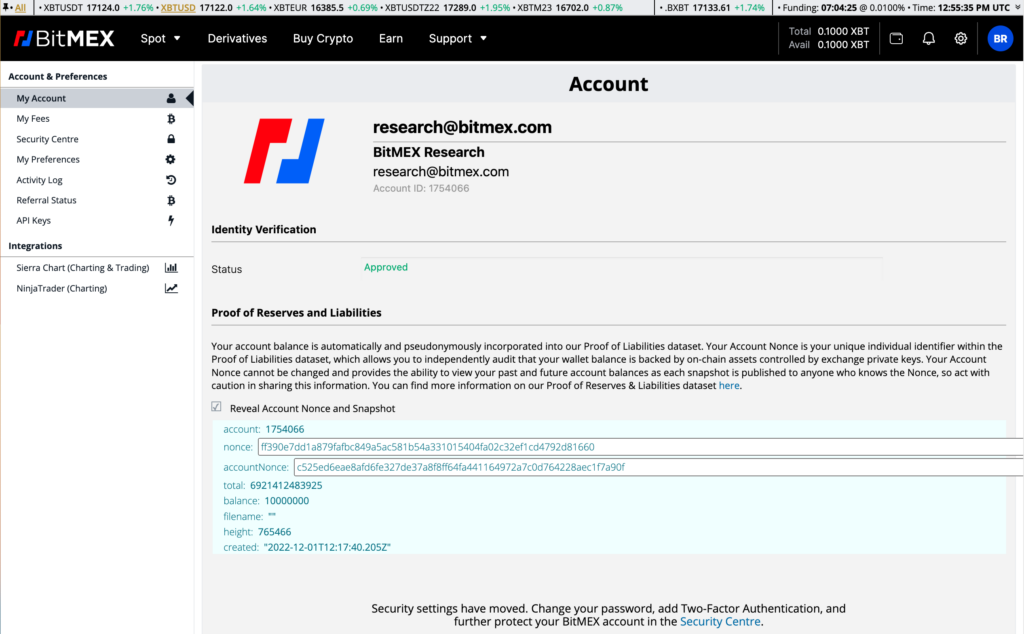
For BitMEX, an example of the platform’s liabilities to a holder of roughly 0.1 BTC in an account looks as follows (the funds are reflected as four Merkle-tree leaves):

Following Binance, a number of platforms published reserve data, including Huobi, Bitfinex and Bybit.
Kraken founder Jesse Powell criticized Binance’s Proof-of-Reserves. In his view, the feature does not prove that the exchange holds more bitcoins than its liabilities to customers.
As Ethereum co-founder Vitalik Buterin has said, the use of zk-SNARKs in this case would yield a better result than a Merkle tree.
Read ForkLog’s bitcoin news in our Telegram — cryptocurrency news, prices and analysis.
Рассылки ForkLog: держите руку на пульсе биткоин-индустрии!