


Brave browser and the BAT cryptocurrency: a detailed review
Key points
- Brave is a browser with built‑in privacy protections that hides website advertising by default.
- Brave runs a distinctive advertising model: users may opt in to the Brave Ads network and receive rewards in the Basic Attention Token (BAT).
- The browser includes Brave Wallet, which supports storing and transferring assets on EVM‑compatible networks and Solana.
- From 2016 to 2021 Brave’s user base roughly doubled each year. As of October 2022, around 20m people use the browser daily.
Origins and launch
Brave was founded by Brian Bondy and Brendan Eich. Eich began his career at Netscape Communications, where he created JavaScript, later one of the world’s most popular programming languages. In 1998 he co‑founded the Mozilla Foundation, the maker of a popular web browser. He initially served as chief technology officer and in 2014 became the company’s head, but left soon after his appointment. Bondy previously worked at Khan Academy, Mozilla and Evernote.
In 2015 Bondy and Eich set up Brave Software, and in 2016 released the first version of the Brave browser. Its defining features were the absence of website ads and flexible privacy controls.
The bet paid off: by the end of 2021 the browser had more than 50m users. According to official platform statistics, in early October daily active users exceeded 19.6m.
In 2017 Brave Software ran a lightning‑fast ICO, selling Basic Attention Token (BAT) worth $35m in just 30 seconds.
What makes Brave different
Brave Browser is a free, open‑source browser built on Chromium. It looks and feels familiar to Google Chrome, but by default it does not show website ads and does not collect personal data. Brave also blocks location tracking and malware, disables video autoplay, rejects third‑party cookies and avoids creating a user fingerprint.
The first version merely blocked ads on sites, but Brave Software later launched its own ad network, Brave Ads, which follows a pay‑to‑surf (PTS) model.
It activates if the user enables the relevant option in settings. The application then collects behavioural data and shows relevant ads. Ad frequency can be adjusted. In return, the user earns BAT rewards. Verified advertisers also receive a small portion of the payouts in BAT.
The system determines which ads to show and under what conditions. Brave Software stresses that wherever the ads appear, the key condition is that they are not intrusive.
According to the developers, by blocking ads and trackers Brave runs up to three times faster and uses about a third less memory than Google Chrome.
Brave Wallet
The core Web3 element in Brave is the built‑in Brave Wallet, which requires no extra installation. Users may still opt for familiar extensions if they wish.
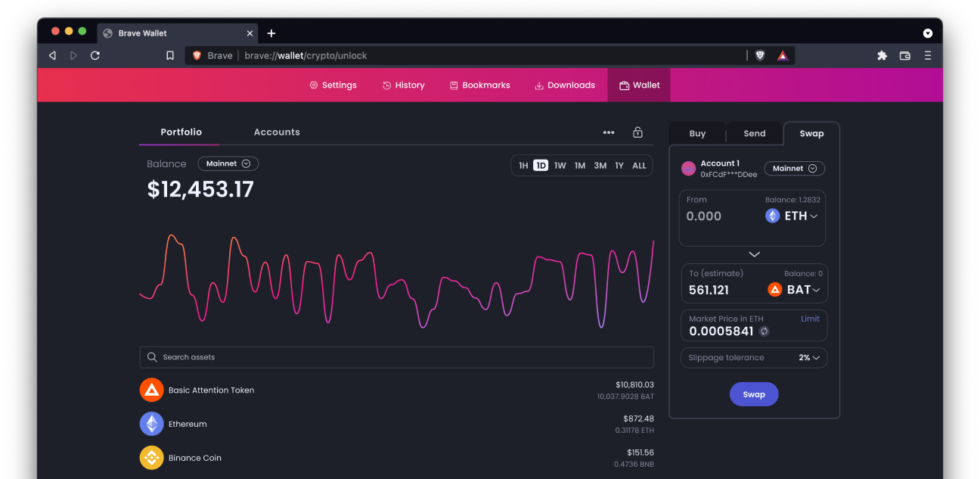
Brave Wallet connects to other wallets and decentralised applications directly within the web page, like well‑known solutions such as MetaMask. It supports transactions with any digital assets issued on EVM-compatible blockchains (Ethereum, Polygon, BNB Chain, Fantom, Optimism and others). The app also lets users swap fiat for crypto via Wyre or Ramp Network, store and transfer non‑fungible tokens (NFTs) and view price charts via CoinGecko.
Brave Wallet includes built‑in DEX functions: users can perform swaps, with the wallet routing via the 0x and Jupiter aggregators. Brave’s fee, depending on the pair, is about 0.8–0.9%.
In May 2022 Brave Wallet added support for the Solana (SOL) blockchain and its native cryptocurrency. This enabled users to create accounts, make cross‑chain swaps and transfer SLP tokens.
In the next browser version, support was added to store and transfer Filecoin (FIL) via Brave Wallet. The wallet also supports the Celo Network (CELO) mainnet.
Key features of Brave
Ad blocking and Brave Ads
One of Brave’s chief advantages is the native ability to block website ads. If desired, users can enable the Brave Ads network to display targeted ads in exchange for BAT rewards.
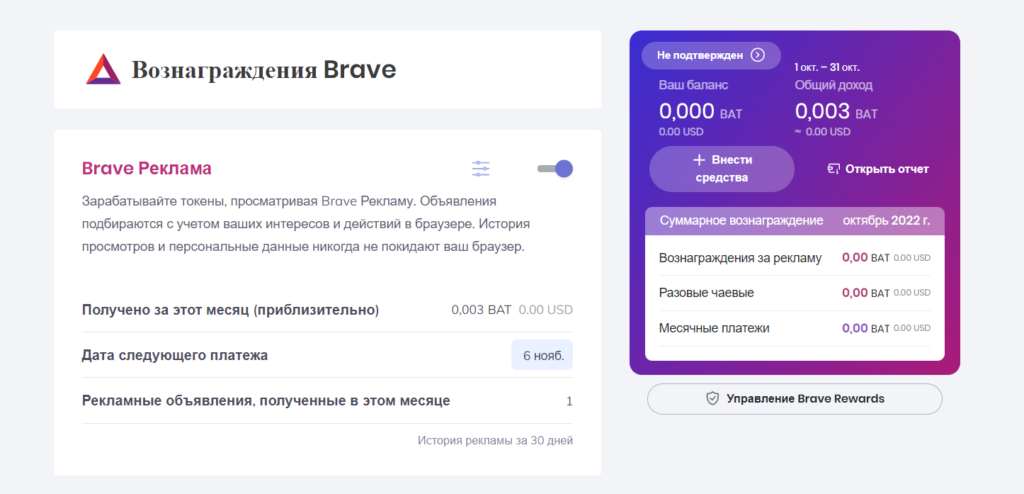
During onboarding, users can set the number of ads they are willing to see. After clicking a link and staying for at least five seconds, the ad network starts crediting BAT for the view. Brave Ads even enables micropayments, which are rarely possible with conventional financial tools today.
Donations to creators
Brave lets users reward creators on Twitch, Twitter, YouTube, Reddit, Vimeo or GitHub, or tip them on a one‑off basis. The minimum per transfer is 1 BAT. To activate this feature, creators must register in the partner network. There is also an auto‑contribute option that pays the sites where you spend the most time, which can be disabled.
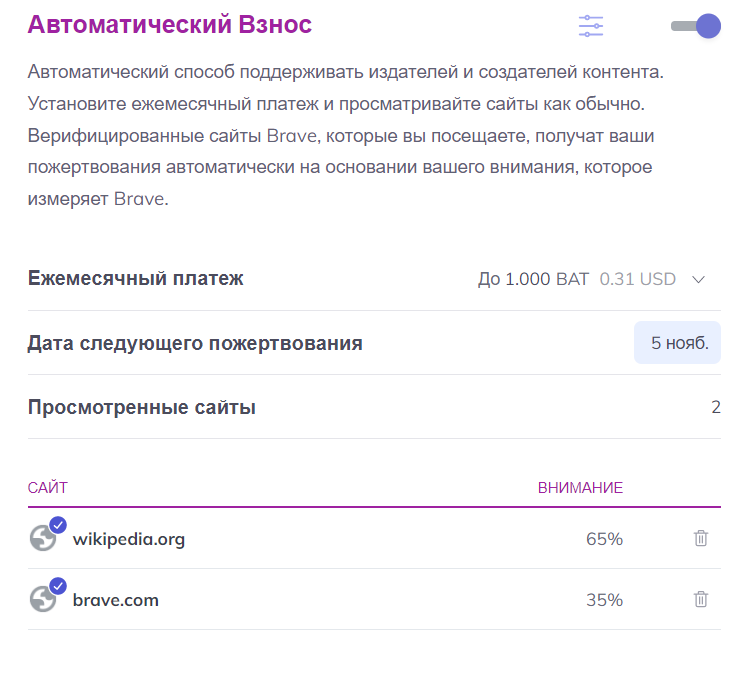
According to Brave statistics, in early October 2022 its network of verified creators included more than 147,000 websites, about 220,000 Twitter users and roughly 819,000 YouTube channels.
Access to blocked web resources and pages
In 2021 Brave Browser integrated support for the IPFS protocol. It provides access to blocked pages, speeds up loading and cuts hosting costs. For example, some Wikipedia sections do not work in Thailand, and around 100,000 websites are blocked in Turkey. All of these pages can be viewed in Brave if you run a full IPFS node or use ipfs:// addressing via a gateway.
A proprietary search engine
To bolster its privacy credentials, in 2021 the team launched its own search engine, Brave Search. It is built on Tailcat, an open‑source system that does not collect IP addresses or personal information. Users can still choose their search engine, but Brave’s own is the default.
In its first year, by the end of June 2022, users entered over 2.5bn queries. The team announced the successful end of the beta and full integration into the browser. Brave also offers end‑to‑end encrypted video calls.
BAT’s functions
BAT is Brave’s main cryptocurrency—an ERC‑20 token on Ethereum. As of 10 October the token trades at $0.3; at its November 2021 peak it reached $1.7. The cryptoasset has been listed on all major exchanges, including Kraken, Gemini, Binance, Coinbase, Bitfinex and others.
Brave users can earn BAT for viewing ads. Payouts are sent to Brave Wallet. Verified Brave Wallet users also receive BAT “cashback” on swaps executed via the wallet, equal to 20% of fees paid.
Creators on YouTube, Twitter and other platforms can receive donations from fans in BAT. Funds can be withdrawn no more than once a month, with a minimum amount of 15 BAT.
Brave forks
On June 6th 2020 a fork of Brave called Braver appeared. Its developers were angered by a scandal over referral links to certain crypto exchanges and wallets embedded in the browser’s source code. The alternative version removed the hidden links, video calls and widgets.
Shortly afterwards, lawyers for the original browser forced Braver to change its name. The fork’s creators promised to try again, this time on Chromium, like Brave.
Three days after the high‑profile fork, Brave’s founder Brendan Eich issued a formal apology and promised to remove the referral links in the new version. Users, however, accused the team of lying: they found the links had been moved lower in the URL bar—essentially a half‑measure.
This was not the first fork of the blockchain‑browser. Before Braver there was the social‑media platform Gab, where BAT was replaced with bitcoin on the Lightning Network.
Further reading
IPFS instead of HTTP—the future of the decentralised internet?
Рассылки ForkLog: держите руку на пульсе биткоин-индустрии!