



We aim to inform readers not only about developments in the Bitcoin industry, but also about what is happening in related technological fields — cybersecurity and the world of artificial intelligence (AI).
ForkLog AI has gathered the week’s most important AI news.
- Elon Musk bought 10 000 GPUs to deploy generative AI at Twitter.
- Ethereum co-founder Vitalik Buterin called ChatGPT «a good teacher».
- Databricks unveiled Dolly 2.0, an open large language model.
- Quora developed a builder for custom chat bots.
- Google created an “artificial society” with AI agents.
- Spot returned to service with the New York Police Department.
- The week’s most notable AI deals.
Media: Elon Musk buys GPUs for Twitter AI projects
Elon Musk has purchased 10 000 GPUs to advance generative AI at Twitter.
According to Business Insider, after more than a month since hiring of former DeepMind staff, the social network is pushing its own AI project. The GPUs Musk bought are used in one of the company’s two data centers to build a large language model (LLM). The project is still in its early stages, the publication notes.
It is reported that Twitter plans to train the LLM on its own massive data set. It is not known how the social network intends to deploy generative AI. It is possible that the technology will be used to enhance search capabilities on the platform or rethink its advertising business.
Buterin named ChatGPT «a good teacher»
The Ethereum co-founder Vitalik Buterin published a blog post about ChatGPT.
He noted that the chatbot cannot directly provide precise answers. However, the tool is «especially good» for learning to apply certain libraries and APIs that Buterin had never heard of, but others used.
According to him, this lowers barriers between hobbyists and professionals in programming, which «seems a positive development».
Study: AI can crack every second password in under a minute
Home Security Heroes specialists used a specialized PassGAN tool based on a generative adversarial neural network. With it, experts processed more than 15 million accounts from the RockYou dataset.
As a result, PassGAN took less than a minute to crack 51% of passwords, 65% — almost an hour, 71% — about a day and 81% — roughly a month.


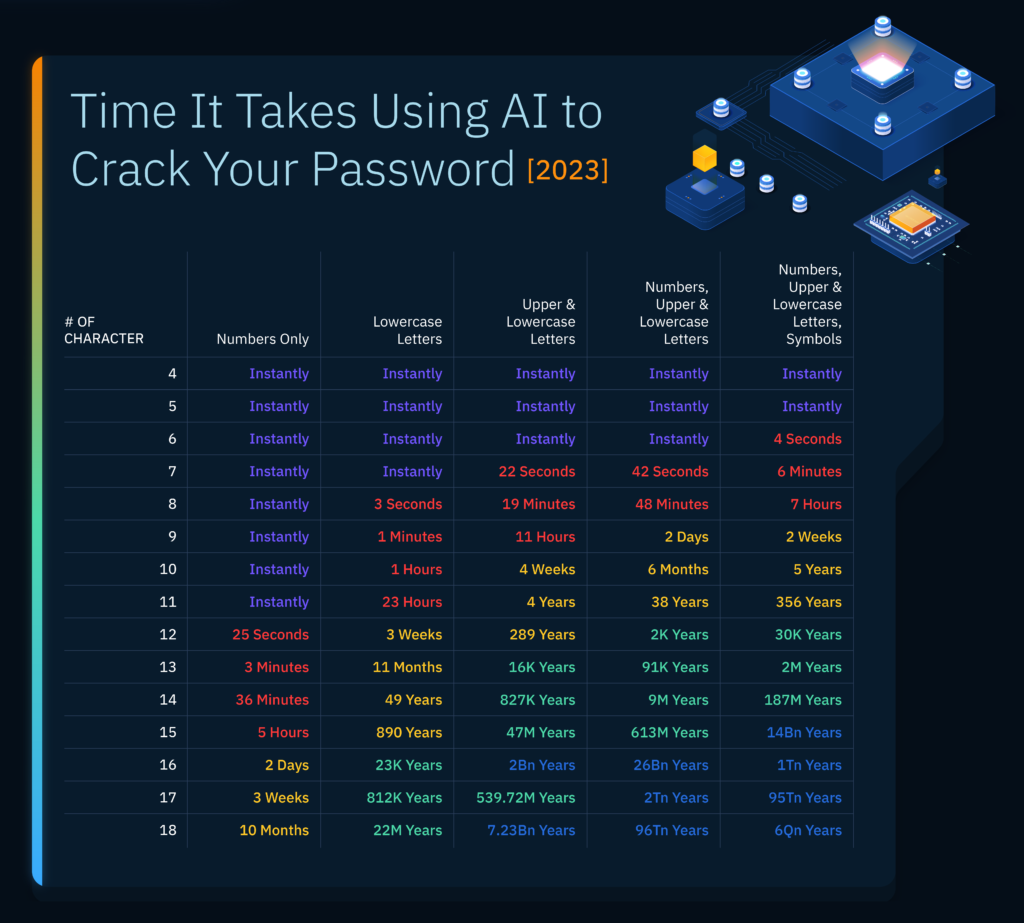
To protect accounts, the company recommended using combinations of more than 12 characters. They should include uppercase and lowercase letters, digits and other components. Experts believe that 18-character mixed passwords are not yet susceptible to AI cracking.
Databricks unveiled Dolly 2.0, an open large language model
The Databricks introduced Dolly 2.0 open large language model (LLM). It can be used for research and commercial purposes.
The 12B-parameter model is based on the EleutherAI Pythia family. To train it, Databricks staff created a data set including 15,000 prompt-answer pairs. Under the licensing terms, the dataset may be used, changed or extended for any purpose, including commercial.
According to the developers, Dolly 2.0 can generate text only in English and is capable of producing toxic content. The company also noted that its knowledge and the accuracy of the LLM are limited.
Media: AI startups facing cloud capacity shortages
AI system developers are facing a shortage of servers to create products.
According to The Information, the shortage was driven by a sharp surge in demand for specialized chips enabling training and running algorithms. This forced cloud providers like Amazon Web Services, Microsoft, Google and Oracle to restrict access to them.
Some customers report multi-month waits to rent equipment. Johnny Dallas, head of Zeet’s cloud technology, said startups may be offered one server, but they “won’t get five for anything.”
Google Chrome to use GPU acceleration
Google will add in Chrome 113 the WebGPU feature, allowing use of GPUs to accelerate AI, online games and graphics. The API will be enabled by default on Windows PCs with Direct3D 12 support, MacOS (Metal) and ChromeOS (Vulkan).
According to the company, WebGPU will allow developers to reach existing graphics levels with far less code. It will also deliver more than threefold acceleration of inference for ML models.
Google also said that the Chrome 113 release serves as a “building block” for future updates and improvements, promising more advanced graphics features and deeper access to shader cores in the future.
Quora launches custom chat bot builder
The Quora platform expanded Poe with a feature for creating custom chat bots based on existing dialogue AI. It is available to all users.
For now, Poe offers using ChatGPT and Anthropic Claude Instant as a foundation. After selecting a base and writing a short prompt, a user can launch a new bot and share it with others.
To demonstrate the potential of the feature, the company launched several custom dialogue AIs, including PirateBot, Roastmaster, and Chefbot.
According to Quora, users of the feature will gain benefits such as a convenient interface across devices or platforms and a unique URL for the system.
The company is also working on an API for hosting bots from managed servers and developing more advanced dialogue AI.
AR lenses from Snapchat arrive in Microsoft Teams
Microsoft added AR lenses from Snapchat to the corporate messenger Teams.


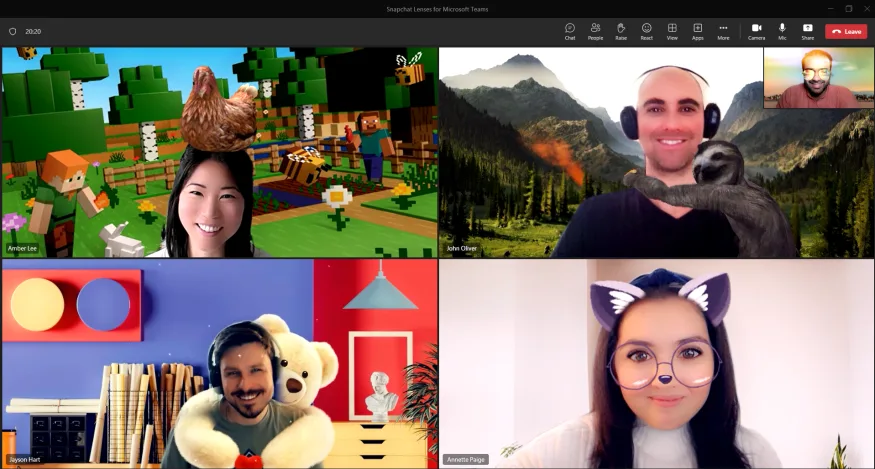
Users have access to 26 lenses. They can transform themselves into a cartoon character, add virtual snow or use various backgrounds. In the future, the lens library will be continually updated.
To integrate AR lenses into Teams, the company used Snap’s Camera Kit software development kit.
Google creates an “artificial society” with AI agents
Researchers at Google and Stanford University launched an “artificial society” with AI agents named “Smolville.”
In a closed world, 25 characters wake up, cook breakfast, interact with each other and have fun. To do this, researchers feed ChatGPT with details about each agent such as their profession and relationships with other AIs. They then run a simulator of “human behavior.”



Agents can analyze their surroundings and use “memories” to determine actions. They can also reason, generate new ideas, and build long-term plans.
After some time following the simulation’s launch, researchers “surveyed” the characters. Some pursued careers, and an agent named Sam decided to run for mayor of the city thanks to “years of political experience.”
Researchers believe that the ability to create realistic simulations of human behavior will be useful for various virtual spaces, including NPC activations in games.
Spot returned to service with the New York Police Department
The New York Police Department brought back Spot from Boston Dynamics into service. In 2021 the department had “fired” the robotic dog amid public backlash.
Law enforcement plans to purchase two units for $750,000. They intend to use robotic dogs only in bomb threats, hostage situations or other life-threatening scenarios.
According to New York Mayor Eric Adams, the technology is “here to stay” and should not be feared. Spots can help “save lives,” he said.
Adams and police also said they are testing a fully autonomous outdoor security robot K5 ASR from Knightscope. They intend to use it for intelligence gathering.
New York City Police Commissioner Keechant Sewell said that the deployment of the technology would be “transparent, orderly and undertaken in collaboration with people.” Spot and K5 ASR will not use facial recognition, she noted.
The week’s most notable AI deals
From 9 to 15 April 2023, AI startups raised over $247 million. Here are the most notable deals.
- AlphaSense creators attracted $100 million from Alphabet CapitalG.
- Infogrid raised $90 million to develop building data collection and analytics technology.
- Carbon Robotics, a maker of weed-elimination robots for fields, raised $30 million.
- Overwater Ventures, investing in AI startups among others, raised $20 million.
- Distyl AI raised $7 million and formed a partnership with OpenAI to help enterprise clients harness generative AI and large language models.
Also on ForkLog:
- OpenAI примет меры to unblock ChatGPT in Italy.
- Eric Schmidt: pause in AI research выгодна only for China.
- Alibaba представил a competitor to ChatGPT.
- OpenAI запустила баунти-программу with rewards up to $20,000.
- The US intends to ban investments in Chinese AI.
- Universal Music urged streaming services удалять ИИ-музыку.
- Amazon представила the cloud AI platform Bedrock.
- Bloomberg разработало чат-бота for the financial market.