



Critical Vulnerability Found in Bitcoin Wallet Chips
A popular microcontroller used in billions of IoT devices and crypto wallets contains serious flaws that threaten bitcoin theft. This was reported by experts from Crypto Deep Tech.
The vulnerability, identified as CVE-2025-27840 in the NIST database, affects the ESP32 chip, used for Wi-Fi and Bluetooth connectivity. The bug allows attackers to permanently infect microcontrollers via updates, paving the way for future attacks.
Once breached, attackers can unauthorizedly sign crypto transactions and remotely steal private keys.
The microcontroller installed in hardware wallets like Blockstream Jade also has insufficient entropy in its pseudorandom number generator (PRNG) used for transaction signature creation. This allows attackers to guess key pairs through brute force.
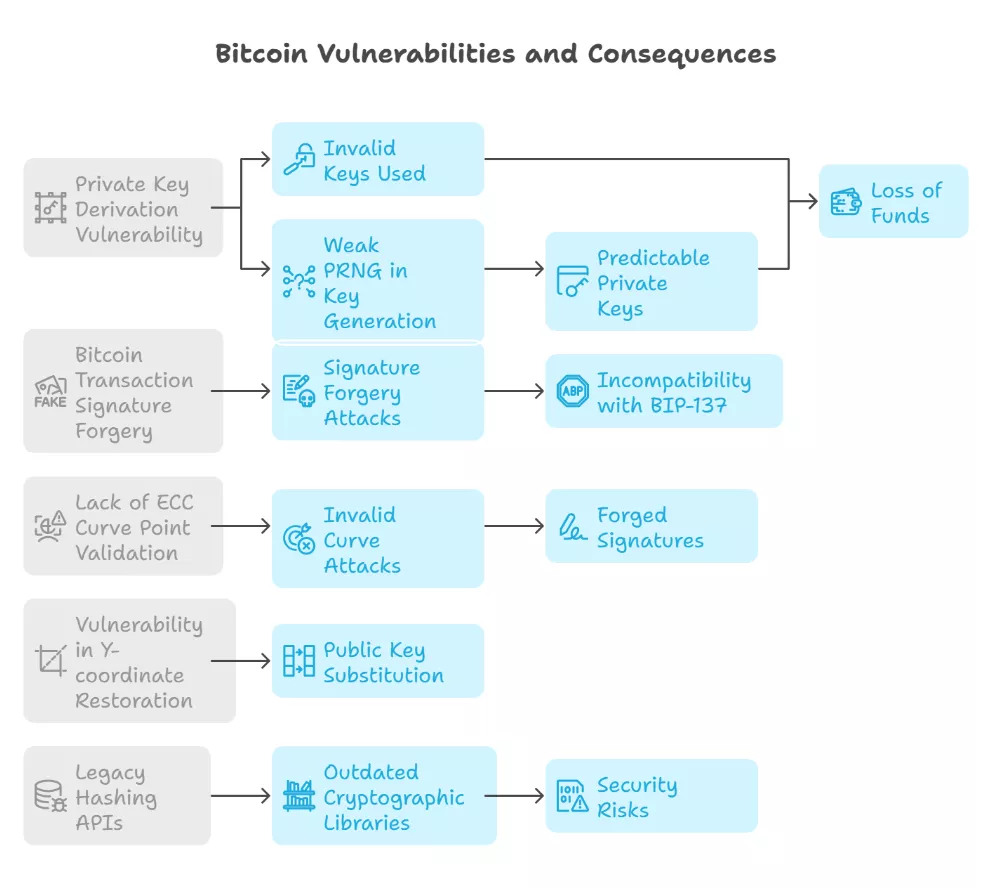
During experiments, specialists tested potential attack vectors through the identified flaws. The implementation of scripts allowed them to:
- generate invalid private keys using PRNG weaknesses;
- forge bitcoin signatures due to incorrect hashing;
- extract private keys using small subgroup attacks and manipulation of cryptographic operations ECC;
- generate fake public keys by exploiting Y-coordinate ambiguity on the ECC curve.
In their research, Crypto Deep Tech experts used a real wallet containing 10 BTC.
“Implementing robust security mechanisms and regular security updates are key elements for ensuring secure and reliable operation of digital systems. The need to enhance security in devices and networks, such as ESP32, is becoming increasingly relevant,” the specialists concluded.
Back in March, hardware crypto wallet manufacturer Trezor addressed a vulnerability in the Safe 3 and Safe 5 models. The issue was related to the microcontroller used for cryptographic operations.
Рассылки ForkLog: держите руку на пульсе биткоин-индустрии!