




In November, the spot trading volume on centralized cryptocurrency exchanges fell to $1.59 trillion, marking the lowest level since June, according to data from The Block.
This represents a 26.7% decline from October’s figure of $2.17 trillion.
Binance maintained its lead with a trading volume of $810.44 billion in November, down from $599.34 billion the previous month (a decrease of ~26%).
Bybit ranked second with $105.8 billion, followed by Gate.io with $96.75 billion and Coinbase with $93.41 billion.


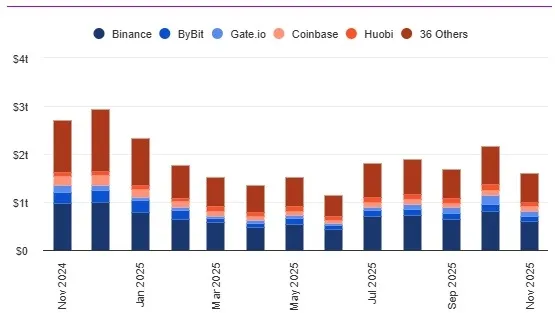
“Spot trading volumes on centralized exchanges decreased as the market transitioned from October’s excitement to November’s stagnation, with volatility disappearing and momentum weakening,” commented CIO of Kronos Research, Vincent Liu.
The expert largely attributed the decline to traders locking in profits after the rally and market contraction.
According to Defi Llama, decentralized exchanges also saw a reduction in trading volumes in November, dropping to $397.78 billion from $568.43 billion in October.
In the DEX segment, Uniswap led with $79.98 billion, significantly less than October’s $123.88 billion. PancakeSwap recorded $70.57 billion compared to $102.02 billion in the previous month.

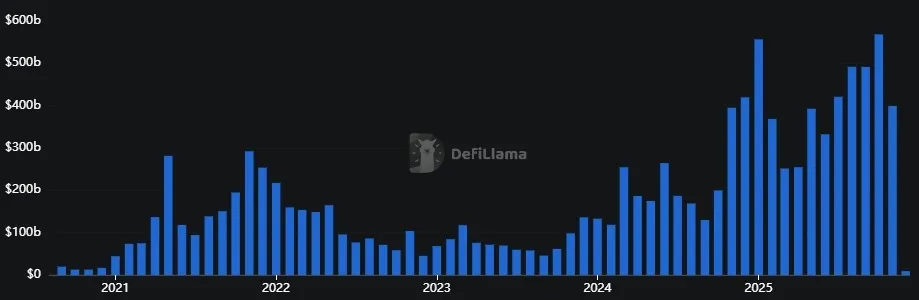
Market activity shifted towards centralized platforms, with the ratio of trading volumes on DEX to CEX in November decreasing to 15.73% from 17.56% recorded in October.
According to Liu, the dynamics are driven by structural reasons rather than trader sentiment.
“The narrowing of trading ranges in November favored central exchanges, where higher liquidity and tighter spreads enhanced execution efficiency. Meanwhile, the reduction in speculative flows and weakening incentives for DeFi slowed DEX turnover, intensifying rotation,” he believes.
Bernstein Highlights Resilience of Crypto Companies
The current downturn in the digital asset market differs from previous corrections, as major cryptocurrency companies “appear strong,” actively restructuring their models towards new revenue sources. Analysts at Bernstein reached these conclusions, reports The Block.
Brokerage firm specialists led by Gautam Chhugani acknowledged that negative sentiment has affected the stock dynamics of crypto companies. Over the past 30 days, Coinbase’s shares fell by 21%, and Circle’s by 37%.

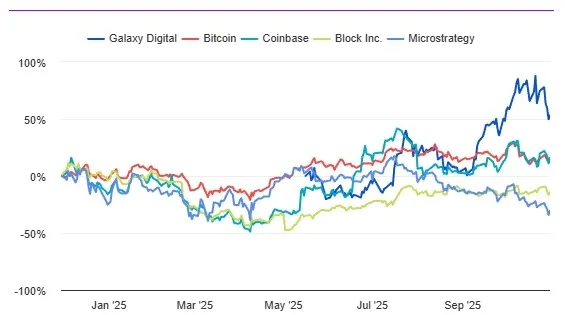
Bernstein noted that for the most part, “speculative excesses” affected Strategy and its imitators. Regarding Michael Saylor’s firm, analysts confirmed their view that there is “no realistic scenario” that could threaten its viability.
From November 17 to 30, Strategy acquired 130 BTC for ~$11.7 million. The average purchase price was $89,960. The company’s crypto reserve reached 650,000 BTC. It spent about $48.38 billion to form it — an average of $74,436 per coin.
Strategy has acquired 130 BTC for ~$11.7 million at ~$89,960 per bitcoin. As of 11/30/2025, we hodl 650,000 $BTC acquired for ~$48.38 billion at ~$74,436 per bitcoin. $MSTR $STRC $STRK $STRF $STRD $STRE https://t.co/1oVrm9kxVn
— Strategy (@Strategy) December 1, 2025
Bernstein experts emphasized that the operational metrics of industry players sharply contrast with market valuations, pointing to business model transformations and favorable regulation. Crypto companies are moving beyond the cyclicality defined by trading revenue.
One of the prominent examples of this trend, according to Bernstein, is Coinbase. The largest American bitcoin exchange is actively entering the segment of tokenized stocks, prediction markets, and consumer payment spheres, integrating all directions on a single platform.
In July, Coinbase launched the “super app” Base App based on the eponymous crypto wallet. In August, the company completed a deal to acquire the largest bitcoin options trading platform, Deribit, for $2.9 billion.
In November, Coinbase launched a platform for conducting ICOs. The first token sale on the platform was conducted by the L1 blockchain project Monad.