



DAO — a decentralised autonomous organisation governed by smart contracts. These contracts handle voting, financial management and the orchestration of workflows.
Interest in such structures among the crypto community is rising. New DAOs appear almost daily. To join them, people leave well-paid jobs, and investors invest millions of dollars into the sector.
ForkLog has examined who originated the concept of the DAO, what types of decentralised organisations exist, and why people join distributed communities.
- The concept of the DAO was conceived by EOS founder Dan Larimer. Vitalik Buterin developed the idea and expressed it in the original Ethereum white paper.
- The first decentralised autonomous organisation was the crowdfunding platform The DAO, whose story ended in a collapse and losses of more than $50 million.
- All DAOs by field of interest can be categorised into eight groups — from governance of DeFi protocols to investments and NFT collecting.
Origins of Decentralised Governance
The concept of a DAO emerged about nine years ago when the founder of the blockchain platform EOS, Dan Larimer, introduced the term “decentralised autonomous corporation”. He described it as a structure whose charter is defined by the source code.
Vitalik Buterin expanded on this idea, suggesting that the codebase could define the organisation’s operational activities, its mission and the ways to achieve the latter.
In the original white paper of Ethereum he wrote:
«The general concept is that a virtual organisation has a defined set of participants or shareholders who, perhaps having a majority of 67% [votes], have the right to spend its funds and change the code. […] The methods of distributing the DAO’s funds can vary from rewards and salaries to more exotic mechanisms such as using an internal currency to incentivise work. Essentially, this mirrors the legal attributes of a traditional company or NPO, but with the use of blockchain technology».
Years later the first DAO appeared—the The DAO. It was a decentralised analogue of a crowdfunding platform, an autonomous venture fund governed collectively by all investors. The project was developed by the German startup Slock.it.
The DAO defined the key features of modern DAOs. It possessed four important characteristics:
- Impartiality in participant selection. Anyone could join the governance of the fund’s assets. The only condition — owning a DAO token;
- Flexible structure. The voting system allowed proposals of any kind—from targeted investments and charity to the creation of products useful to the organisation;
- Possibility of profit extraction. The organisation could generate profit from its initiatives. It could be directed toward developing the project or simply converted into a DAO and distributed among participants;
- Fair governance model. DAO holders had voting rights in decisions affecting the governance of the organisation or its internal projects.
The DAO attracted 11.5 million ETH (~$150 million at the time), roughly 14% of the total Ethereum supply. Its story ended in a crash — due to a bug in the code, the project lost more than $50 million. Yet this DAO laid the groundwork for the subsequent development of the concept.
The Beauty of Diversity
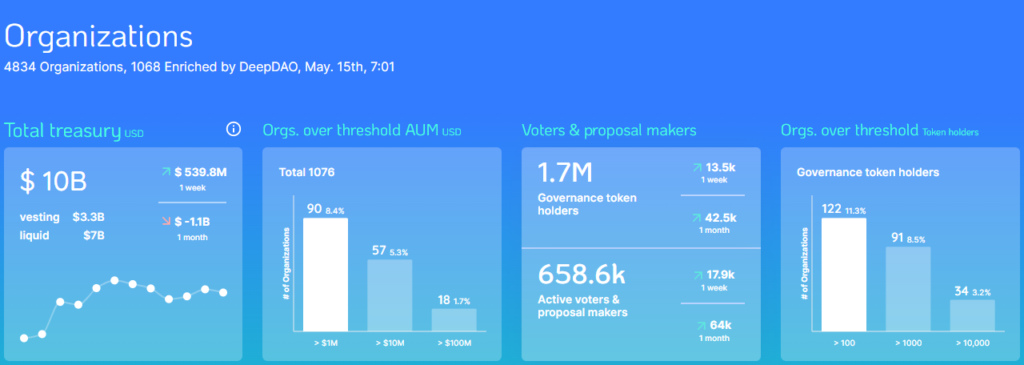
Total assets under management across 1,076 decentralised organisations tracked by DeepDAO amount to $10 billion, and the total number of participants exceeds 1.7 million.


Proponents of the DAO model argue that self-organised communities can provide a new level of social coordination without the need for centralised leadership.
People group into DAOs to jointly create, allocate and receive resources within a shared mission. The latter can be driven by a wide range of goals—from more efficient governance of a DeFi protocol to NFT collecting.
Conceivably, DAOs fall into two broad categories: technically oriented and socially oriented.
The former focus on building digital infrastructure, governing protocols and developing sector services. They tend to use blockchain to coordinate participant actions.
The latter aim to unite people and explore new ways of interacting. Governance of such organisations can take place even outside a decentralised network.
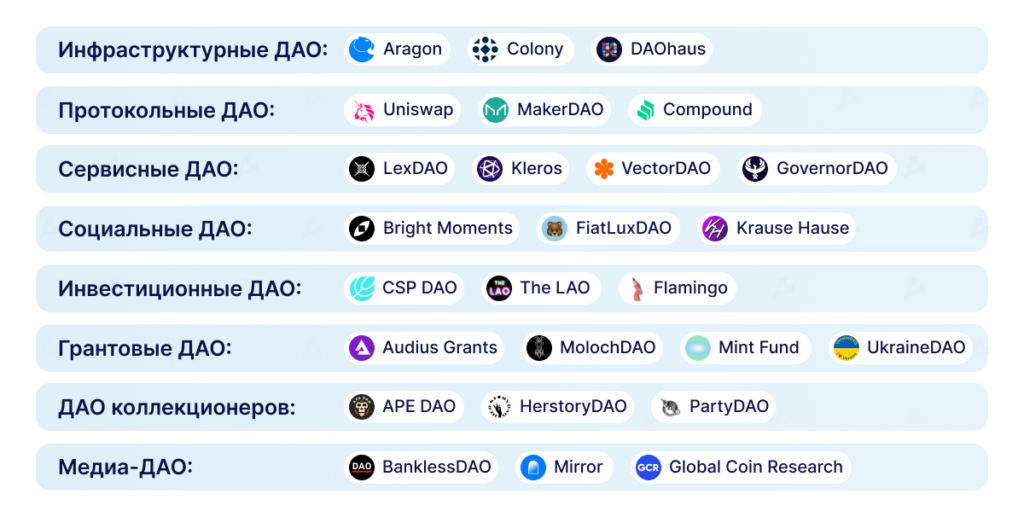
By areas of interest, DAOs can be divided into eight groups:
- Infrastructure;
- Protocol DAOs;
- Service DAOs;
- Social DAOs;
- Investment DAOs;
- Grant DAOs;
- Collector communities;
- Media DAOs.


Infrastructure DAOs
These organisations enable people to create their own DAOs. They offer templates, frameworks, ready-made smart contracts and APIs that streamline the operational process on the blockchain.
In other words, such projects allow even users with limited technical skills to organise a decentralised community.
There are over 20 infrastructure DAOs on the market, offering various solutions for organising communities across different networks. Notable players in the segment include:
- Aragon — an open-source project offering a suite of solutions for creating and managing DAOs on Ethereum, Polygon, Metis Andromeda or Harmony;
- Colony — a blockchain platform operating solely on Ethereum. The project’s smart contracts are designed for collaborative work among groups of people, enforcing rules without a hierarchical structure;
- DAOhaus — a kind of directory for decentralised organisations that lets users join existing communities and create their own on the Moloch framework. The project operates across networks—from Polygon to Ethereum and corresponding L2 solutions.
Protocol DAOs
The primary task of protocol DAOs is to hand governance of the project to the community. Organisations issue digital tokens whose holders can propose, vote and amend the protocol’s mechanics.
Such structures typically introduce various models of liquidity mining and yield farming to attract new users and increase decentralisation.
Protocol DAOs include:
- Uniswap — the largest decentralised exchange built on the automated market maker model. The project’s development trajectory is steered by UNI holders.
- MakerDAO — a DeFi platform on Ethereum that enables issuing the stablecoin DAI against digital assets. The governance token here is MKR, which also participates in the stability mechanism for DAI.
- Compound — a decentralised lending protocol where interest rates are determined algorithmically by supply and demand. It is also based on the Ethereum network.
Service DAOs
As noted above, decentralised organisations manage assets worth about $10 billion and represent a significant segment of the crypto industry. Service DAOs form the B2B segment of the market. They provide other distributed communities with services within their core competencies.
In some jurisdictions, DAOs can obtain the status of a legal entity; in others they require an affiliated traditional structure to interact with conventional companies and partners. This creates a demand for professionals specialising in law.
Most often DAOs adopt proposals under which these tasks are handled by law firms. In some cases, however, the legal aspects can be handled by smart contracts.
Organisations like LexDAO offer tools that DAOs can use instead of costly and often inaccessible legal services.
There is also a developing segment of “decentralised courts”. If disputes arise between two DAOs, they can turn to a platform like Kleros, which acts as a form of arbitration service. In similar fashion, internal conflicts can be resolved.
There are many other variants of service DAOs: from outsourcing services (VectorDAO) to project governance delegation (Governor DAO).
Social DAOs
Social DAOs can be viewed as the end product of the evolution of forums and group chats. These communities primarily focus on social interaction and can be formed around shared hobbies.
For example, Bright Moments is an NFT-art gallery organised as a DAO. To join the community, a user must purchase a non-fungible token from the Crypto Citizens collection.
FiatLuxDAO is a community of UC Berkeley alumni. The DAO focuses on funding scientific and technological innovations.
KrausHaus is a gathering of basketball fans who created a DAO to raise funds, purchase and manage a league NBA team.
Investment DAOs
The aforementioned The DAO was the first representative of this group. Such DAOs focus on profit — participants pool capital, knowledge and experience to form an investment portfolio aligned with common goals.
These DAOs may fund decentralised projects at early stages or invest in digital tokens.
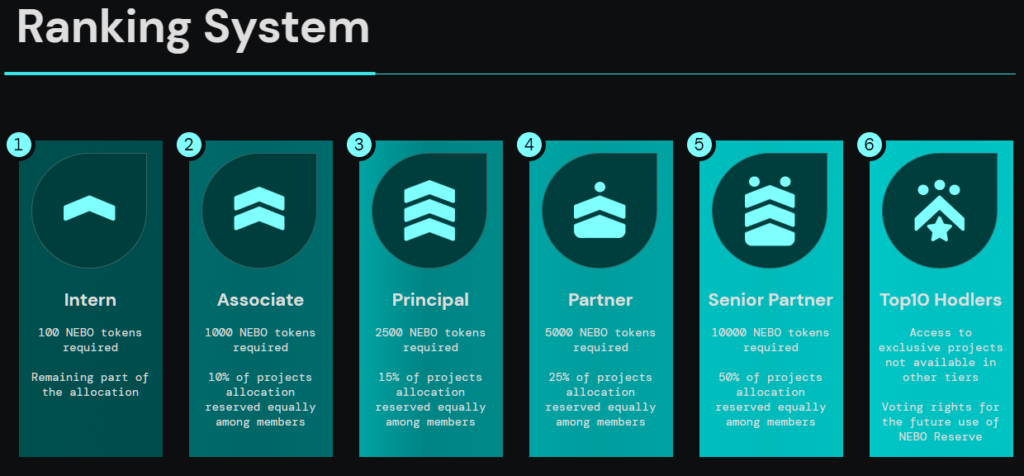
CSP DAO is oriented toward development teams using blockchain technology. Management of the structure is via NEBO tokens, which also determine investment shares.


theLAO is the spiritual successor to The DAO. It is a venture fund focused on the Ethereum ecosystem. The portfolio of the LAO, launched in April 2020, includes more than 30 projects.
All members of the community sign an operating agreement. Interaction with traditional institutions is provided by OpenLaw — it handles tax reporting and performs various administrative functions. Like traditional funds, the LAO charges a management fee.
Some investment DAOs focus on a specific industry segment. For instance, Flamingo strategies are limited to the NFT space, including fractional NFT.
Grant DAOs
As with the previous case, participants pool capital to achieve common aims, but do not set out to maximise profit.
In most cases these are “distributed” grant programmes aimed at supporting the ecosystem of a protocol:
- Audius Grants funds projects and initiatives within the Audius ecosystem;
- MolochDAO — a community whose participants fund Ethereum Improvement Proposals (EIP).
However there are other examples — Mint Fund funds digital artists interested in creating NFTs. The DAO subsidises the costs of token issuance (gas fees) and provides advisory and other support.
This group also includes charitable organisations such as Ukraine DAO.
Collector DAOs
The rapid growth of the NFT segment and the rise in the value of digital artworks prompted the emergence of DAOs aimed at collecting non-fungible tokens. Members of such DAOs typically hold a stake in the treasury.
Some DAOs focus on specific collections. For example, APE DAO supports the Bored Ape Yacht Club ecosystem. Others select collectibles guided by different principles — herstoryDAO buys digital works by Black women.
There are also organisations that buy NFTs to shard them and pursue fractional ownership. PartyDAO is an example of such a structure.
Standalone are DAOs created to purchase physical items or fund public initiatives. For instance, in February 2022 AssangeDAO raised more than $32 million to assist in the release of WikiLeaks founder Julian Assange from prison.
Media DAOs
The aim of media DAOs is to disseminate news and other information.
Some media DAOs resemble community-run traditional media. For example, Bankless token holders can vote on various proposals and initiatives, and can be authors of content subject to demonstrated skills.
Mirror comprises a community-owned blogging platform. It enables authors to publish content and monetise it.
Global Coin Research is a hybrid community of authors and investors focused on the Web 3.0 industry. Governance-token holders of GCR gain access to a co-investment platform and exclusive analytical content. Creators of the latter earn tokens for writing.
***
The DAO landscape is changing and evolving, so in the future we will see even more variants of decentralised coordination of people. Socially oriented structures are more dynamic in this regard, as they prioritise social interaction among users.
In technically oriented DAOs, large sums of money are often at stake, and these organisations are notoriously “unwieldy” — accountability for capital requires on-chain governance with a mandatory system for submitting and ratifying proposals.
A decentralised structure offers an alternative model of governance and development that, under certain conditions, can be more effective than traditional mechanisms. At the same time, due to legal and other issues, creating a DAO is not always warranted — sometimes a conventional governance structure is more viable.
Follow ForkLog’s Bitcoin news on our Telegram — crypto news, prices and analysis.