



DeepMind trains AI agents to interact with humans
Researchers at DeepMind have developed AI agents that can interact with people in a natural way and learn from them.
How can AI begin to interact naturally with people?
Introducing a new framework where agents can improve their behaviour using human feedback. Tested in a virtual playhouse, agents can listen, ask questions and perform actions in real-time. https://t.co/zw5c9hmSLH pic.twitter.com/irbt6govk8
— DeepMind (@DeepMind) November 23, 2022
To this end, the researchers created an interactive three-dimensional environment in which AI agents and people could move freely, interact, and communicate as avatars. Information exchange between them occurred in natural-language chat.
In the three-dimensional environment, the research team also collected interaction data for reinforcement learning. According to DeepMind, the generated dataset comprises 25 years of real-time interaction between agents and hundreds of people.
To create advanced AI avatars, the researchers copied user behavior in the virtual environment. Otherwise, AI agents would act in a disorderly and incomprehensible manner to people, DeepMind said.
They then optimized behavior with human feedback using reinforcement learning following the classic trial-and-error principle. However, they based the reward model on people’s assessment of goal achievement rather than the number of points earned.
Then, based on these interactions, DeepMind trained a reward system that predicts real users’ preferences. It served as a feedback mechanism for further optimization of the agents.
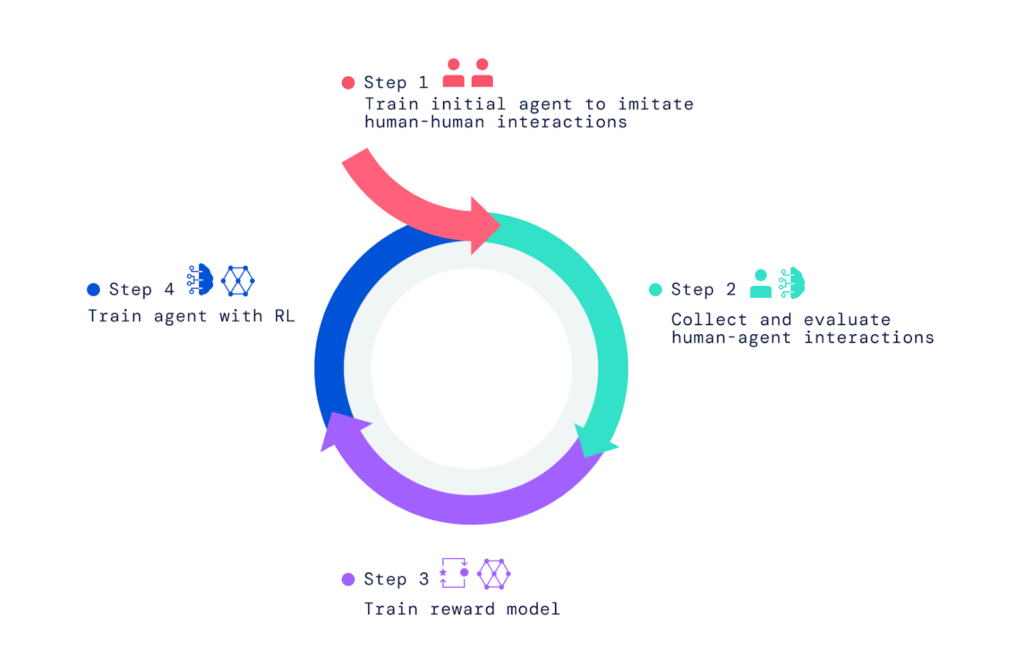
Tasks and questions for the learning process came from people, as well as avatars mimicking humans.
According to DeepMind, their AI can solve a variety of tasks that the team had not previously anticipated. For example, they arranged objects based on two alternating colors or brought users an object similar to the one they were currently holding.
When evaluating the AI agents, enhanced by reinforcement learning, they showed significantly better results than those trained merely to imitate a human.
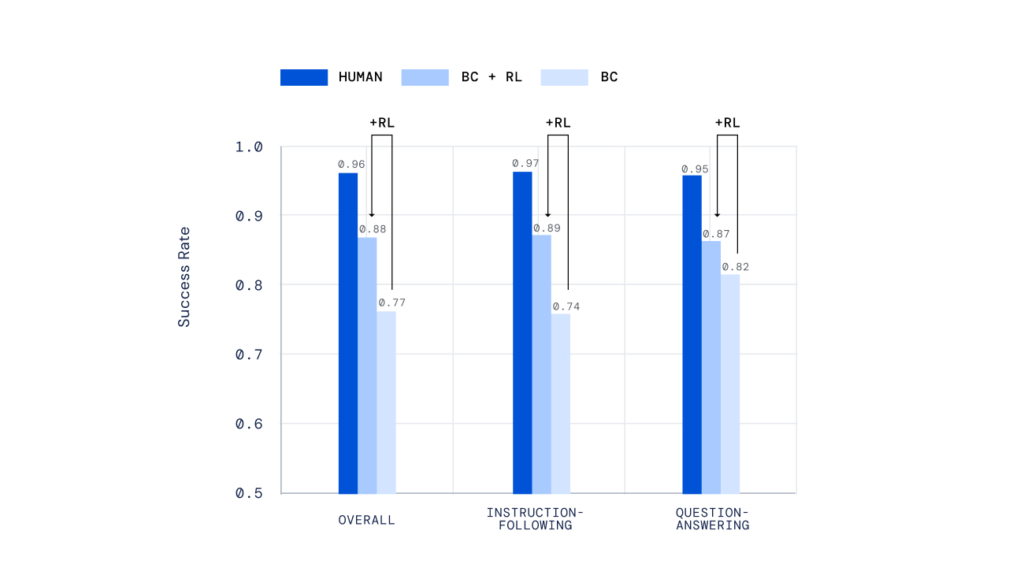
According to the researchers, the learning process can be run multiple times for further optimization of the AI using an updated reward model.
DeepMind sees the presented framework as a contribution to developing in-game agents that can interact with people more naturally. The framework could also assist in developing digital or robotic assistants, the researchers say.
Earlier in September, DeepMind developed AI agents capable of playing virtual football.
Subscribe to ForkLog news on Telegram: ForkLog AI — all the news from the world of AI!
Рассылки ForkLog: держите руку на пульсе биткоин-индустрии!