



The decentralized finance (DeFi) sector continues to attract heightened attention from cryptocurrency investors and traders. The most important events and news from the last three weeks have been gathered by ForkLog in one piece.
Value of locked assets, market capitalization and DEX volumes
On Saturday, December 4, the amount of funds locked in DeFi protocols reached a historic high of $14.8 billion.


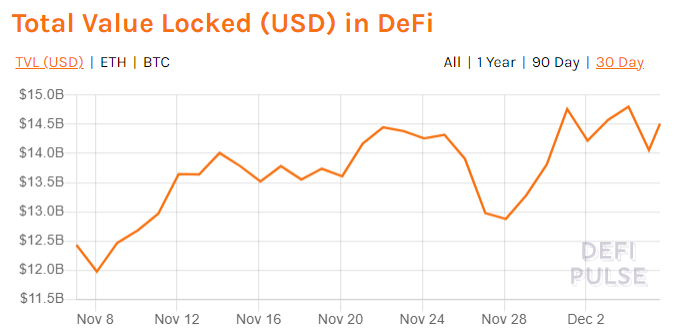
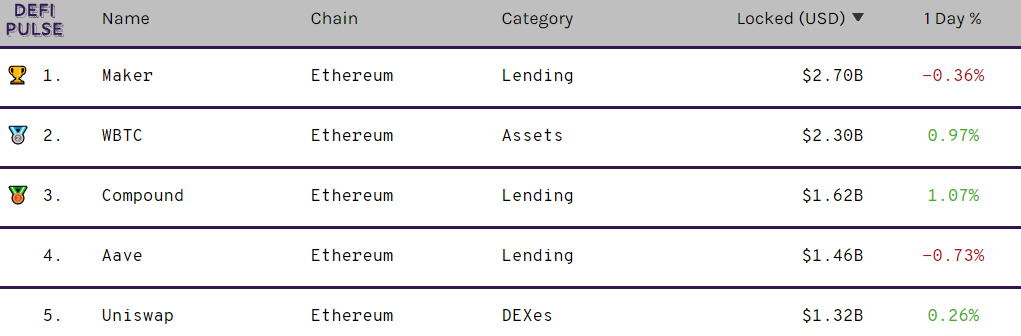
At the time of writing, the metric had adjusted to $14.51 billion. Maker led the way — its dominance index stands at 18.6%.
Maker accounts for $2.7 billion of all funds in DeFi protocols. The top five over the past three weeks remained unchanged, however Uniswap fell from first to fifth place.


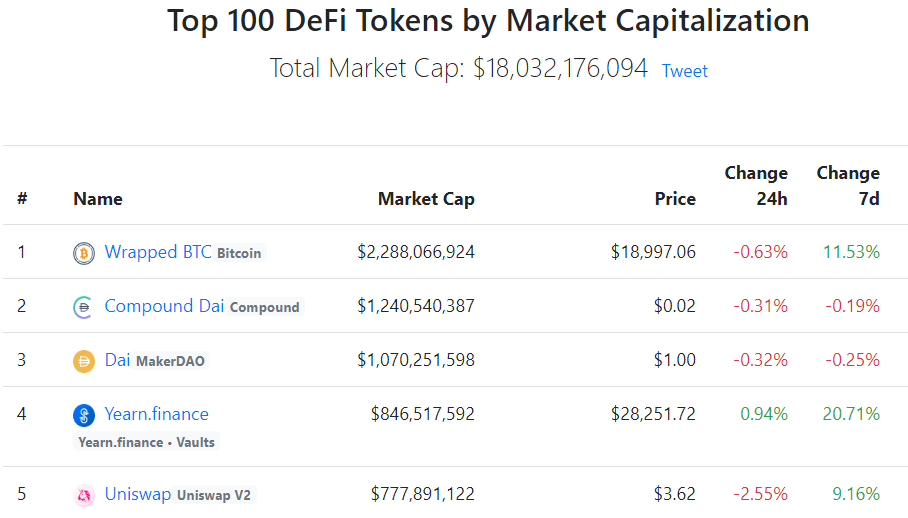
The market capitalization of DeFi tokens reached a record high of $18 billion.


Trading volume on decentralized exchanges over the last 30 days stood at $16.69 billion. Compared with the previous period, the figure was down 3%.
Aave v2 Launch
On Thursday, December 3, the second version of the Aave lending protocol went live. Developers activated several important updates, including the ability to trade assets in all supported currencies, even when they are used as collateral.
👻It’s the moment we’ve all been waiting for… Aave V2 is live on mainnet! 🍾🎊
Head over to https://t.co/gzkAogjUOS to try it out
Check out the Aavesome new features, security & audit details, and more in the latest blog post: https://t.co/N1oXXH4X5u
— Aave (@AaveAave) December 3, 2020
The loan repayment process has also been simplified. In the first version, if a user wanted to use collateral to repay, they had to withdraw funds from the collateral, purchase the borrowed asset, repay the debt, and finally unlock the deposited collateral. The new approach allows closing collateral positions directly using the collateral.
News of the Aave v2 release positively affected the token price of the project’s own token — soon after the release its price surged to an all-time high of $94.26. At the time of writing, Aave trades around $91, which still represents nearly a 50% gain over the last week.


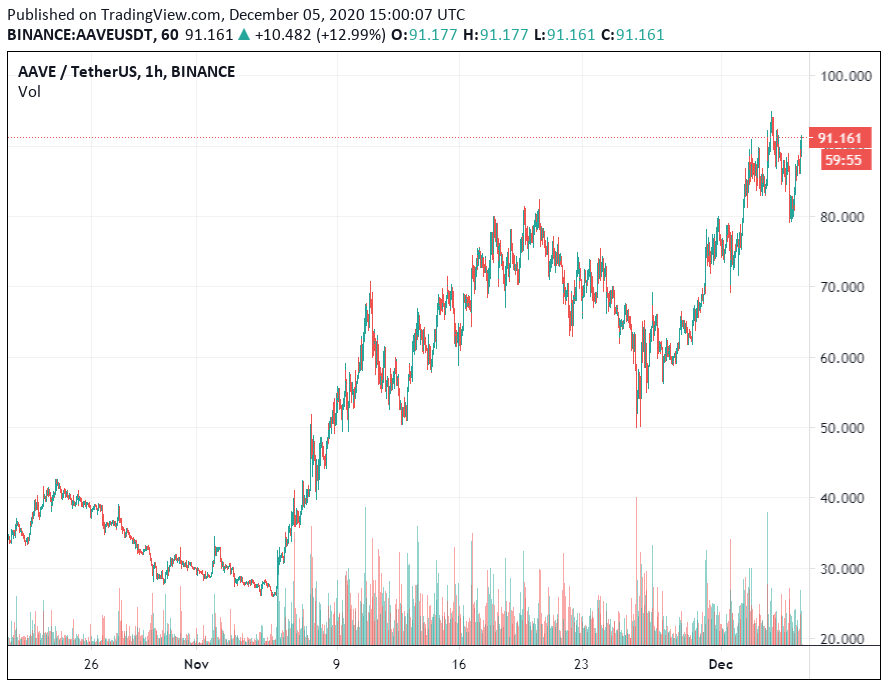
Hourly chart of AAVE/USDT from TradingView (Binance).
yEarn.Finance acquired SushiSwap and five more DeFi projects
On December 1, the yEarn.Finance protocol announced the acquisition of SushiSwap, a fork of the leading non-custodial platform Uniswap. Under the deal, funds locked in SushiSwap (TVL) will be transferred to yEarn.Finance.
After the deal closes, the project will have about $1.2 billion in funds at its disposal. This would make yEarn.Finance the second-largest decentralized exchange (DEX) after Uniswap. The latter’s TVL is estimated at $1.36 billion.
According to yEarn.Finance founder André Cronje, the rationale for unifying yEarn.Finance and SushiSwap is largely due to the similar functionality of the projects.
“The strategies of yEarn.Finance require the experience of a customized AMM [automated market maker], while SushiSwap expands the boundaries of yield farming and money markets,” he emphasized.
SushiSwap will also assist yEarn.Finance with the launch of the Deriswap platform. It will feature swaps, options and a lending function.
This marks Cronje’s sixth acquisition recently. Previously, yEarn.Finance integrated with the lending protocol Cream, the project Pickle Finance and the Argent wallet, the Akropolis project and the peer-to-peer insurance market Cover Protocol.
Chainlink co-founder: attacks on DeFi protocols using flash loans will continue
Price oracles are a weak point of DeFi protocols, so attacks on them will continue and will become more complex, said Chainlink co-founder Sergey Nazarov.
“The true essence of an attack is that there is a single price data provider, a single exchange. Often, for simplicity and speed of development, data from intra-network DEXs and exchange infrastructure are used to obtain prices and launch DeFi applications,” Nazarov explained.
To manipulate prices even on a single exchange, attackers require substantial capital. They prefer flash-loan attacks because they give access to large sums in a short period. This, in turn, allows hackers to manipulate token prices, distorting oracle data.
The danger of such attacks is that they do not require knowledge of code, only sufficient funds. However, obtaining data from several intra-network exchanges will not protect DeFi platforms, though it would make them more complex and costly, Nazarov warns.
The supply of “Bitcoin on Ethereum” has decreased
The trajectory of the number of tokenized Bitcoins on Ethereum over the past two weeks has declined, according to Dune Analytics.
On November 20, the market supply of “Bitcoin on Ethereum” stood at 153,591. By December 4, it stood at 147,658 (−3.8%).
The chart below illustrates the dynamics of the number of locked “Bitcoin on Ethereum.” The decline is visible across all popular coins in the segment.


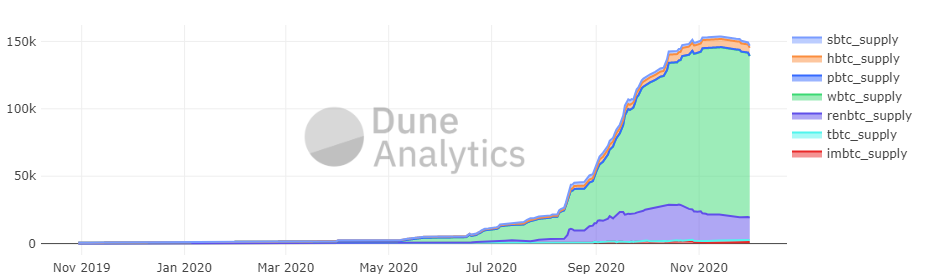
The onset of the negative trend coincided with Bitcoin’s rally to new highs at the end of November. Ethereum, which correlates with the first cryptocurrency, breached $630 on December 1. This market dynamic could have prompted users to withdraw tokenized Bitcoins from DeFi applications and sell them on the open market.
Study: DeFi token indices are not as diversified as commonly believed
A problem with DeFi indices is their excessive dependence on the performance of a handful of the included “blue chips.” They do not always fulfill the task of reducing risk for investments in this sector. This is stated in the study by Messari analyst Roberto Talamas.
The analyst studied the DeFi Pulse Index. Since its September launch, the product built on it has attracted $35 million. The instrument allows users to invest in 10 popular Ethereum tokens — LEND, YFI, COMP, SNX, MKR, REN, KNC, LRC, BAL and REPv2.
Based on covariance and total dispersion analyses of the DeFi Pulse Index components, the analyst concluded that 77% of its total risk is formed by just four assets. Uniswap (UNI) accounts for 26.1% of total risk, Aave (AAVE) 20.18%, Yearn Finance (YFI) 17.87% and Synthetix (SNX) 13.29%.
Talamas argues that simply adding more assets to the index due to their high correlation during stable trends would be counterproductive. A higher return with simultaneous risk reduction could be achieved by moving to an equally weighted portfolio and weekly or monthly rebalancing.
1inch raises $12 million with Pantera Capital backing
The liquidity aggregator from decentralized exchanges, 1inch, announced successful closing of its financing round, through which $12 million in venture funding was raised. The round was led by Pantera Capital.
The funds will be used by 1inch for further product development, expanding the team, entering new markets and more aggressive marketing.
“We are genuinely excited to receive support from large global investors. We recently released the second version of our protocol, and several new products are on the way. With these funds we will be able to develop cutting-edge solutions that will play a truly important role for the DeFi sector,” said 1inch co-founder and CEO Sergej Kunts.
The 1inch developers announced the second phase of yield farming on Mooniswap
Money on Chain launches decentralized exchange on the Bitcoin sidechain RSK
The Bitcoin-collateral DeFi protocol developer Money on Chain announced the launch of an automated decentralized exchange Tex on the RSK protocol.
The platform processes orders in batches at intervals of a few minutes. Each execution (cycle) matches the orders submitted to the blockchain.
The trade in a cycle is executed at the same average price across all orders presented by traders. The limits specify the maximum or minimum acceptable price. Additionally, Tex integrates oracles to monitor price changes between cycles.
We also reported:
- Rally in the DeFi token DAI led to a $100 million liquidation in Compound.
- Compounder Finance suspected of an exit scam of $10.8 million.
- Analysts found a loophole in MakerDAO allowing users to avoid liquidations.
- Ethereum holders prefer DeFi services to centralized exchanges.
- The number of active users of ten popular Ethereum dapps surpassed 1 million.
- A third of ForkLog readers shunned DeFi investments due to distrust of projects.
Subscribe to ForkLog news on Telegram: ForkLog FEED — the full news feed, ForkLog — the most important news and polls.