




The decentralized finance (DeFi) sector continues to attract heightened attention from cryptocurrency investors. ForkLog has gathered the most important events and news from the past weeks in this digest.
Key DeFi sector metrics
The total value locked (TVL) in DeFi protocols declined to $113 billion. The first, third and fourth places are held by lending protocols Aave ($13.21 billion), MakerDAO ($8.52 billion) and Compound ($7.47 billion).


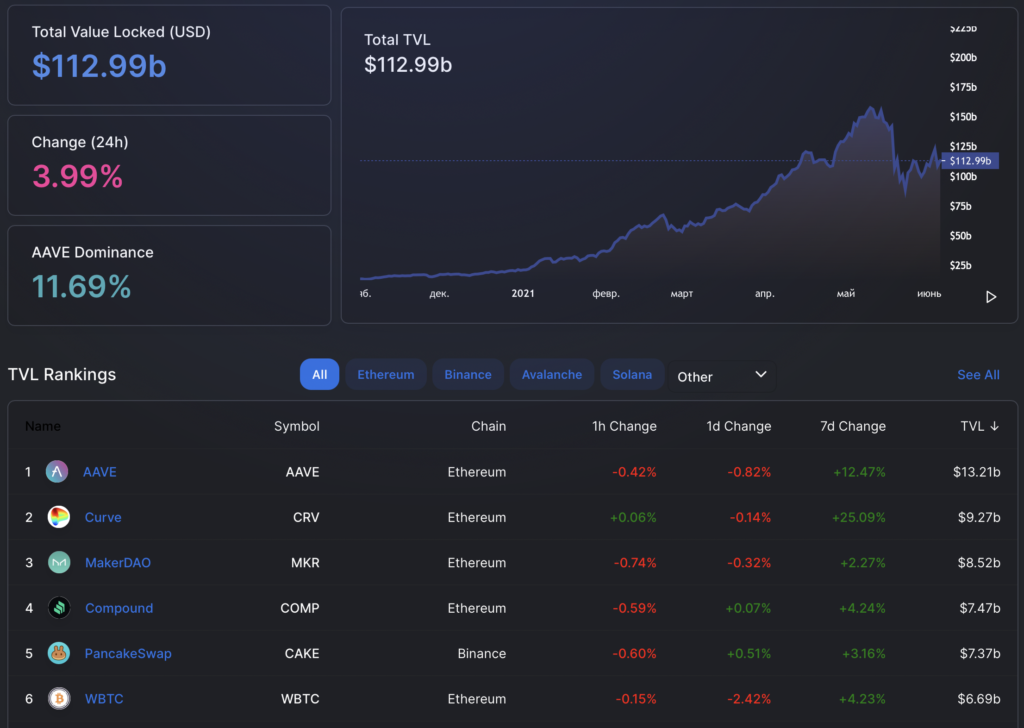
DeFi Llama includes in the final total a group of tokenized bitcoins. WBTC at $6.69 billion ranked sixth, while hBTC with $1.28 billion was 23rd.
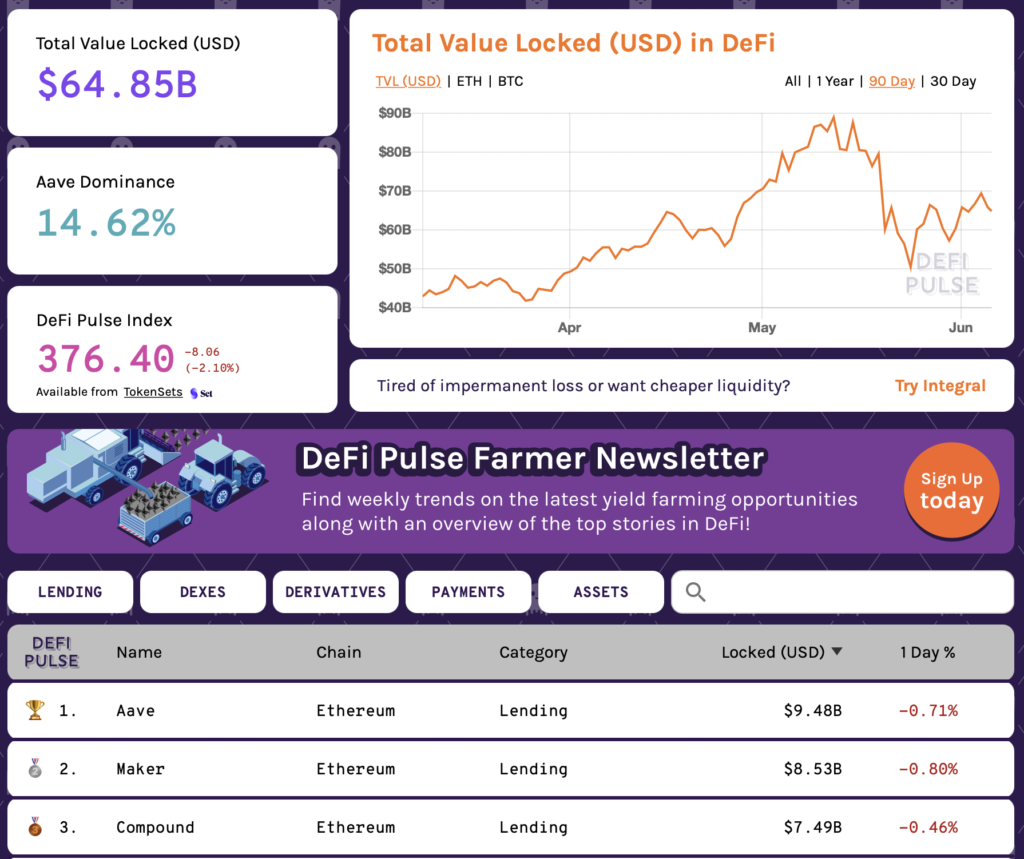
TVL in Ethereum-based applications fell to $64.85 billion. Over the last 30 days the figure fell by 20%.


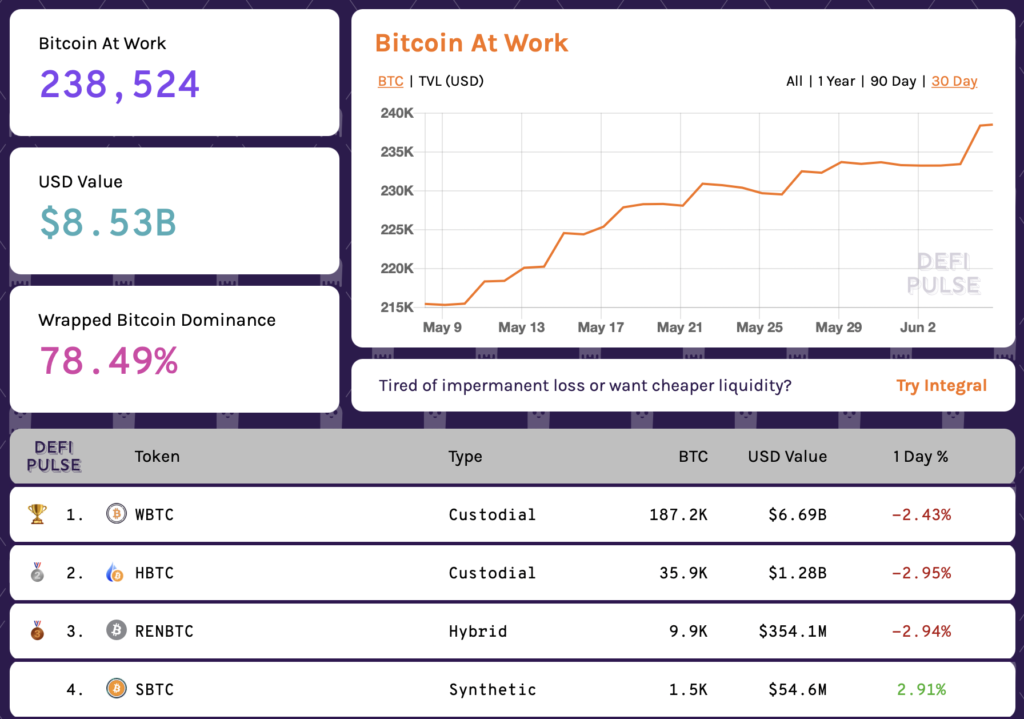
The growth of the tokenized-Bitcoin segment has stalled. The total market value of WBTC, HBTC, renBTC and other Bitcoins on Ethereum declined to $8.53 billion. Three weeks ago the figure was $10.89 billion.


Trading volume on decentralized exchanges (DEX) over the last 30 days amounted to $137.7 billion.
59.5% of total non-custodial exchange turnover is accounted for by Uniswap. The second DEX by trading volume is SushiSwap (14.1%), the third is Curve (7.9%), the fourth is 0x Native (6.2%).
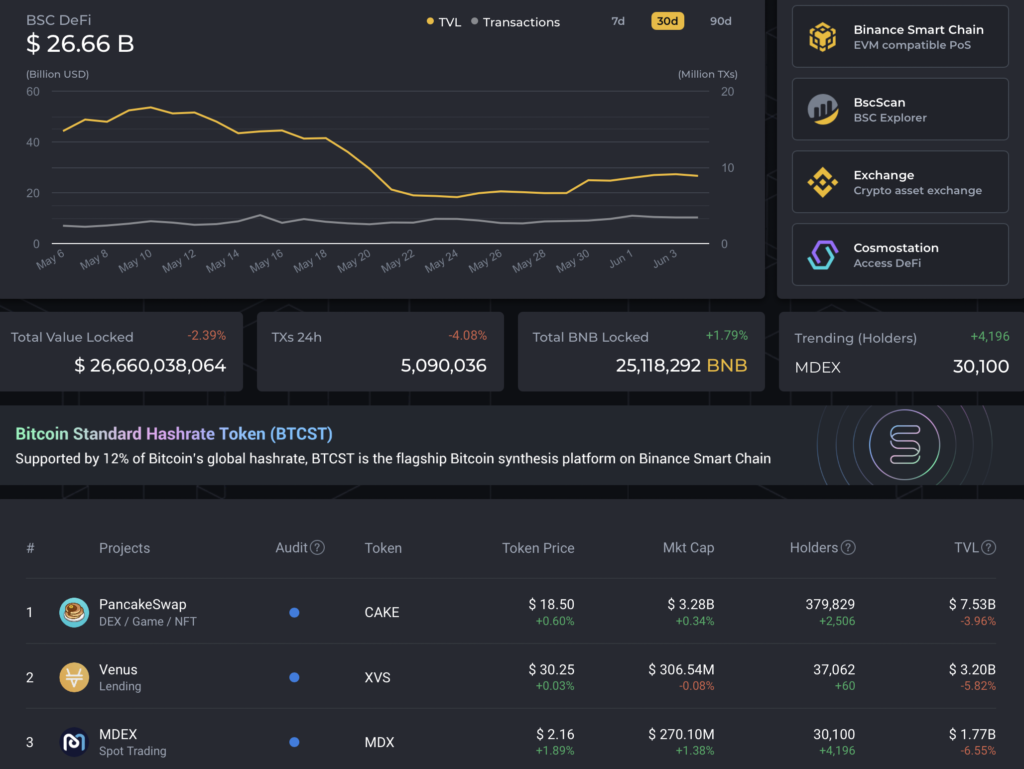
TVL of projects on Binance Smart Chain (BSC) declined. The aggregate figure fell to $26.66 billion, down 40% over the last 30 days.


DeFi sector did not panic on May 19
Analysts at Glassnode are convinced that the DeFi sector demonstrated resilience during the May 19 crash and extreme gas prices. This manifested in high activity on DEXs, robustness of liquidation and arbitrage mechanisms, and the pegs of stablecoins.
Prices of major DeFi tokens during this period showed greater beta than Ethereum. However, during the buyers’ capitulation, this relative deviation did not exceed 15%.


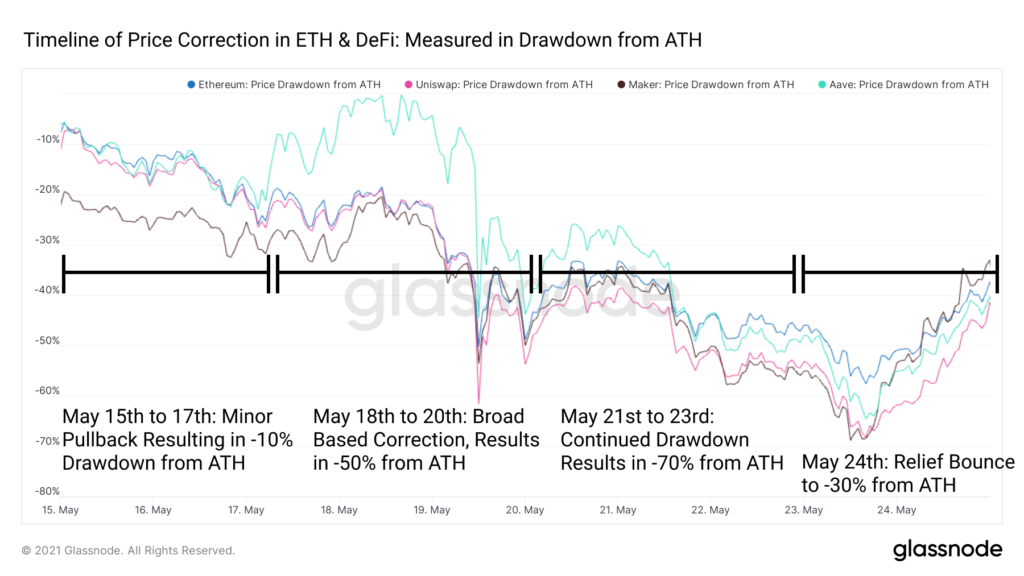
The largest decline was for YFI (72%). In the subsequent rebound, price declines from the all-time high in the sample narrowed to 42-56%.
Despite the sector’s resilience, on May 19 the liquidation volume in the Venus lending protocol on BSC reached $200 million.
Shortly before the cascade of liquidations, the native token XVS showed significant growth, one of the main drivers being the Venus Reward Token (VRT) airdrop.
According to the project’s founder Joselito Lizardo, many market participants used high leverage to increase capital efficiency. With the onset of volatile correction, a cascade of liquidations occurred on the XVS market. He added that there were no operational glitches.
1inch opens fiat sales of DeFi assets
The liquidity aggregator from DEX 1inch signed a cooperation with the payments network Mercuryo and opened fiat sales of DeFi assets.
According to 1inch co-founder Sergei Kunts, some users faced difficulties in trying to buy DeFi assets with fiat, and the integration will provide a convenient method for everyone.
Users only need the 1inch Wallet app installed on their smartphone.
UMA and Opium launch SpaceX launch insurance solution
DeFi derivatives platform Opium Protocol announced a collaboration with the decentralized UMA to launch the Optimistic Oracle.
The new tool from UMA transmits off-chain data to the blockchain, making transactions faster and cheaper. The oracle assumes that all requests are correct. A transaction is executed with minimal gas.
If one of the users disagrees, the dispute is referred to the Data-Verification Mechanism. It mirrors conventional logic: contracts are enforced, since otherwise the wrongdoer risks court that guarantees performance of the deal and losses.
Opium Protocol has implemented a risk-hedging solution via a decentralized insurance contract (CDS), linked to SpaceX launches with the help of UMA’s optimistic oracle. It concerns the SmallSat Rideshare joint-launch program. It provides relatively cheap access to space for small satellite companies, starting at $1 million per payload of 220 kg.
The instrument will also enable other parties with financial interest in the success or failure of a particular SpaceX mission to hedge risks or even speculate, as in a traditional financial market.
Thai authorities consider regulating the DeFi sector
The Thai Securities and Exchange Commission is considering regulation of the DeFi sector.
According to the agency, token-related activities may require a license from the financial regulator in the future.
Investments in DeFi
DeFi dashboard Zapper attracted $15 million following a Series A round. It was led by Framework Ventures with participation from Mark Cuban, Ashton Kutcher’s Sound Ventures, Coinbase Ventures, Long Hash, Sino Global, ParaFi Capital and other investors.
The funding will be used to launch a mobile app and a marketplace for developers. According to Zapper CEO Seba Odeta, this will allow the community to quickly implement new features and keep pace with the rapidly expanding DeFi ecosystem.
Developers of the confidential DeFi platform and privacy-focused cryptocurrency Beam raised $2 million.
In the round were Collider Ventures, Altonomy, LionsChain, Alternity Capital, Youbi Capital, AirSpeed18, Bering Waters, Taureon, Patrick Dai, Winslow Strong, Ivo Georgiev and others.
The team will use the funds to promote the upcoming Beam blockchain upgrade. The release will add additional support for privacy-oriented assets and smart contracts operating in the Beam Virtual Machine (BVM).
Alongside the deployment of the BVM on the mainnet, the Beam Foundation will gradually hand governance to a decentralized autonomous organization, governed by the BEAMX token.
The community-governed DEX EmiSwap raised $104 million from an unspecified number of investors.
The DEX describes itself as a platform using an automated market maker mechanism, complemented by a governance token ESW. Holders participate in the exchange’s governance, which operates as a decentralized autonomous organization (DAO).
According to the site, EmiSwap also reimburses users 100% of Ethereum network fees for any ESW operations.
Participants in the EmiDAO alliance include Alpha Sigma Capital, DigiFinex Exchange, IDCM Exchange, HollaEx Exchange and others. The launch of the DEX was the first joint project of the partners.
In Q3 2021 the exchange planned to release non-fungible tokens (NFTs) called NFT Magic Cards to implement a game mechanic aimed at attracting new users to the platform.
Beam DeFi project Impossible Finance operating on the BSC ecosystem raised $7 million in a seed investor round.
Funding was provided by True Ventures, CMS Holdings, Alameda Research and Hashed. Also among more than 125 investors are Sino Global Capital, IOSG, Divergence, GBV, Coin98, Lemniscap, Primitive and Incuba.
The team will use the funds to expand the product line and create a multi-chain ecosystem to foster DeFi growth and composability. In particular, adding support for Ethereum and Polygon is planned.
The team will launch an AMM-based liquidity protocol that will act as an incubator for other DeFi projects. In this regard, it could become a decentralized analogue of Y Combinator.
Hacks and scams
A hacker drained $6.2 million from Belt Finance on the BSC-based DeFi ecosystem. According to The Block researcher Igor Igamberdiev, the attacker borrowed $385 million in BUSD on PancakeSwap. After that, he deposited $10 million into the bEllipsisBUSD strategy.
The hacker deployed $187 million in BUSD for the bVenusBUSD strategy and repeated these steps more than seven times. Then swapped $190 million in BUSD for $169 million in USDT via Ellipsis.
After that, the attacker withdrew more BUSD from the bVenusBUSD strategy and swapped $169 million in USDT for $189 million in BUSD, using Ellipsis. Then he deposited BUSD into the bVenusBUSD strategy.
Finally the hacker repaid instant loans and realised a profit.
The DeFi100 team on BSC was suspected of fraud. The developers themselves reported a hacker attack and stressed that there was no exit scam.
Crypto analyst CryptoWhale wrote on Twitter that the team had disappeared with investors’ money. He claims it involved $32 million of user funds.
The DeFi100 website carried a message saying that investors were deceived and they “cannot do anything about it.” Initially the project did not comment on the rumors, but later said that the site had been hacked.
Representatives of DeFi100 also called the $32 million scam report “false and unfounded.” They said the project’s peak market capitalization was less than $2 million, and it never held investors’ funds.
The attacker targeted the BSC-based cross-chain yield-farming protocol bEarn Fi and withdrew assets worth about $11 million from its pools.
The project team said they are investigating the incident; other bVaults were not affected. The developers paused deposits and withdrawals temporarily.
The PancakeBunny token on BSC slid more than 80% due to the attack. The attacker used flash loans to carry it out.
According to the developers, the hacker borrowed a “huge amount” of BNB on PancakeSwap. He used the funds to manipulate the prices in the USDT/BNB and BUNNY/BNB pairs.
Project representatives stressed that user funds were not harmed. The exact amount of losses was not disclosed.
The The Block researcher Igor Igamberdiev noted that the attacker obtained “more than $40 million” — 114,000 WBNB and 697,000 BUNNY.
Two DeFi protocols on BSC — BurgerSwap and Julswap — were attacked using flash loans.
The BurgerSwap team said that in 14 transactions the attacker withdrew $7.2 million. Some went to BURGER and xBURGER tokens, also stolen were WBNB, BUSD and Ethereum. The team promised to cover losses.
A similar attack vector was observed at Julswap. The project’s CEO Tobias Graf refuted a hack and exploit. According to him, details of the incident will be presented soon.
Also on ForkLog:
- PwC: crypto funds are showing increasing interest in the DeFi sector.
- Wharton School of Business: DeFi could change the global financial system.
- Analysts warned about bugs in the DeFi project SafeMoon, allowing $20 million in assets to be withdrawn.
Read ForkLog’s Bitcoin news in our Telegram — cryptocurrency news, prices and analysis.