



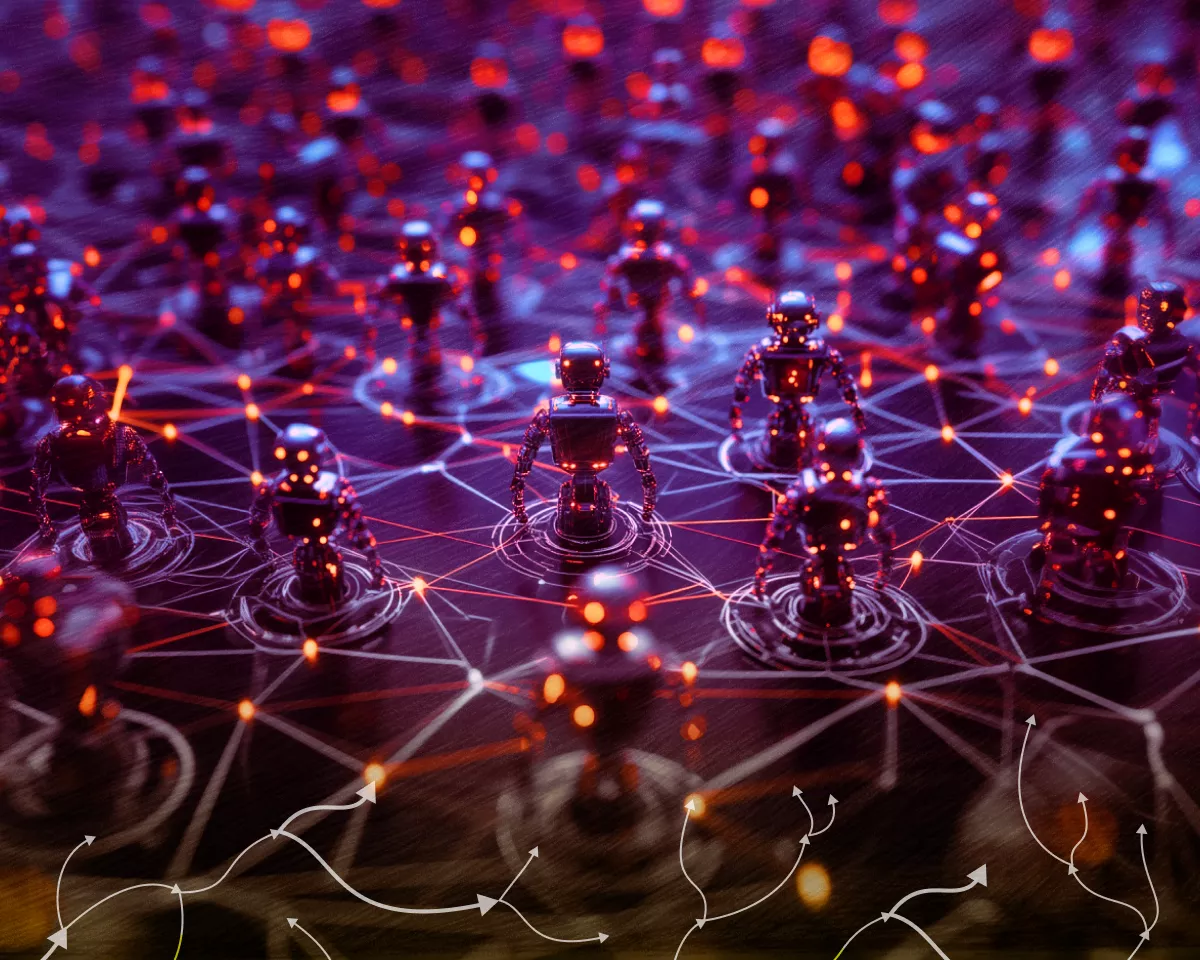
In January 2025 Nvidia CEO Jensen Huang outlined the next step in the evolution of artificial intelligence. In his view, it should be physical AI (Physical AI, PAI) — a global “brain” for robots and autonomous devices, enabling machines to navigate the real world.
The blockchain industry picked up the idea, proposing a decentralised version. In February the analytics platform Messari published a report on a new form of interaction among people, machines and Web3 — DePAI. The notion of an infrastructure based on DePIN and a stack for developing a future “robot economy” inspired crypto influencer Miles Deutscher. In April he called DePAI “the biggest trend in crypto for the next two years”.
This article explores how DePAI could help build a balanced future for people and machines.
Nvidia’s physical AI
At CES 2025 Huang announced Cosmos — a platform for building World Foundation Models (WFM) aimed at revolutionising systems of physical AI (PAI): robots and autonomous vehicles.
Cosmos uses WFM to model real-world conditions, allowing AI systems to be tested. A controlled testbed reduces costs and speeds development.
Huang noted the open nature of Cosmos, whose source code is available on GitHub.
“We sincerely hope that the openness of Cosmos will do for the world of robotics and industrial AI what Llama 3 did for industrial AI,” he added.
According to Nvidia, PAI enables autonomous systems — such as robots, driverless cars and smart spaces — to perceive, understand and carry out complex actions in the real world.
Large language models (LLMs) such as GPT and Llama can generate human language and abstract concepts, but are limited in their grasp of the physical world’s laws. PAI can complement them by training spatial understanding.
3D data for AI are generated via high-fidelity simulations that serve both as data sources and training environments. The process starts by creating a digital twin of a space, for instance a factory, then adding sensors and robots. As sensors capture rigid-body dynamics (movement and collisions) or the interaction of light with the environment, real scenarios are modelled in the virtual copy.
PAI opens new possibilities for many industries. In robotics, the concept can improve a range of unit capabilities across products:
- autonomous mobile robots. Using data from built-in sensors, machines can navigate complex environments and avoid collisions in warehouses;
- conveyor manipulators. Adjusting grip force and position based on an object’s coordinates, demonstrating adaptive motor control;
- surgical robots. Trained to perform tasks difficult for machines, such as threading a needle and suturing;
- general-purpose humanoid robots. They need both gross and fine motor skills, and must perceive, understand and interact with the real world regardless of the task.
A PAI model is rewarded for successfully completing required actions and improves over time. Machines gradually develop complex skills, including precise motor actions needed for real-world use: careful box packing, assisting in vehicle assembly or navigating spaces.
DePAI — a Web3 stack for intelligent robots
The crypto community embraced PAI, proposing blockchains as an antidote to AI centralisation. In a February report, Messari analyst Dylan Bane added the word “decentralised” to the acronym.
Own your robots.
Decentralized Physical AI (DePAI) offers an alternative to centralized control of robots and the Physical AI infra stack.
From real world data collection to Physical AI Agents operating robots deployed by DePIN, DePAI is well on its way.@MessariCrypto ? pic.twitter.com/ukskuYIG75
— Dylan Bane (@dylangbane) February 11, 2025
The acronym reads: DePAI — decentralised networks of physical artificial intelligence.
DePAI sits at the intersection of AI, robotics and Web3. It could power a future economy in which automation is balanced with human needs.
What began as generative AI for content is becoming autonomous agents capable of making decisions on their own. The remaining step is to give them effective “bodies”.
Messari’s DePAI map lists six main groups by activity.


DePIN projects such as the geodetic network GEODNET or the Google Maps alternative Hivemapper naturally slot into a new DePAI stack. The products of such startups can become robots’ ears and eyes in the real world and in real time, serving as their data-collection layer.
The startup WeatherXM incentivises users to deploy personal weather stations and upload climate data in exchange for tokens. Such data can be used by devices within DePAI. For example, integrated smart-home systems could automatically adjust ventilation or temperature based on current weather.
In robotics, the startup Frodobots uses DePIN to deploy low-cost “sidewalk” delivery robots worldwide. The data used helps address the complexity of human decision-making in real-world navigation. Gamers can practise controlling machines in an accessible format.


Also in the mix is a company creating digital twins of physical robots on the Polkadot blockchain — Robonomics Network. It explores connecting robot operating systems and IoT devices with a blockchain to publish tasks and deliver services via smart contracts.
Machine coordination networks are being built by blockchain platforms focused on DePIN — Peaq and IoTeX. Their high-throughput architectures provide the many parallel transactions DePAI requires.
The Posemesh data-transmission protocol from Auki focuses on creating a global network of spatial intelligence. It aims to ensure privacy and help build a virtual map for robots. Its functions are not limited to logistics and are also used for AI self-training in simulation.
In investment DAOs — Xmaquina. The project focuses on creating a structure for collective ownership, management and development of costly AI robots. It allows communities and investors to co-finance and develop technologies while distributing benefits fairly.

In a global machine economy, DePAI could, in theory, return power to people that currently belongs to corporations. Users already need to know who owns the technology, which manufacturer sets interaction standards and who ultimately earns the profits.
DePAI in the future machine economy
On April 14, 2025, the well-known crypto analyst Miles Deutscher called DePAI one of the biggest trends in the industry.
New phrase to keep an eye on: DePAI.
Will be one of the biggest trends in crypto over the coming 1-2 years.
Stands for “Decentralised Physical AI Infrastructure Stack”:
• AI agents
• On-chain robotics
• Crowdsourced data
• Incentivised computeWill post my top picks soon. pic.twitter.com/JTioqfwJYz
— Miles Deutscher (@milesdeutscher) April 14, 2025
The image attached to the post illustrates the complexity of relationships within the DePAI stack. The dynamics, shown as vectors, indicate the purpose of actions among infrastructure participants.
The Peaq blockchain team, which is actively involved in DePAI’s development, highlights seven components every autonomous system needs:
- hardware. Robots that let AI models interact with the physical world;
- software. AI agents — the minds of machines;
- aggregation and distribution of data for training and evolving PAI;
- spatial intelligence. Robots’ understanding of and interaction with their environment;
- DePIN networks. Providing storage, compute and power for systems;
- the machine-economy layer. It unites all elements via specialised protocols for interaction between DePIN networks, AI and robots;
DAOs. Enabling people, communities and companies to own, govern and earn on equal terms.
While most of these are familiar to the average Web3 user, the future machine economy needs explanation. By uniting leading crypto technologies, the model could deliver the following benefits:
- provide an incentive system that prompts robots to act in humanity’s interests — based on decisions made by people;
- support global governance and open participation, allowing everyone — not only corporations — to be part of the economy;
- serve as a global trading platform;
- set standards and protocols for interaction among autonomous robots;
- open the way to decentralised systems for distributing prosperity;
- provide transactional and application infrastructure to create and connect decentralised applications and machines.
The flipside of utopia
Like any new technology, DePAI faces serious challenges that must be solved before mass adoption. The main problems are:
- privacy and regulatory compliance. Using real-world data (faces, voices) risks breaching local legal norms. Even with ZKPs, clear anonymisation standards and data-use policies are needed;
- network and device security. Cyberattacks could cause physical damage via malicious commands. Smart-contract protection, encryption and built-in robot safety systems are needed;
- standardisation and interoperability. Devices use different protocols — unification is needed at hardware and software levels;
- scalability and infrastructure. High throughput, reliable blockchains and physical infrastructure (storage, charging stations) are required;
- governance and liability. A DAO may own robots, but maintenance requires centralised teams. It is unclear how responsibility should be allocated in the event of incidents or damage.
The vision of a machine economy that ends to people’s advantage is enticing, but whether robotics giants such as Tesla and other corporations will take part remains an open question.
Web3, with blockchains as its foundation, is likely the best solution today for implementing decentralised AI. DePAI, for its part, clearly sets out the benefits for all sides of future progress — but who participates will be decided over time.