



Developers unveil Polygon 2.0 architecture
Polygon Labs outlined the proposed architecture for the next iteration of the eponymous Ethereum-second-layer network. Polygon 2.0 is formalised as a set of protocols designed to operate together.
1/ Today, we are excited to propose the Polygon 2.0 architecture, designed to provide unlimited scalability and unified liquidity, thus transforming Polygon into the Value Layer of the Internet!
Read the blog ?? or keep scrolling ?https://t.co/sShy6R1E6R pic.twitter.com/BTdwkri4nI
— Polygon (Labs) (@0xPolygonLabs) June 29, 2023
Developers proposed four levels, each handling a portion of processes within the network:
- Staking (Staking Layer);
- Interop (Interop Layer);
- Execution (Execution Layer);
- Proving (Proving Layer).
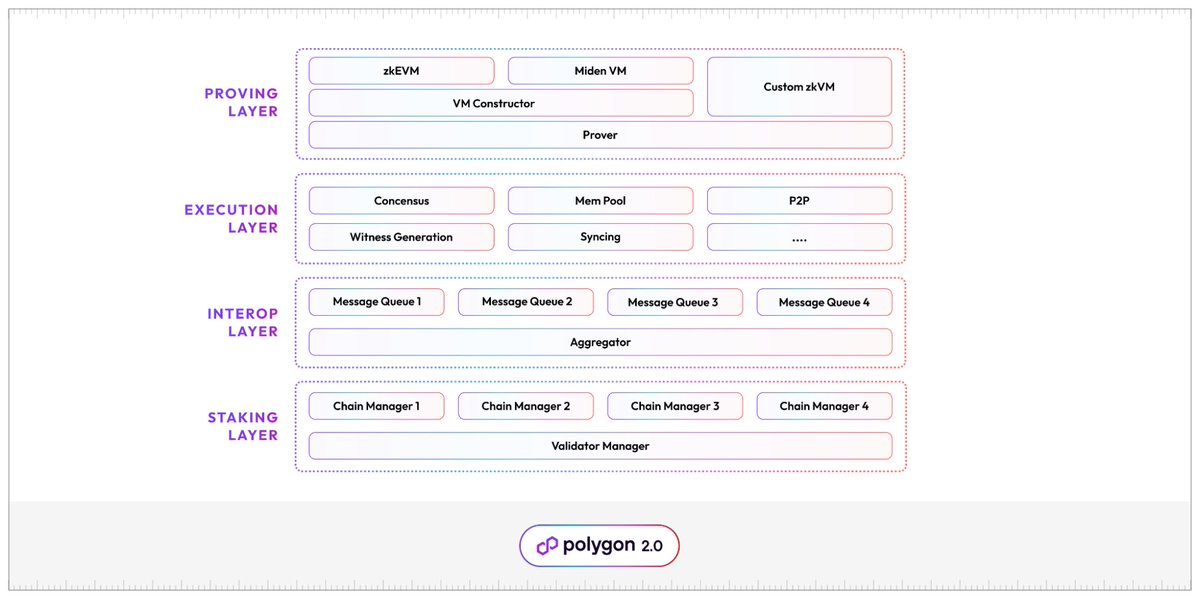
Staking Layer — protocol based on Proof-of-Stake, using the Polygon (MATIC) token to secure decentralisation of existing chains in the ecosystem. This is achieved via a pool of validators and a built-in staking model. Initial validators receive rewards for staked assets and additional income from transaction-validation fees.
The Interop Layer provides messaging between networks within the ecosystem.
“It abstracts the complexity of cross-chain transactions and makes Polygon look like a single chain, providing universal access to native Ethereum assets and seamless composition,” the developers explained.
Interop Layer is based on the LxLy protocol (used by Polygon zkEVM) on the basis of zero-knowledge proof technology (ZK-Rollups) to ensure security.
The Execution Layer allows any network on Polygon to create sequential transaction packets — blocks. It includes several components typical of most blockchains (Bitcoin, Ethereum and others) such as consensus, mempool, databases, synchronization, etc.
“This protocol layer is fairly commercialised, since it is used in a similar format by most networks, but relatively difficult to implement,” the developers noted.
For this reason they plan to make broad use of already existing efficient solutions.
Proving Layer is a high-performance and flexible verification protocol. It validates all transactions in the network. The layer envisages three components:
- Common prover for proving transactions;
- State machine for interpreting them;
- and optionally — the State machine constructor, which will define them.
In the opinion of the team, such a structure offers a number of advantages, including simple and efficient creation, aggregation and verification of proofs.
Developers promised to share more details about each component of Polygon 2.0 in the near future.
Earlier, when outlining the concept of the planned upgrade, they described its goal as turning the network into a ‘value layer’ for the Internet.
Рассылки ForkLog: держите руку на пульсе биткоин-индустрии!