




ForkLog magazine examined the diversity of projects and the main directions in the development of the decentralized finance (DeFi) segment.
- The Ethereum-based DeFi ecosystem is developing rapidly, attracting developers and venture funding.
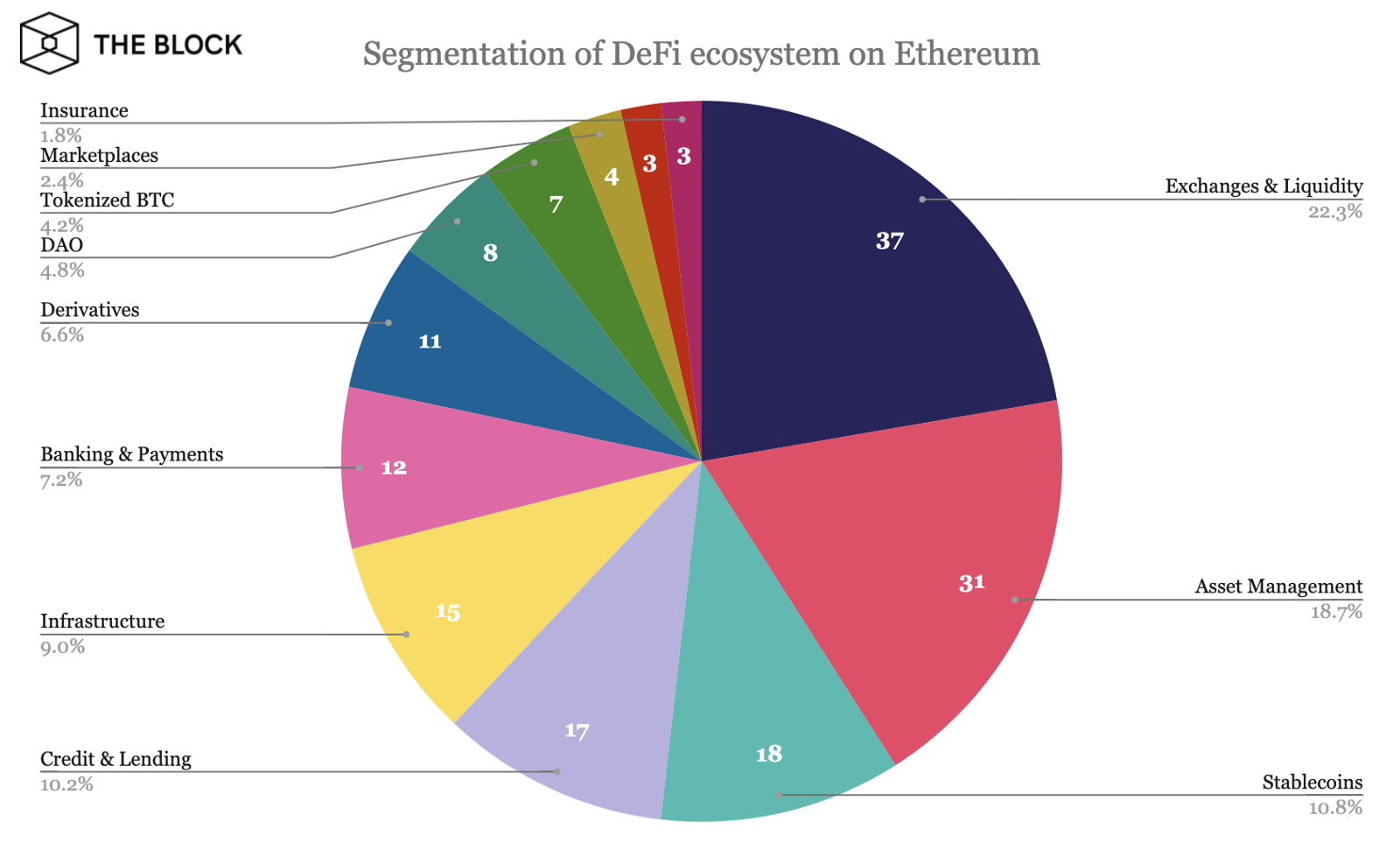
- The largest share of the segment is held by exchanges and liquidity providers—roughly 22%. Asset-management services account for about 19% of the market.
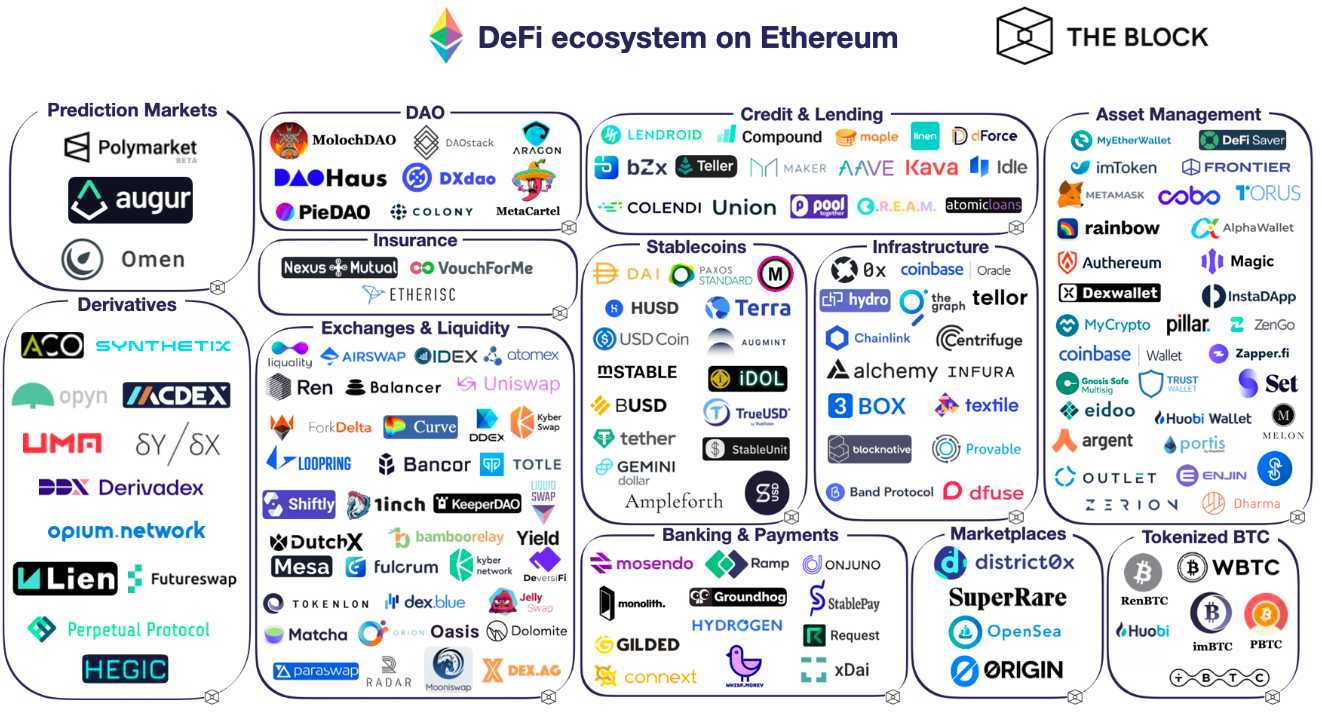
- According to The Block, the DeFi ecosystem comprises at least 166 startups and protocols operating across 12 areas.
New projects appear in DeFi almost every day. Some offer interesting solutions that attract investment and liquidity to protocols. Other projects are nothing more than imitators, chasing fleeting hype. Some are even created merely to misappropriate user funds and disappear.
«The number of scams, frauds and hacks in the cryptocurrency market has always been astronomically high compared with other industries. I cannot say that there are more of them in DeFi than the market average,» said Nikita Ovchinnikov, Head of Business Development at 1inch. «The true leaders of this segment became interested, believed and started building products as early as 2018. Projects such as Compound, Synthetix and others did not enter the market for hype and quick money.»
Some industry figures are clearly not enamoured with the DeFi fever. Renowned trader Ton Veis отождествляет DeFi projects with Ponzi schemes. What is happening in the market reminds him of the ICO boom.
Despite the sceptics’ views, sizable sums are flowing into the segment’s development. For example, Binance will allocate $100 million to support the DeFi ecosystem and ensure its interaction with centralized services.
Developers are trying to turn almost every traditional financial service into a decentralized protocol, whether trading, lending or derivatives. In the last six months, at least 17 DeFi projects attracted venture funding.


«The uniqueness of DeFi lies in the all-encompassing interconnection between protocols, parts of which can be assembled like Lego bricks into something new. Rising liquidity or more funds locked in one product creates feedback loops and increases the value of the entire market. The higher the trading volume on DEXs, the more money liquidity providers earn. The more they earn, the more liquidity flows into the market. Increased liquidity leads to smaller spreads, more users and higher trading volumes, returning us to the start of the chain,» noted Nikita Ovchinnikov.
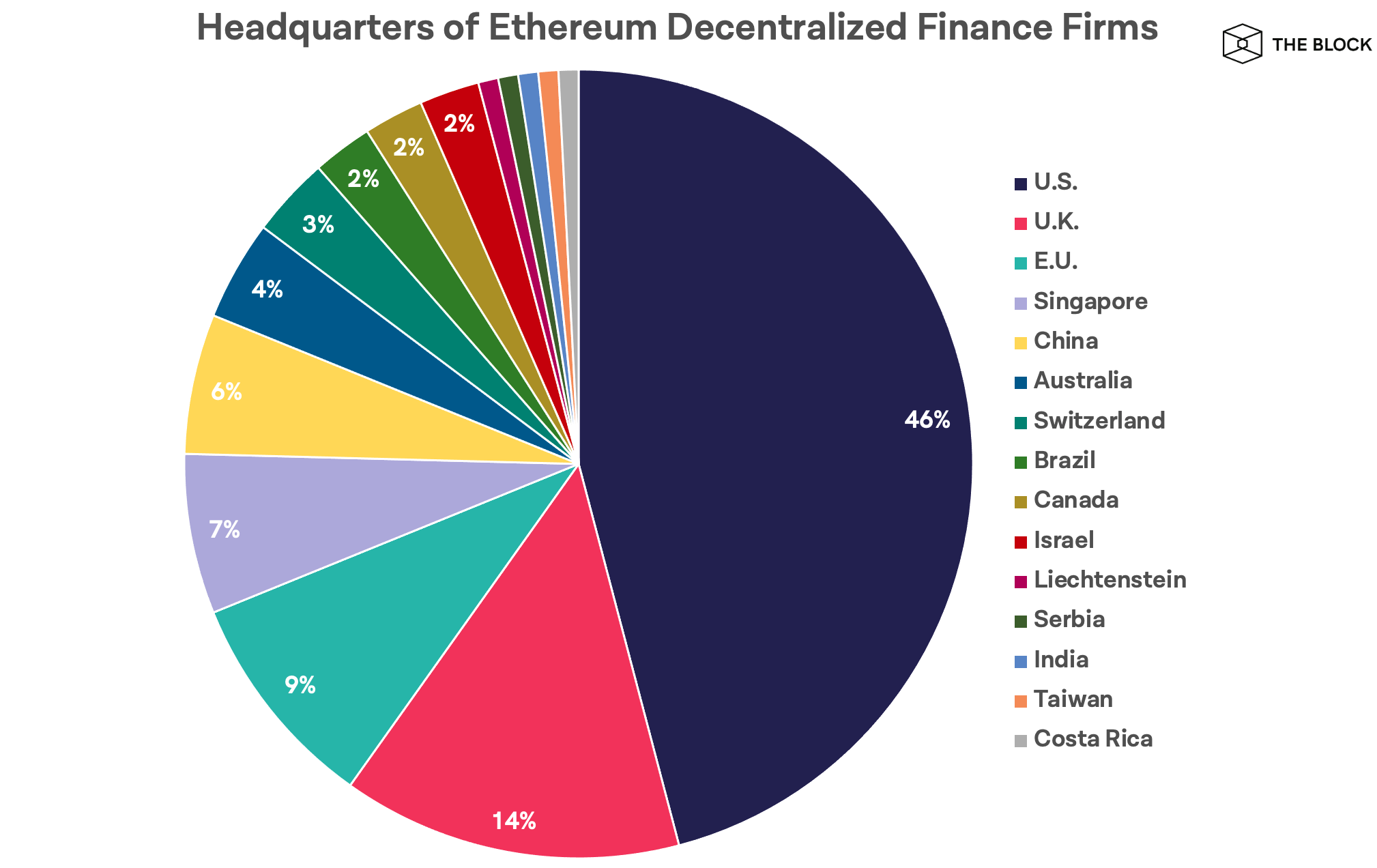
Almost half of the sector’s startups are based in the United States. Other popular jurisdictions include the United Kingdom, the European Union and Singapore.


The Block counted 166 companies and protocols that fall under Ethereum DeFi. The largest share in the sector is taken by the category “Exchanges and liquidity providers” — 22%. Decentralized asset-management services account for about 19% of the market.
The category “Exchanges and liquidity providers” covers decentralized trading venues and liquidity aggregators. The latter source liquidity from the exchanges themselves to generate the best possible price execution.
Ovchinnikov is convinced that DEXs are gradually displacing centralized exchanges. The latter are studying various aspects of decentralized solutions and listing DeFi tokens.
«In 2017–2018, DEX trading mainly involved second-tier tokens, and market professionals did not expect significant breakthroughs for a host of reasons. But everything changed when top projects set the trend for listings on Uniswap, Balancer and other similar platforms. Traders could not buy hot assets on familiar venues, and tokens rose rapidly, attracting a huge user base,» shared the observer.
The “Asset Management” category can be split into wallets and other services that let users store digital assets and access a wide range of decentralized applications. Other services in this category offer automatic rebalancing of assets according to specific trading strategies, or attempts to maximise returns from funds invested in various protocols.
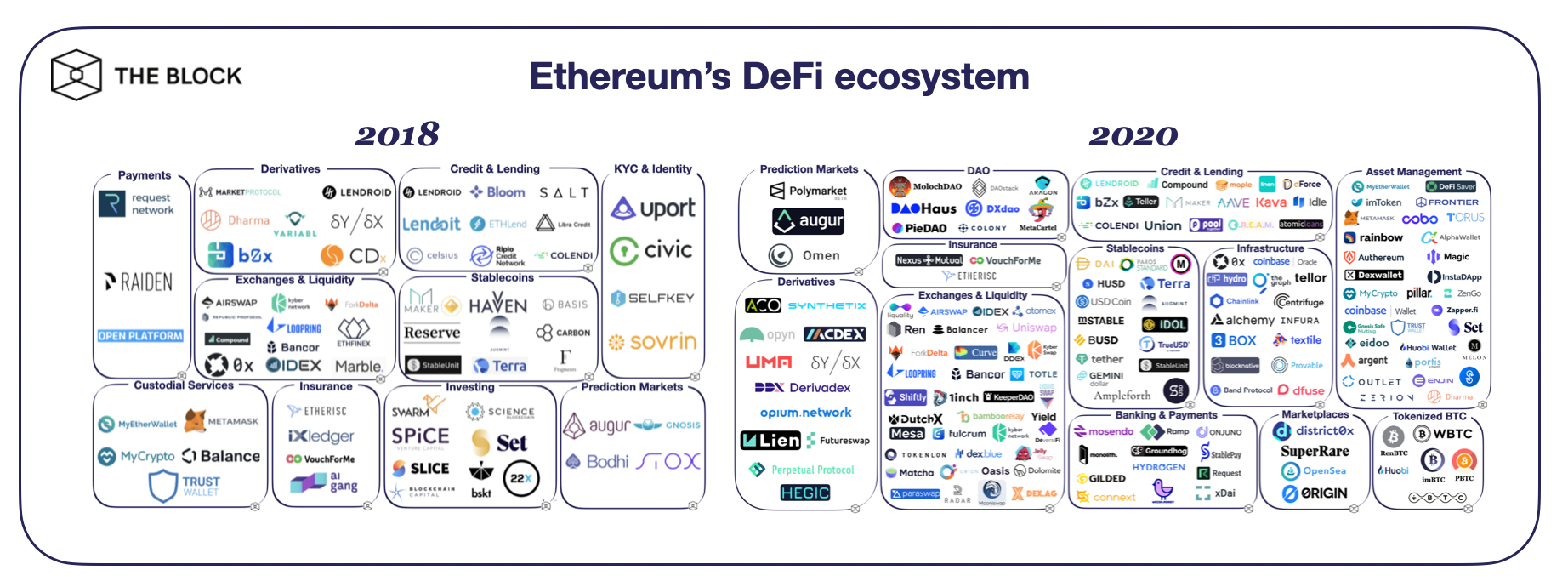
DeFi ecosystem projects operate along 12 core directions:
- prediction markets;
- decentralized autonomous organisations (DAOs);
- lending;
- asset management;
- derivatives;
- insurance;
- exchanges and liquidity providers;
- stablecoins;
- banking and payments;
- infrastructure;
- marketplaces;
- tokenisation of bitcoins.


In October 2018, analysts counted 64 companies participating in the Ethereum-based DeFi ecosystem. Since then, the number of such startups and protocols has grown by 159%.


Asset Management


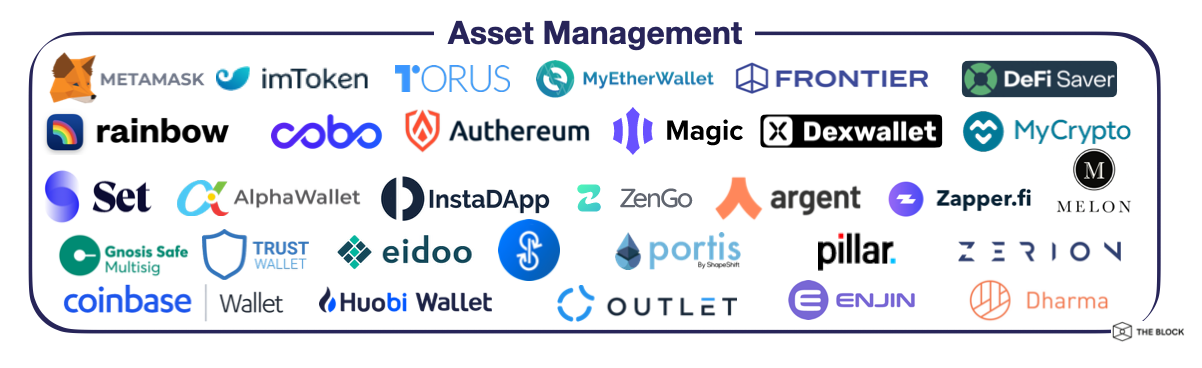
AlphaWallet — a mobile Ethereum wallet.
Argent — a non-custodial wallet for Ethereum and ERC-20 tokens, supporting smart contracts.
Authereum — a platform that gives users access to various DApps.
Cobo wallet — a Beijing-based multi-currency platform and DApp store with asset-holding and management features.
Coinbase Wallet — a wallet and browser for DApps.
DeFi Saver — an app enabling users to manage assets via various DApps.
Dexwallet — a mobile crypto wallet that natively supports DeFi apps.
Dharma — a non-custodial wallet with access to lending protocols and a simple interface for trading on DEXs like Uniswap.
Eidoo — a Switzerland-based multi-currency DeFi platform that helps users manage their assets.
Enjin — a blockchain wallet and game development platform.
Frontier Wallet — a wallet and interface for managing funds across DeFi protocols.
Gnosis Safe — a non-custodial Ethereum wallet with smart-contract support.
Huobi Wallet — a multi-currency wallet with staking and a DApp browser, developed by Huobi Group.
imToken — a non-custodial crypto wallet and DApps browser supporting asset management.
InstaDapp — a contract-enabled wallet enabling asset management via decentralized applications.
Magic (Fortmatic) — a non-custodial service for managing user private keys used for authentication and DApps transactions.
Melon Protocol — an Ethereum-based protocol for on-chain asset management.
MetaMask — a browser extension and mobile wallet that provides access to Ethereum applications.
MyCrypto — a user interface to store, send and receive crypto assets.
MyEtherWallet — a service that lets you create Ethereum wallets, interact with smart contracts, and manage ERC-20 tokens.
Outlet Finance — a service that creates a savings-like account earning interest from various lending protocols.
Pillar — an open-source crypto wallet. Through its interface, users can interact directly with Web3 platforms.
Portis — a non-custodial blockchain wallet.
Rainbow — a non-custodial wallet for Ethereum assets.
TokenSets — automated crypto-asset management strategies.
Torus Labs — a Web3 browser and wallet for digital assets, offering non-custodial key management.
Trust Wallet — a multi-currency wallet enabling storage of BEP2, ERC-20 and ERC-721 tokens.
Yearn Finance — an Ethereum yield-aggregating protocol. Users can deposit assets that are then allocated to DeFi lending and liquidity pools with the highest yields.
Zapper — a DeFi dashboard that also lets users invest in Uniswap, Curve and Balancer pools.
Zengo — a non-custodial crypto wallet. Instead of a seed phrase, facial recognition is used to access funds.
Banking and Payments


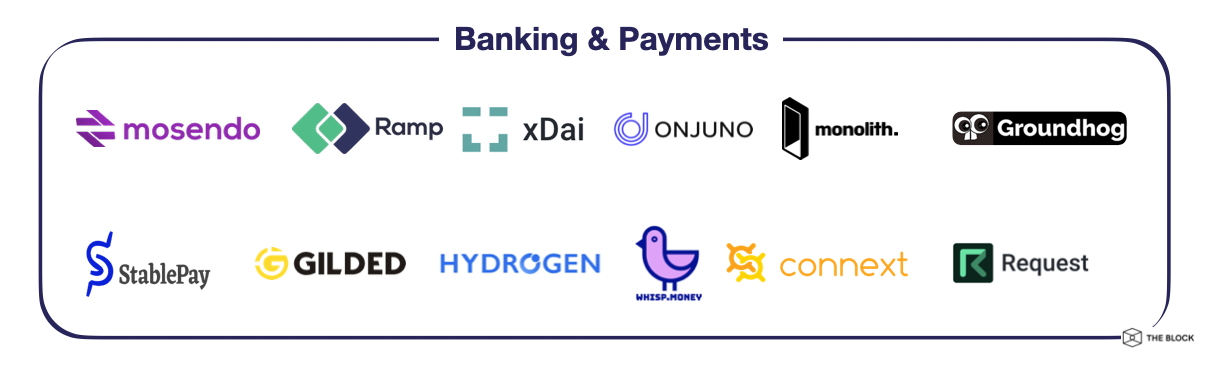
Connext — a P2P payments infrastructure.
Gilded — a platform for invoicing, payments and accounting.
Groundhog opens up the possibility for companies to manage subscriptions with recurring payments in digital assets.
Hydrogen Platform — a multifunctional fintech platform providing APIs for a range of financial products.
Juno — an Ethereum-based banking platform offering debit cards and relatively high-interest savings.
Monolith — a wallet and issuer of a crypto debit card.
Mosendo — a payments app enabling users to send each other DAI stablecoins.
Ramp Network — a payments gateway allowing users to use bank accounts and cards to easily buy Ethereum and DAI stablecoin.
Request Network — a P2P payments system.
StablePay — converts payments and tips into ERC-20 tokens into DAI to avoid volatility risks.
Whisp — an automated payroll service.
xDai — a low-fee stablecoin payments system built on the xDai network.
Lending


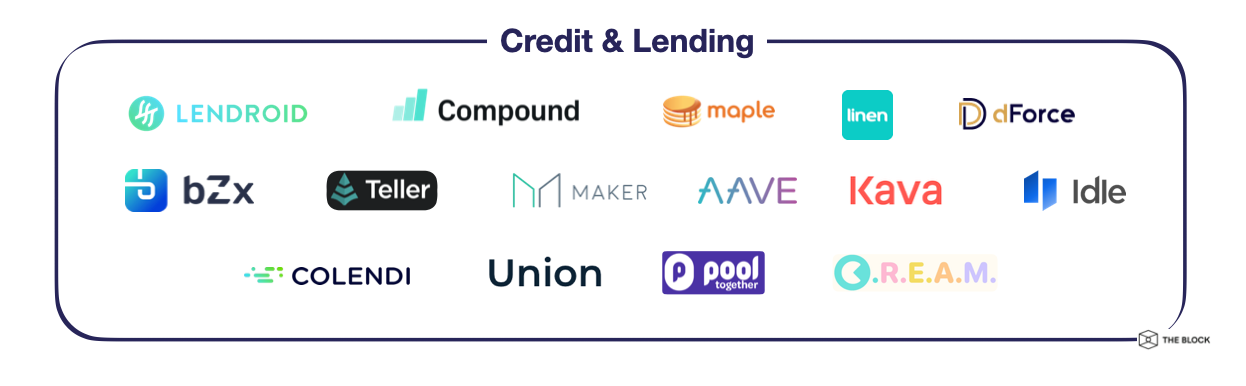
Aave — a protocol that lets users earn on deposits and borrow digital assets.
Atomic Loans — a service permitting borrowers to obtain funds with Bitcoin as collateral.
Bella Protocol — a suite of DeFi products including a “one-click savings account,” a lending protocol and a yield-farming automation tool.
bZx — a lending protocol on which the Fulcrum lending and trading platform and Torque fixed-rate loan service are built.
Colendi — decentralized credit scoring and microfinance.
Compound — an open-source Ethereum market protocol enabling users to borrow and deposit crypto assets. Read more about the project via the link.
Cream.finance — a Compound-based project that also supports lower- and mid-liquidity tokens.
dForce — a lending DeFi project from Asian developers.
Kava — a lending DeFi platform where users can earn interest on deposited crypto assets.
Lendroid — a non-custodial lending platform. Developers plan to add support for collectible assets.
Linen App — a wallet with access to lending DeFi protocols.
Maker — a decentralized lending platform. The central element is the Collateralized Debt Positions (CDPs) — smart contracts that mint the DAI stablecoin.
Maple Finance — an integrated application with Compound, enabling users to invest in collateralised crypto-backed bonds.
Pool Together — an Ethereum app that pools user funds. Interest accrues on these assets, and once a week a distribution of accrued interest is drawn among participants.
Teller — a DeFi protocol offering unsecured loans. A borrower rating is built from banking and other data, and loan terms are set accordingly.
Union Protocol — a service positioned as a debt union in the form of a DAO. Users place DAI in a common pool. Risk profiles and collateral factors are defined for participants. Funds from the pool are lent via the Compound protocol, and rewards are distributed among participants.
DAOs


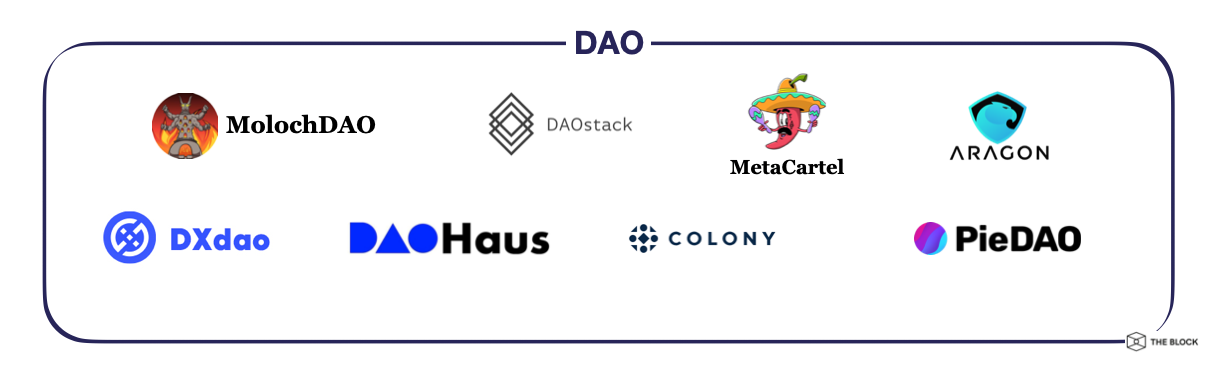
Aragon — an open-source project enabling creation and governance of decentralized autonomous organisations and communities.
Colony — a blockchain platform for collaborative, community-based companies.
Daohaus — a platform where users can build and join various DAOs.
DAOstack — a framework for collective work and decentralized governance.
DXDao — a DAO that develops, grows and governs DeFi products.
MetaCartel — a decentralized autonomous organisation funding Ethereum apps.
MolochDAO — a DAO whose members vote on proposals for Ethereum development.
PieDAO — a DAO specialising in diverse asset diversification strategies.
Derivatives


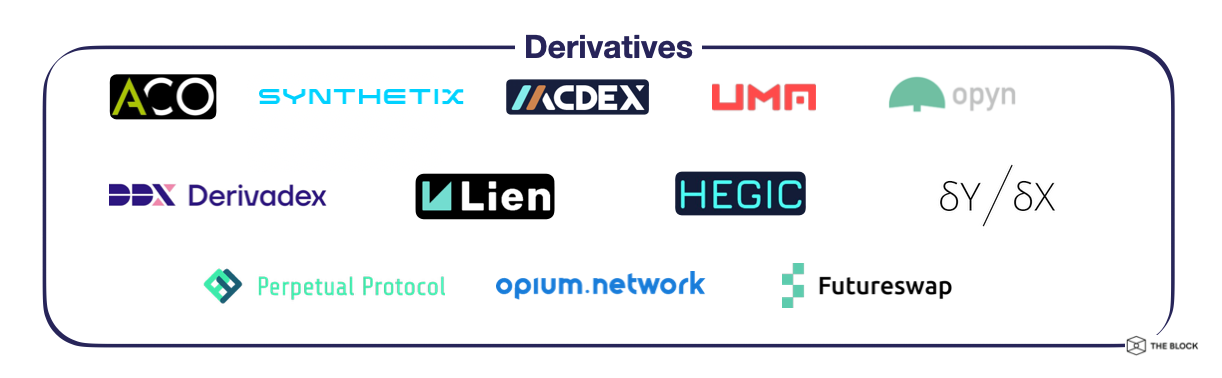
ACO — a decentralized options protocol. Users can trade, issue and exercise call and put options.
DerivaDEX — a decentralized derivative exchange built on Ethereum. It offers leveraged trading and perpetual swaps on Bitcoin and Ethereum, with margin and contract execution settled in USDT.
dYdX — an open-source protocol supporting margin trading of derivatives and a lending function.
Futureswap — a decentralized futures exchange offering up to 20x leverage on perpetual swaps based on ERC-20 tokens.
Hegic — an on-chain options protocol on Ethereum.
McDEX — a non-custodial derivatives exchange.
Opium Protocol — a protocol for creating, executing and trading derivatives instruments.
Opyn — an Ethereum options platform enabling hedging for DeFi protocol risks.
Perpetual Protocol — a decentralized perpetual contracts protocol using a virtual automated market maker mechanism.
Synthetix — an Ethereum platform for trading synthetic assets.
UMA — a kind of constructor for financial contracts.
Exchanges


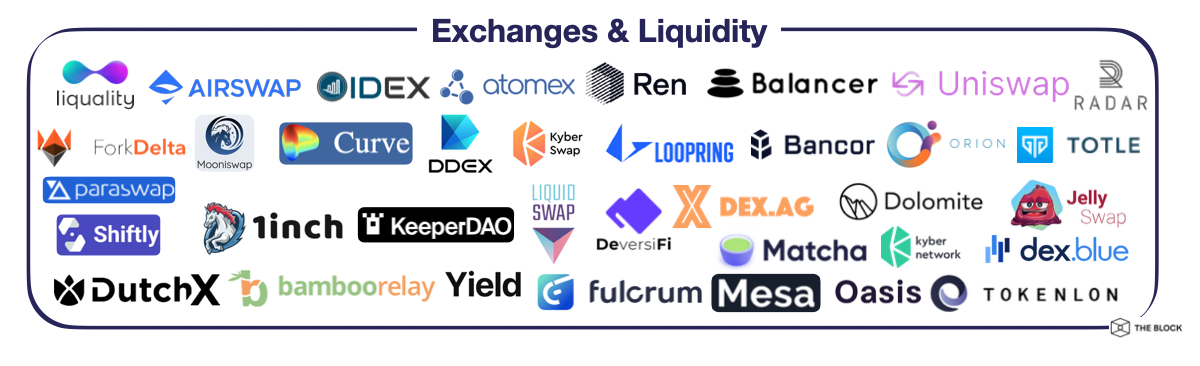
1inch.exchange — a decentralized exchange aggregator. It splits a trading order among multiple non-custodial platforms to minimise slippage and ensure the best possible price for the user.
Airswap — a P2P platform for buying and selling assets on Ethereum.
Atomex — a crypto wallet with an integrated hybrid exchange supporting atomic swaps.
Balancer — an automated market maker protocol. Users can swap ERC20 tokens using the service’s liquidity pools.
Bamboo Relay — a lending and trading service for ERC20 tokens built on the bzx and 0x protocols.
Bancor — a platform of decentralized liquidity pools enabling token exchange.
Curve — an automated market maker platform for trading stablecoins and “Bitcoin on Ethereum.”
DDEX — a decentralized exchange with up to 5x leverage.
DeversiFi — a decentralized Ethereum platform supporting spot and margin trading.
Dex.AG — a decentralized exchange aggregator.
dex.blue — a trading platform integrated with Uniswap, Kyber and Oasis.
Dolomite — a decentralized exchange and portfolio-management service built on the Loopring protocol.
Fairdex — a decentralized platform using a Dutch auction system.
ForkDelta — a non-custodial exchange for Ethereum tokens.
Fulcrum — a crypto platform supporting margin trading and lending.
Idex — a non-custodial Ethereum exchange.
JellySwap — a P2P trading service supporting atomic swaps.
KeeperDAO — a “underwriter of on‑chain liquidity for DeFi.” The platform enables arbitrage through management of liquidations and rebalancing within DeFi apps.
Kyberswap — a non-custodial trading platform for ERC-20 tokens.
Liquality — an atomic-swap protocol allowing Bitcoin and Ethereum holders to exchange assets trustlessly.
LiquidSwap — a liquidity aggregator from decentralized exchanges.
Loopring — a payments and DEX protocol with zkRollup technology.
Matcha — a trading platform that uses smart order routing.
Mesa — a Gnosis-based decentralized exchange.
Mooniswap — an automated market maker with a decentralized token exchange.
Oasis — a MakerDAO platform where users can borrow and deposit tokens and trade them.
Orion Protocol — a liquidity aggregator mixing DEX and centralized exchanges. Developers plan to build a lending product, price oracles and a decentralized high‑leverage trading platform.
Paradex — a non-custodial trading platform using 0x technology.
ParaSwap — a DEX aggregator.
Radar Relay — a decentralized platform enabling crypto-asset trades, long and short positions with leverage and the deposit of ETH, USDC and DAI for interest.
Ren — a protocol connecting Ethereum with other major blockchains, including Bitcoin, Bitcoin Cash and Zcash. The platform supports multi‑sign lending and cross‑chain trading at high volumes.
Shiftly.Finance — a DEX aggregator for trading Ethereum tokens.
SushiSwap — a protocol marketed as the “evolution of Uniswap.”
Tokenlon — a platform for exchanging ERC-20 tokens using 0x technology.
Totle Swap — a DeFi aggregator that pools liquidity from DEXs and synthetic‑asset platforms to find the best price for a given order.
Uniswap — a decentralized Ethereum-based asset exchange using an automated market maker model.
Yield Protocol — an on‑chain lending protocol that uses yTokens as a form of zero‑coupon bonds.
Infrastructure


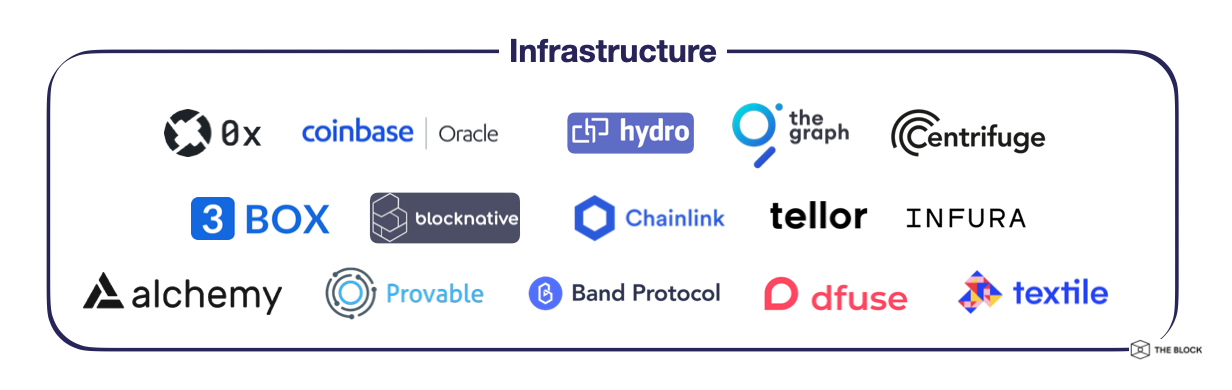
0x — API for decentralized exchanges used by many projects for peer-to-peer Ethereum-token operations.
3Box — decentralized cloud storage that manages user data.
Alchemy — a platform for developers offering tools to build and grow blockchain infrastructure.
Band Protocol — a decentralized data-oracles platform. The protocol delivers off-chain data to DeFi smart contracts.
Blocknative — a platform that tracks activity in mempools of Bitcoin and Ethereum.
Chainlink — a decentralized network of oracles.
Coinbase Oracle — a feed of quotes for DeFi protocols.
dfuse — an open‑source platform providing developers with infrastructure to work with blockchain data.
Hydro Protocol — a framework for building decentralized exchanges.
Infura — an Ethereum infrastructure provider enabling developers to use DApps without running a node themselves.
Provable — a blockchain‑oracles service for DApps.
Tellor — decentralized oracles for DeFi.
Textile — open‑source tools for working with decentralized databases and IPFS-based storage.
The Graph — a blockchain data indexing protocol.
Insurance


Etherisc — a decentralized insurance protocol. Users can collaborate to create their own insurance products.
Nexus Mutual — a decentralized protocol offering coverage for smart contracts on Ethereum.
VouchForMe — a P2P insurance platform using a “social proof” model to assess liquidity and solvency.
Marketplace


District0x — a network of decentralized communities and marketplaces on Ethereum.
Opensea — a marketplace for digital collectibles in the form of NFT tokens.
Origin Protocol — a protocol for creating blockchain marketplaces on Ethereum and IPFS.
SuperRare — a marketplace for digital artworks.
Prediction Markets


Augur — a decentralized prediction market protocol on Ethereum.
Omen.eth — a prediction-market protocol created by the Gnosis team.
Polymarket — a prediction market where users can bet on the outcomes of various events.
Tokenised Bitcoins


Huobi BTC — a tokenised version of Bitcoin on the Ethereum blockchain, developed and controlled by the Huobi exchange.
imBTC — an Ethereum token pegged to Bitcoin, issued by Tokenlon.
PBTC — the ERC-20 version of Bitcoin, part of the pTokens project from Provable.
renBTC — another Bitcoin-on-Ethereum project.
sBTC — the synthetic Bitcoin replica from the DeFi platform Synthetix.
tBTC — a Bitcoin-pegged Ethereum token developed by KEEP Network.
WBTC — an Ethereum token pegged to Bitcoin. Its issuance is controlled by the crypto custodian BitGo, with Kyber and Ren also involved.
Subscribe to ForkLog news on Telegram: ForkLog FEED — the full news stream, ForkLog — the most important news and polls.