



According to analysts at Messari, decentralised physical infrastructure networks (DePIN) were among the strongest performers in the blockchain economy in 2024. Adding more than 130% to their market capitalisation over the year, the segment drew investor attention thanks to new avenues focused on efficient use of energy resources.
Helium Mobile, the flagship DePIN wireless coverage network, continues to grow its user base and is partnering with leading telecoms. New global projects have proved their practical utility. The startup Glow has installed 70 solar power plants from California to India, and GEODNET, the world’s largest geodetic network, has been deployed in 140 countries.
This article outlines the path DePIN took in 2024 and the prospects that await it, based on Messari’s annual Crypto Theses report.
From forecasts to facts—and fresh forecasts
In 2024 DePIN demonstrated its usefulness through record funding, industry partnerships and success across energy, wireless and data. The networks became a key driver of real-world blockchain adoption.
Although DePIN entered 2024 with limited revenue, the picture has since changed. Several protocols reached seven- and even eight-figure sums, showing early signs of growing demand. According to Messari, some projects posted notable results:
- Glow’s revenue exceeded $25 million;
- Helium and IO.net each generated more than $12 million;
- Filecoin ($8 million), Render ($4 million), Akash ($4 million) and GEODNET ($2 million) also surpassed the $1 million annual revenue mark.


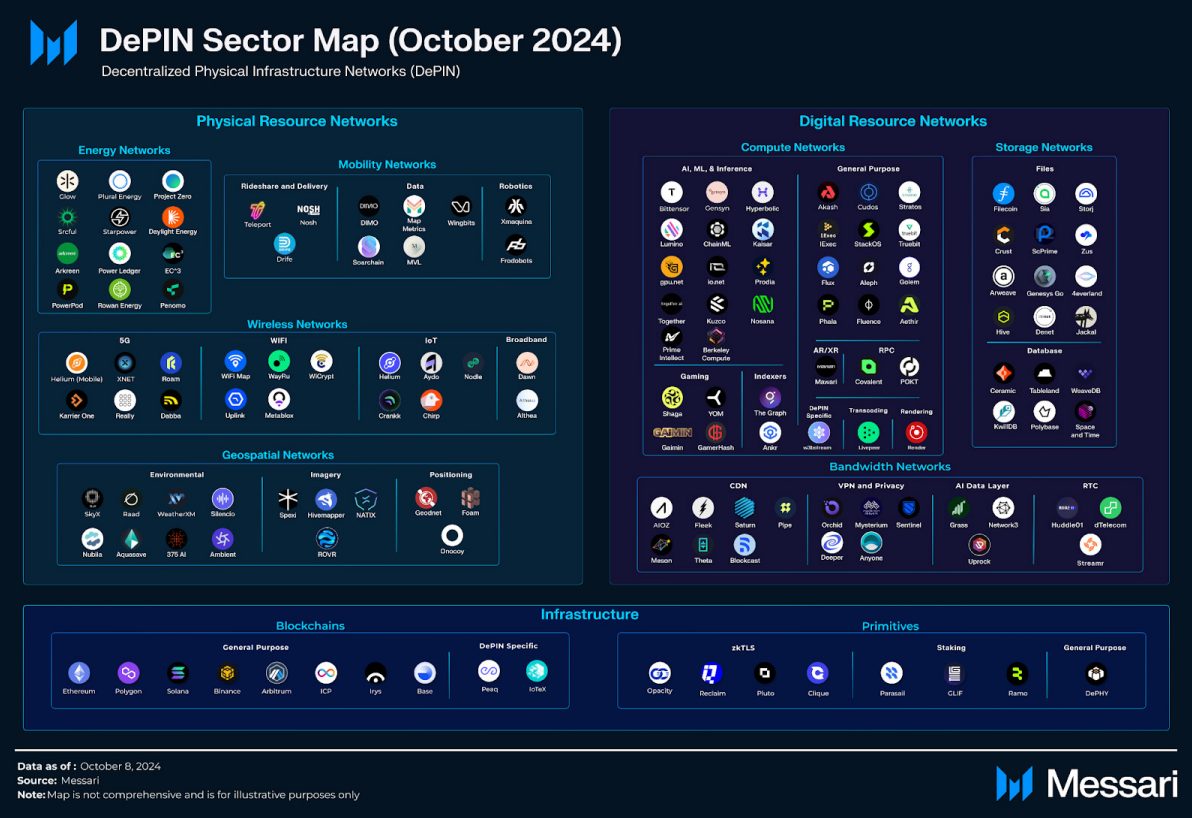
Analysts forecast that DePIN startup revenues will accelerate in 2025, exceeding $150 million. Crossing that threshold would cement the sector’s lead in real-world crypto adoption.
Among the projections is that DePIN startups could partner with major governments, potentially including the crypto-friendly administration of US president-elect Donald Trump. The new “czar” for AI and digital assets, David Sacks, has already shown interest in the sector by investing in Solana, Helium, Render and Hivemapper. Given the energy needs of generative AI and the shift to renewables, the White House is likely to consider decentralised infrastructure solutions.
In 2024 Solana became the blockchain of choice for most DePIN projects. Many protocols either migrated to this layer-1 (L1) network or were built on it from the start, such as Grass Network.

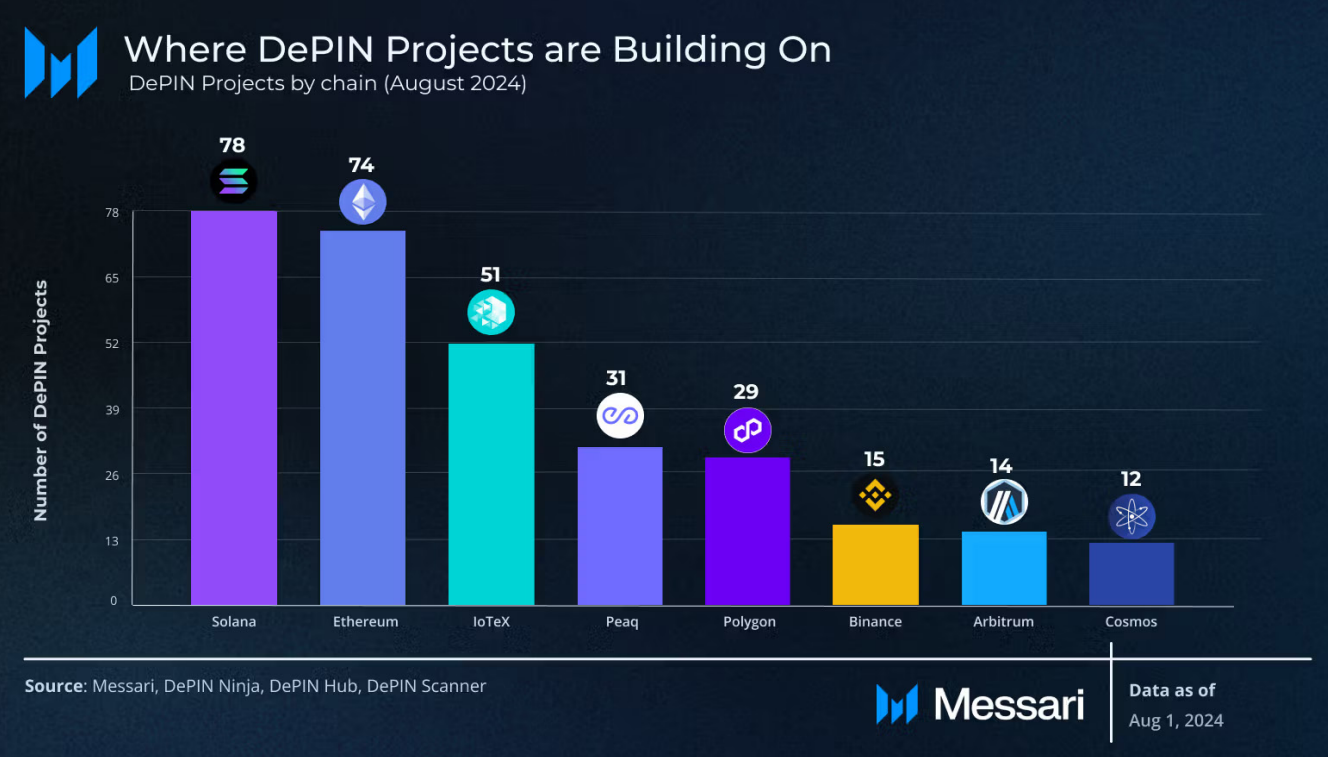
Two specialised networks, Peaq and IoTeX, also launched in 2024, offering tailored solutions that general-purpose blockchains do not always provide.
Given the segment’s priorities, DePIN developers are likely to be drawn to the Base L2. In December 2024 the makers of automotive devices DIMO announced a move to the platform, while two promising projects, Daylight and Blackbird, are being built on its network.
The two largest DePIN companies by revenue, Glow and Helium, operate in energy and wireless. With both areas offering strong potential, new protocol launches and growth of existing ones should cement their status as the most important DePIN subsectors.
Helium proves its mettle, DAWN joins the fray
Analysts expect Helium to become the most valuable DePIN by market capitalisation. Tailwinds include the expansion of the Carrier Offload programme, the growth of Helium Mobile and a simplified token model that centres on HNT.
Carrier Offload lets mobile operators use Helium’s coverage to offload traffic generated by their subscribers’ devices, improving service quality and optimising costs.
In January 2024 Helium Mobile developer Nova Labs and Telefonica announced a partnership to test the programme in Mexico. Several US carriers have since joined, and each day they offload terabytes of their subscribers’ data onto the network.
According to the project’s statistics, the service had more than 124,000 subscribers at the time of writing.

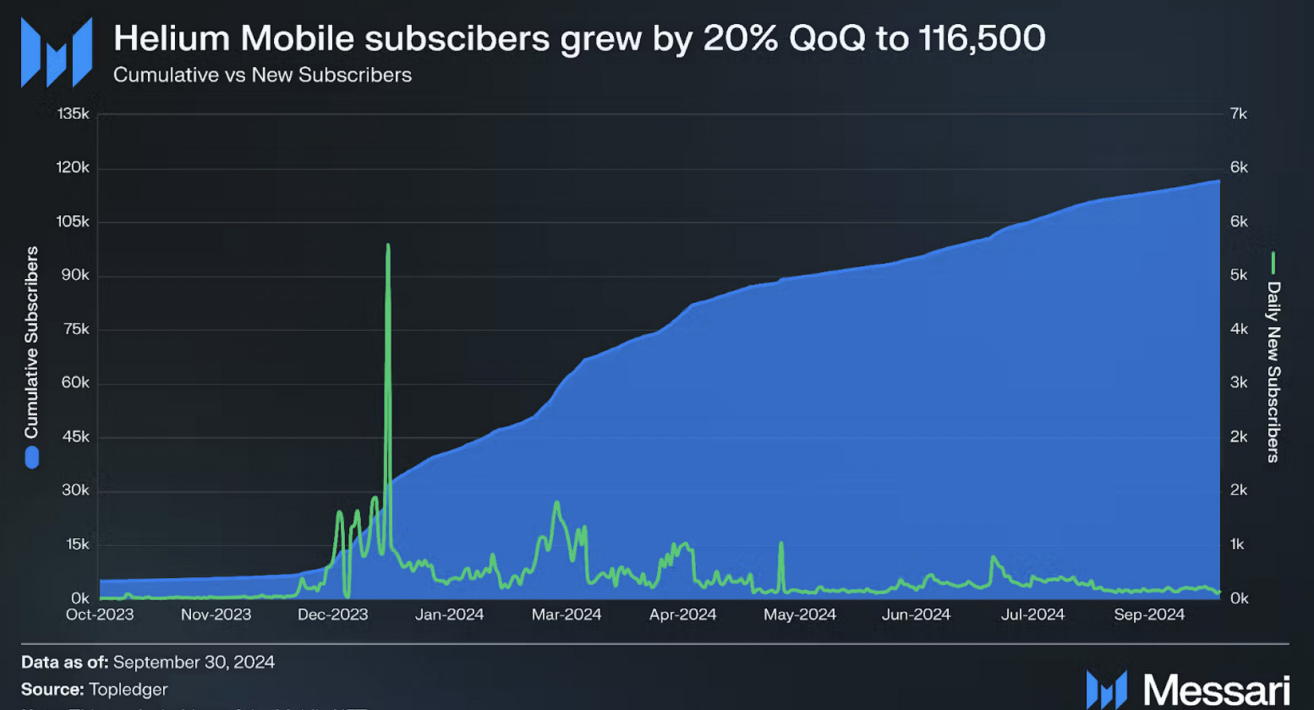
Beyond Helium, the wireless sector is seeing notable progress in wireless broadband.
DAWN was founded by Neel Chatterjee, co-founder of internet provider Andrena, which serves customers in more than ten US states. In August 2024 the startup focused on decentralised wireless networks raised $18 million in a round led by Dragonfly. In December the investor list was augmented by a $2.5 million injection from VanEck.
The protocol aims to deliver multi-gigabit internet access at 80–90% lower cost than traditional providers. The team’s vision is to shift infrastructure ownership from monopolistic providers to households, turning access into income-generating capital.
Inspired by Grass’s model, DAWN’s browser extension has been downloaded more than 1 million times.
With Helium Mobile expected to keep growing and DAWN’s mainnet due in 2025, wireless is poised to consolidate its position as DePIN’s leading subsector.
Messari projects the segment will reach nine-figure revenues in 2025, continuing to reshape how networks are connected and owned worldwide. Large-scale expansion of Carrier Offload programmes is expected as major telecoms grow more comfortable with the DePIN model.
Projects like Helium are forecast to integrate with satellite broadband systems such as Starlink. The approach would offer a scalable way to connect remote rural areas by using several of Elon Musk’s constellation nodes for backhaul, while low-cost wireless antennas extend coverage locally.
Although the largest DePINs by market capitalisation in 2025 will likely remain in storage and computing, the fastest growth and adoption are set to come in energy and wireless. Leading startups are launching mainnets or exiting beta, opening the door to meaningful expansion in 2025.
DePIN distribute energy and help farmers
In 2024 energy emerged as one of DePIN’s most promising areas, buoyed by an ~${21} trillion market and the global need to accelerate the shift to clean power.

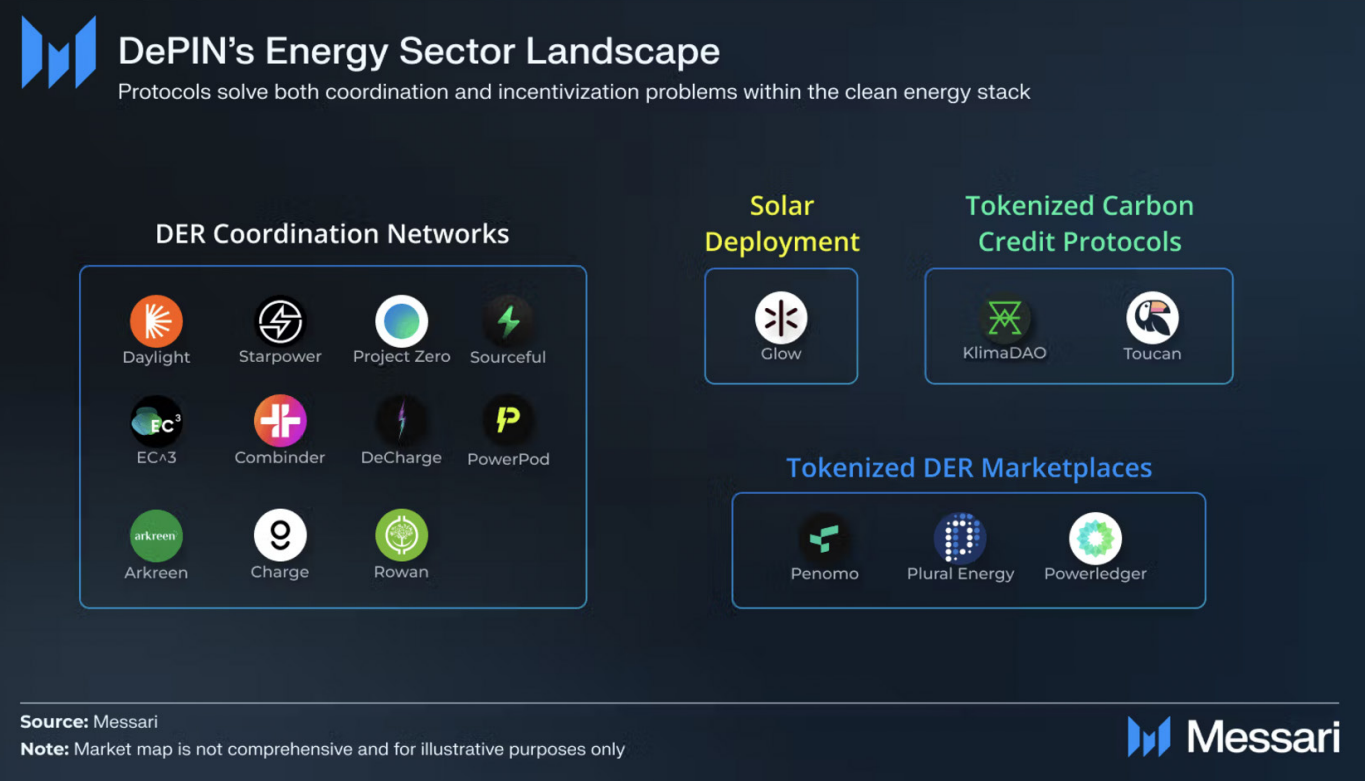
Energy-focused DePINs tackle two core tasks:
- incentivising capacity expansion. Using crypto-economic systems to speed deployment of solar panels and other distributed energy resources (DER);
- building a coordination layer for DER. Aggregating and linking DER into virtual power plants (VPP) and demand response programmes (DRP) to deliver better grid services such as load balancing and blackout prevention.

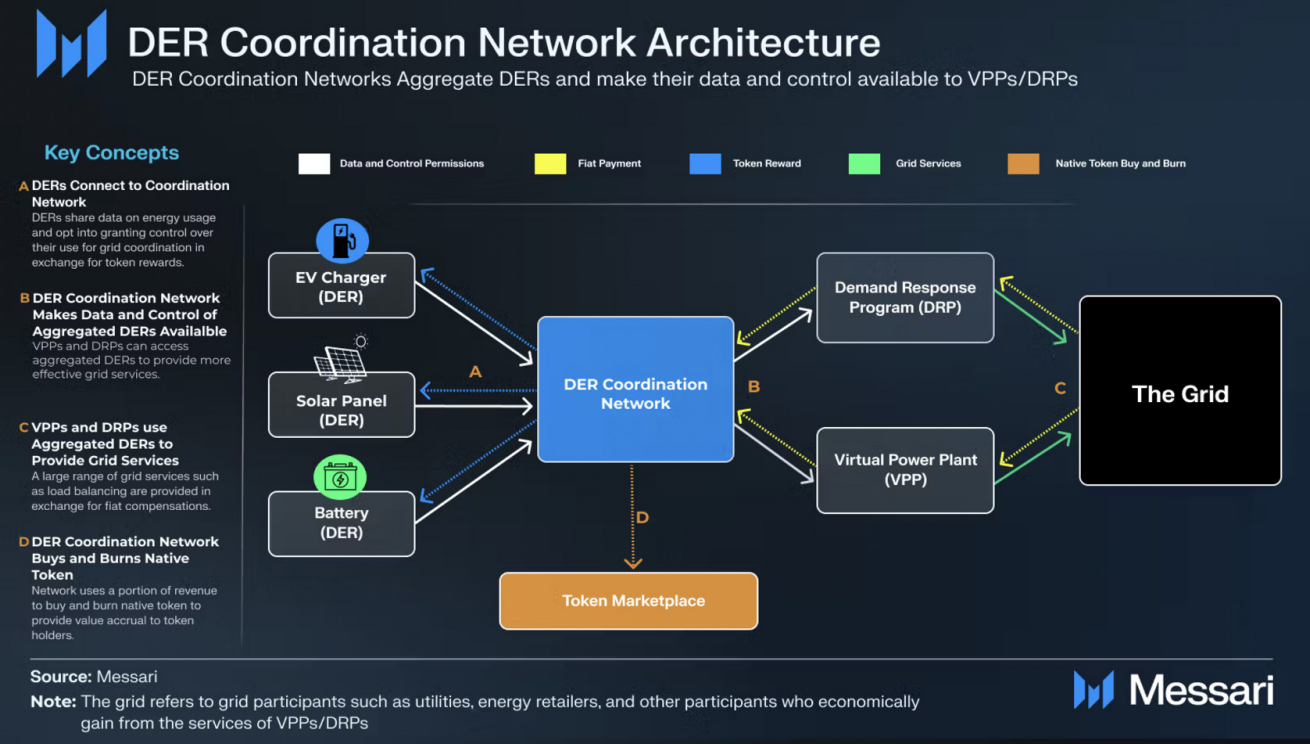
Glow leads the sector in venture funding. According to CryptoRank, the startup has raised $30 million. It also outpaced many on revenue, earning more than $25 million in 2024.
CEO and co-founder David Vorick said Glow helps solar farms by covering their upfront costs with funds from crypto or private investors. Each plant later must contribute its electricity revenue to a common pool.
The project periodically audits electricity production. Each farm’s owners receive USDC for generating carbon credits, which are purchased using the project’s native GLW token.
Messari believes that, as megawatt-scale solar plants roll out across India and beyond, Glow’s 2025 revenue could reach into the hundreds of millions of dollars.
Other distributed-energy projects showing strong results include:
- Daylight Energy, which is growing monthly users at about 400%, with an average of four successful referrals per user;
- Project Zero, integrated with UK energy firm Fuse and preparing to expand into Ireland, Spain, Eastern Europe and Australia;
- Starpower Energy, which has connected more than 13,000 DER devices worldwide. Plans for next year include distributing batteries and EV chargers to build a powerful hardware-centric coordination network.
In environmental data collection, GEODNET has pulled off an economic feat. In under two years the startup built the world’s largest RTK network, with more than 11,000 stations globally. By comparison, the second-largest network, run by the centralised corporation Trimble, comprises just 5,000 stations built over three decades.
The technology eliminates critical GPS positioning errors. While GNSS satellites often err by 3–6 metres in determining true position, RTK stations intercept these signals and correct them, reaching accuracy of up to 1 cm.

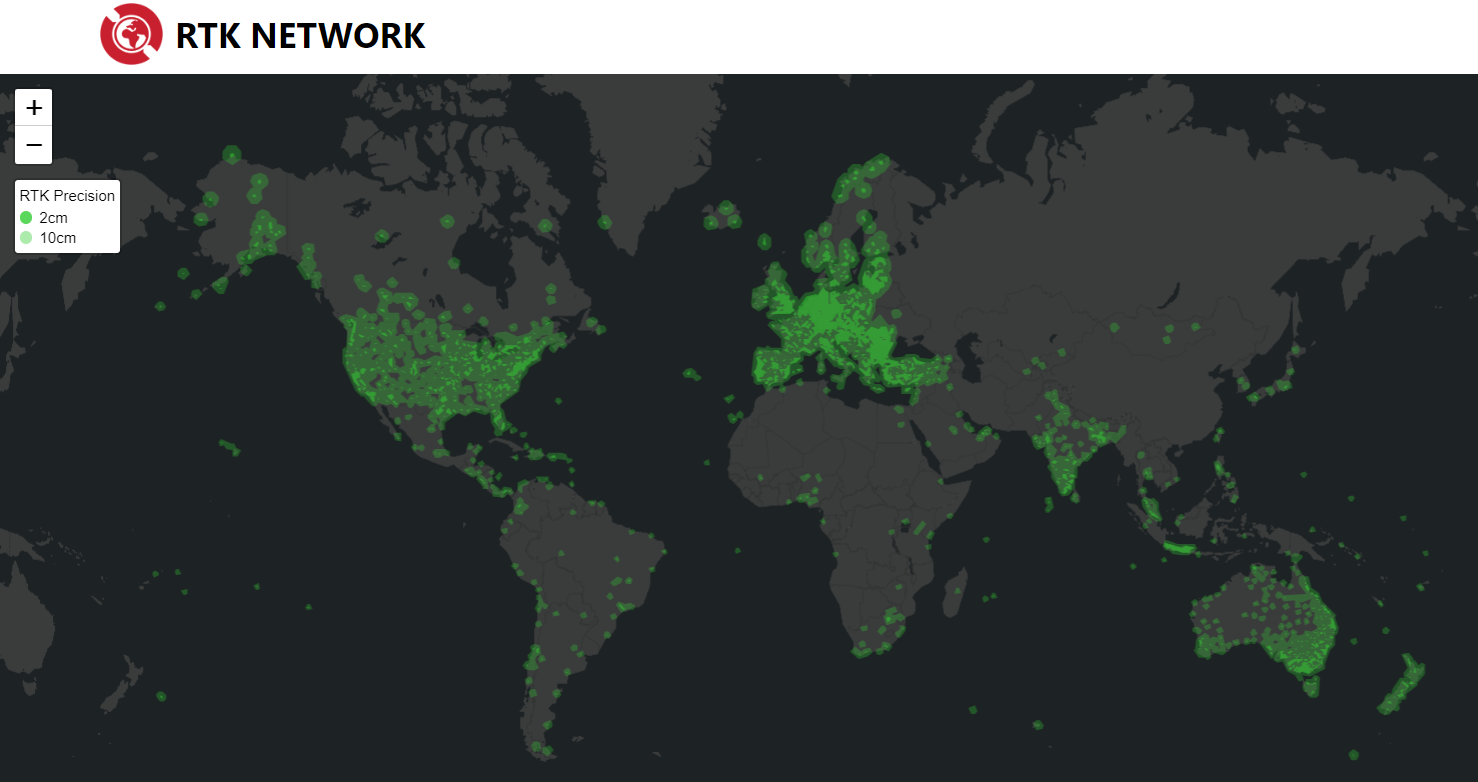
In summer 2024 the US Department of Agriculture reached an agreement to provide terrain data to American farmers.

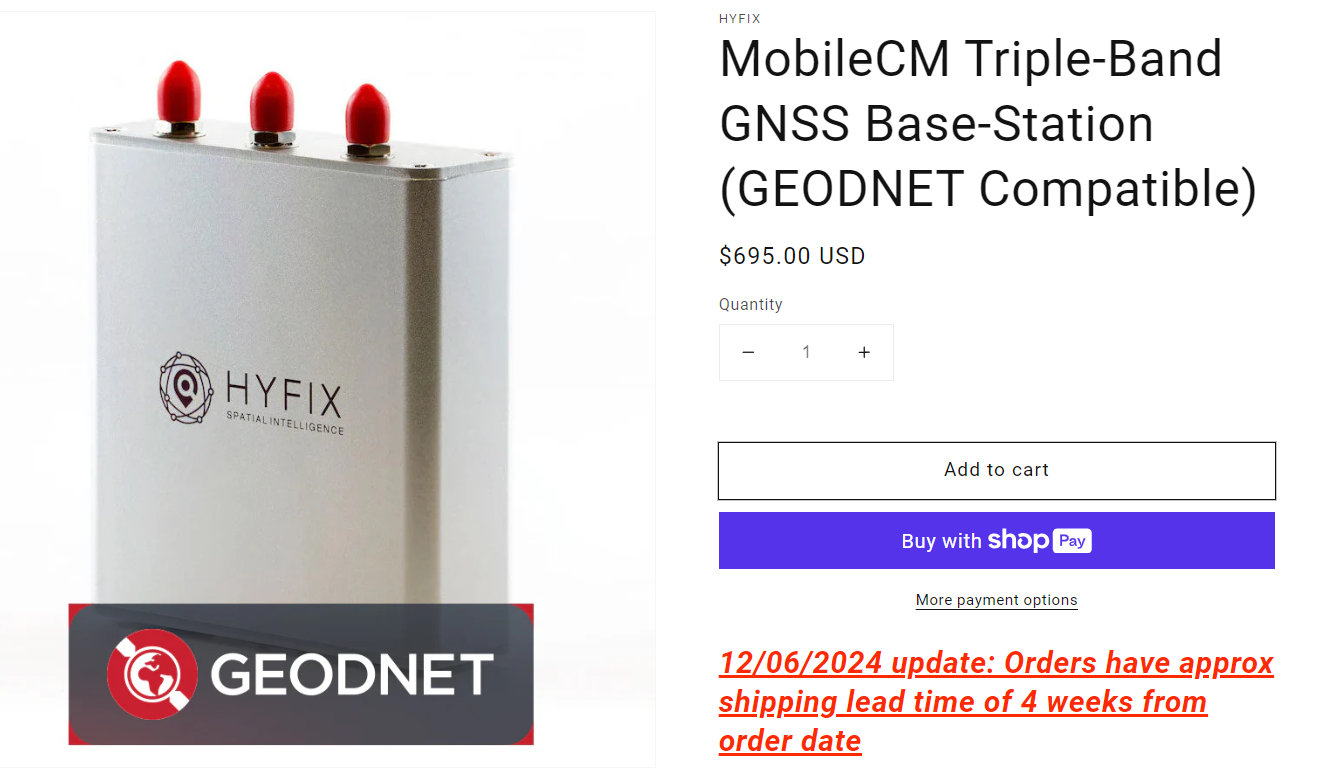
GEODNET’s success is translating into meaningful finances. The network generates more than $1.6 million in annual revenue, with 80% of profits directed to buying back and burning the native GEOD token—creating direct value for holders.
Advantages of the DePIN model in this subsector include:
- crowdsourcing. Property owners host infrastructure, eliminating costly leases. Each RTK station costs about $700, funded by the user;
- no operating expense. Infrastructure owners bear maintenance costs, minimising ongoing spend for the network;
- blockchain efficiency. Blockchains and smart contracts automate global payment distribution, sidestepping fiat frictions.
Messari expects more networks of this kind. By end-2025 they could provide 9% to 100% coverage for priority regions in the EU and North America, with projected revenue above $10 million.
Conclusions
Even this brief survey suggests DePIN is meeting investor expectations and fulfilling crypto-enthusiasts’ ambitions. After strong gains in 2024, the segment has laid the groundwork for a wave of breakthrough applications and use cases in 2025.
Messari’s report highlights the following trends for DePIN:
- heightened investor attention. Traditional industries will start to notice DePIN’s potential to solve long-standing problems with innovative decentralised approaches;
- academic interest. Researchers and opinion leaders will explore its economic, technological and social implications;
- media focus. Real-world success stories will spur public debate about DePIN’s transformational potential.
By uniquely combining blockchain technology with real-world infrastructure, DePIN is set to entrench itself as a cornerstone of Web3 innovation.