



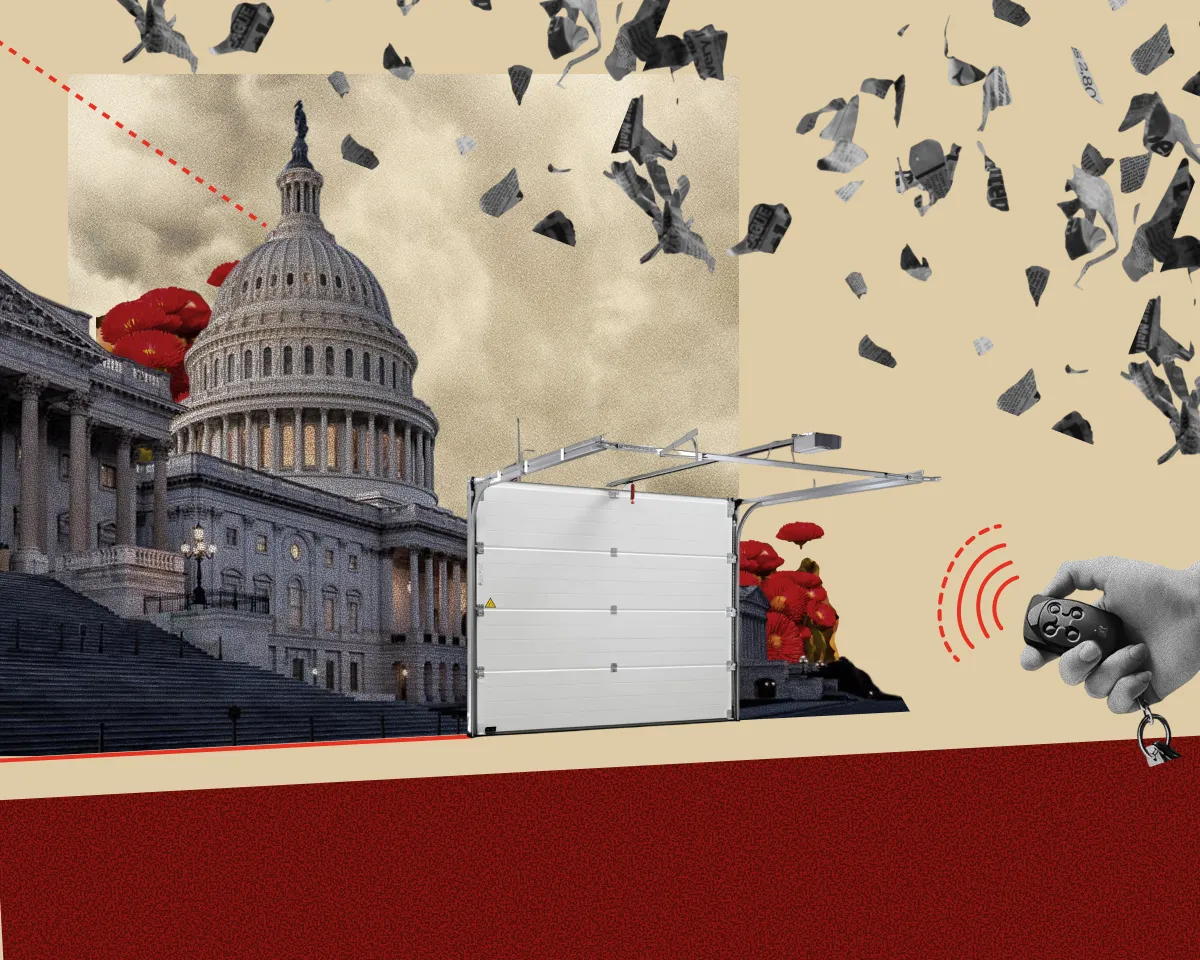
Shuttered public spaces, mass flight cancellations and a freeze on social programmes. Add to that a blackout of critical economic statistics, a hole in cybersecurity and a blow to small business.
A look at America’s longest government shutdown.
Hostages to causes
From October 1, 2025, about 1.5m US civil servants were sent on unpaid leave. Workers in critical infrastructure, such as air-traffic controllers, were forced to work without pay.
For more than a month lawmakers could not agree on funding government agencies. Republicans refused to budge on scrapping cuts to the Medicaid programme and on extending health-insurance tax credits that expire at the end of the year.
Senate majority leader John Thune, in exchange for ending the shutdown, promised Democrats a December vote on extending the subsidies. The deal also provides for staff to return to work and be paid back wages.
On November 10 senators reached a bipartisan agreement that ended a 43-day government stoppage. On November 12, after approval by the House of Representatives, US president Donald Trump signed the bill. It funds government bodies until January 30, 2026 and allows federal agencies to resume work immediately.
The previous record came during Trump’s first presidential term, when a 35-day pause in government operations ended in January 2019.
According to the New York Times, since the start of the 2025 shutdown about 700,000 federal employees worked without pay and more than 600,000 stayed home until funding was restored.


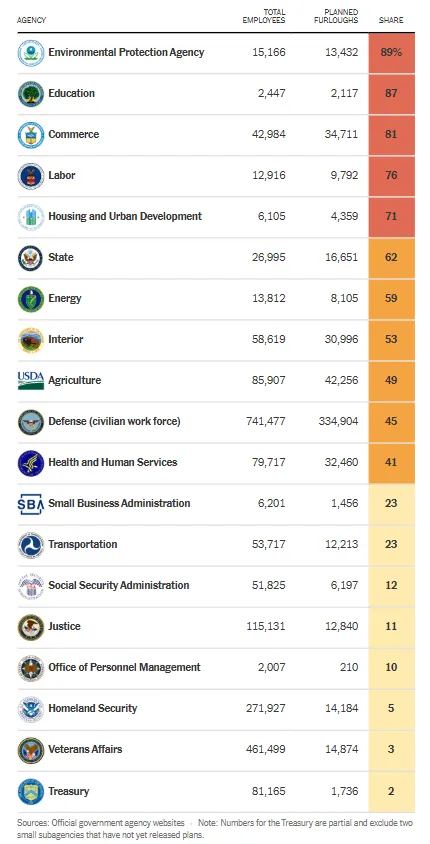
The newspaper’s infographic shows that the deepest furloughs fell across five areas, freezing 71% to 89% of staff: environmental protection, education, commerce, labour and housing.
In early October the Trump administration sent about 4,000 layoff notices to at least seven major federal agencies. A federal judge temporarily blocked them, pausing the proposed measures.
Before the shutdown each department identified the number of “essential” workers who would have to keep working if the government stopped.
Trump nonetheless reallocated billions of dollars to pay salaries for certain categories of federal employees. They included:
- active-duty military personnel;
- federal law-enforcement officers;
- immigration-enforcement agents.
In earlier episodes these groups kept working through the shutdowns but received delayed pay after funding resumed.
The state of play
National parks were closed, federal research halted and programme funding ran dry — such were the consequences of the protracted shutdown.
The Congressional Budget Office (CBO) reported that six weeks without consensus in government could cost the US about $14bn and cut fourth-quarter GDP by up to 2%.
CBO analysts estimated the economy would be hit by delays in federal spending on employee pay, goods and services, as well as food vouchers for low-income Americans.
Some 42m Americans rely on the federal Supplemental Nutrition Assistance Program. November payments remained in limbo until the shutdown ended.
Small business — a key slice of the economy — came under pressure. Many firms depend on government loans and federal agency contracts.
According to CBS News, the shutdown prevented the Small Business Administration from disbursing about $170m a day in loans to hundreds of small employers. As of November 5, more than 8,300 businesses had missed out on $4.5bn.
The government hires millions of contract workers for administrative, IT and other tasks. That work was halted, depriving private companies of revenue.
Grace Zwemmer, a junior economist at Oxford Economics, noted that roughly $800m in federal contracts was at risk of collapsing each week. Unofficial estimates suggest about 5.2m federal contractors were affected.
“A prolonged shutdown can significantly affect these individuals, hitting contractors’ cash flows, potentially leading to furloughs, wage cuts or layoffs, with higher risks for small-business contractors,” she told CBS News.
Tourism felt the strain too. The Federal Aviation Administration cancelled thousands of flights owing to a shortage of controllers. As of November 5, the industry was short about $5bn.
About 13,000 air-traffic controllers and 50,000 Transportation Security Administration employees continued to work unpaid.
Flying blind
Over the past month almost all official data releases were suspended.
Federal Reserve chairman Jerome Powell likened events to “driving in fog”. Sharp, significant shifts in the economy can still be seen, he said, but beyond that “it is hard to say anything with confidence”. He called statistics from private contractors insufficiently reliable.
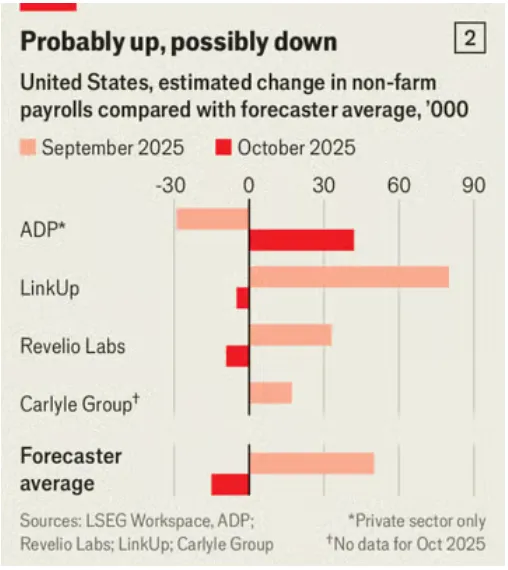
Non-farm payrolls are the data point that most move markets. ADP, a payroll-technology company, is a time-tested alternative to the US Bureau of Labor Statistics (BLS).
As noted by The Economist, at first glance its reports match the BLS, but the figures are deceptive. ADP and the BLS often revise their numbers. Their initial publications line up poorly: only 50% for three-month changes and 10% for monthly ones.
There were no employment releases for September and October at all, and the world’s financial system may never know how the US labour market really moved in that period.

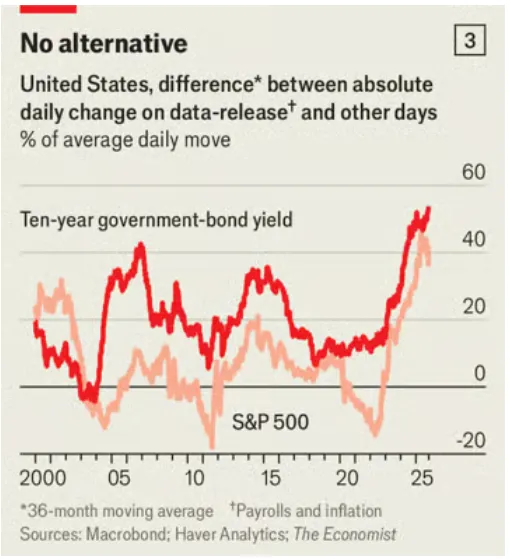
The importance of official statistics shows up in market reactions. Derek Lemoine of the University of Arizona found that, after official releases, expected market volatility declines — investors find them clarifying. The Economist’s rough estimate suggests markets’ sensitivity to official data has risen substantially in recent years.

A digital shutdown
Staff shortages in cybersecurity during the shutdown opened loopholes for attacks on the US government.
On November 6 CBO said it had recently suffered a hack and had taken steps to contain it. According to The Washington Post, a “presumably foreign actor” was behind the incident.
CBO spokeswoman Caitlin Emma told Wired the agency “implemented additional monitoring tools and new security measures to better protect its systems” and that it “periodically faces threats to its network and continuously monitors them”.
Cybersecurity researcher Safi Modjidi said that “many federal digital systems continue to run in the cloud even during a shutdown, though offices are empty”.
“If everything is configured correctly, the cloud provides a baseline level of security. But it is hard to stay calm, knowing that even in the best of times there are problems with cybersecurity,” the specialist noted.
For a prolonged period federal technical specialists have faced layoffs, including at the Cybersecurity and Infrastructure Security Agency (CISA), potentially weakening the coordination of the government’s digital defence. During the shutdown CISA did not halt staff cuts.
Agency spokeswoman Marci McCarthy told Wired that “CISA continues to carry out its mission”, but did not answer specific questions about how the shutdown affected their work and the protection of other bodies’ digital systems, and put the blame on Democrats.
The government’s shift to cloud technology over the past decade, along with greater attention to cybersecurity, has provided some resilience to disruption. But tasks missed during the shutdown will create a serious recovery “debt” that will be hard to clear once work resumes.
“It only makes things worse and adds work in the future, because later you still have to catch up,” a former NSA employee told Wired, requesting anonymity.
He said remaining staff were handling only the most critical tasks.
All quiet on this front
The end of the shutdown marked the immediate resumption of the SEC and the CFTC. With official economic data returning, volatility in digital-asset markets is expected to rise.
Reviews of applications to launch spot altcoin-ETF and the signing of cryptocurrency bills are likely to accelerate.
Although the GENIUS Act passed in July 2025, progress on the Clarity Act, which would structure the digital-asset market, has stalled.
Many members of Congress and industry representatives had hoped the bill, designed to delineate powers between the SEC and CFTC, would pass by year-end. Its approval is now in doubt.
Trump’s pride — and the jewel of his campaign — the tamed bitcoin — weathered the shutdown relatively calmly.
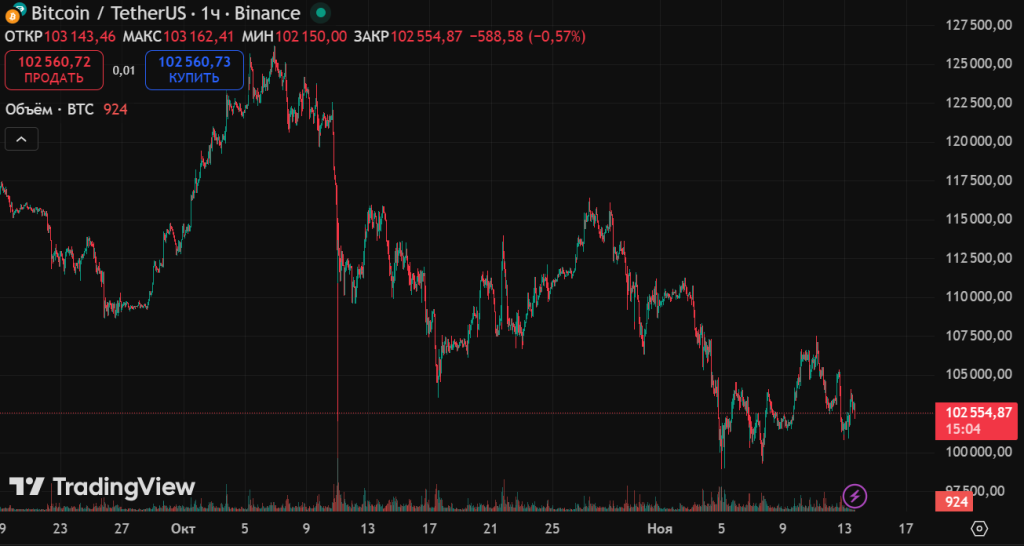
Digital gold did not experience severe stress at the outset of the government pause. On October 1 the price, on the contrary, rose by more than 10%, reaching $126,000. That again vividly demonstrates the asset’s reserve nature. Previously, in almost all bouts of global turmoil, bitcoin rose in price — for example, during the pandemic.
The crypto market’s reaction to the end of the shutdown proved restrained. Over the past 24 hours bitcoin added about 0.6%. At the time of writing the asset trades at $102,437.


In time, the political instability that caused the crisis may strengthen the ideological appeal of decentralised assets. Bitcoin arose as a response to distrust of centralised monetary systems, and periods of state crisis traditionally increase interest in it as insurance.