




The volume of illicit crypto assets laundered using cross-chain operations reached a record $7bn over the year, according to Elliptic’s report.
Analysts categorize this criminal activity into three categories:
- decentralized exchanges that enable swapping cryptocurrencies, including within a single blockchain;
- cross-chain bridges, through which coins move between networks;
- crypto-exchange services that do not comply with KYC rules.
In Elliptic’s first report, “State of Cross-Chain Crime,” published in October 2022, analysts counted $4.1bn laundered through these channels. They estimated the figure would reach $6.5bn by the end of 2023.
“However, our latest calculations of $7bn show that cross-chain crime is growing faster than forecast,” the analysts noted.
In their view, the popularity of laundering funds by this method is linked to:
- the shift of criminal activity from Bitcoin to other coins with attractive properties such as privacy (Monero) or stable value (stablecoins such as USDT, DAI, etc.);
- generating illicit proceeds in tokens other than digital gold, for example as a result of hacks of DeFi protocols;
- the absence of verification at cross-chain services, unlike centralized platforms;
- a lack of analytic tools that reliably track cross-chain transactions;
- enforcement actions against mixers and exchanges that do not comply with KYC rules, prompting the search for alternatives.


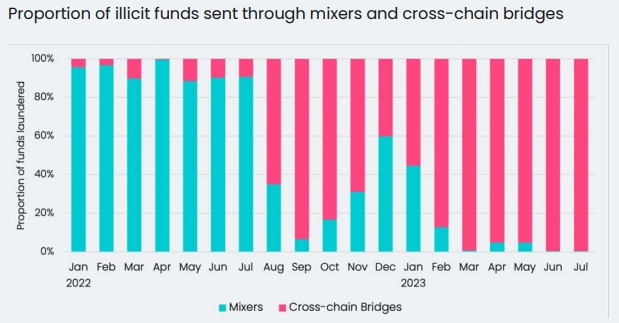
Only through decentralized exchanges did criminals launder $3.9bn in the 12 months to July 2023. The figure was up 82% from the previous period.

By asset provenance, volumes of cross-chain illicit operations rose significantly in the Ponzi-scheme and theft segments.
Linked to the Lazarus Group, the hacker group, $900m — about one-seventh of the total sum.
From January to August Web3-industry lost about $1.25bn due to hackers and scammers, according to Immunefi.
September proved to be the costliest month of the year, with losses of $329.8m, according to CertiK.