




The surge in users and the expansion of the gas limit have led to the ‘bloating’ of the Ethereum blockchain, adversely affecting node operations. The Ethereum Foundation (EF) warned of this issue, proposing several potential solutions.
The protocol’s state encompasses all data stored on the network. Node operators must download this data set to track transaction history and other information necessary for block verification.


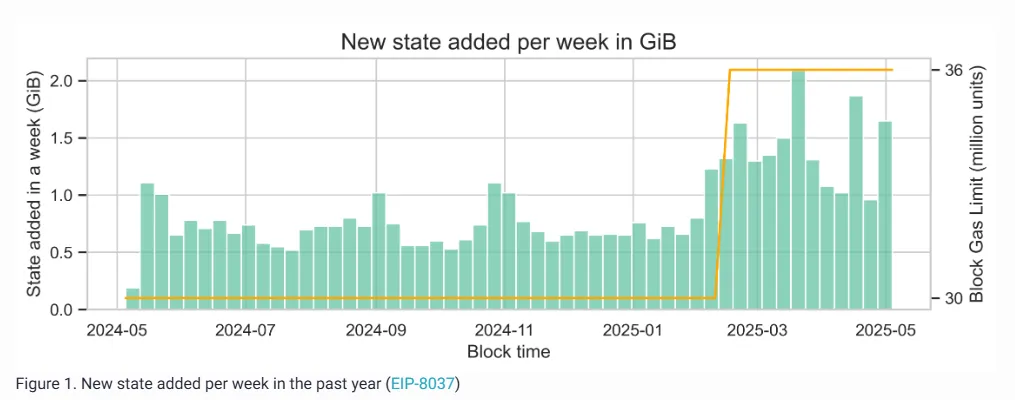
As data accumulates, running a full node becomes more costly, unreliable, and less decentralised, EF clarified. Developers highlighted specific costs:
- Validators and full nodes must store more information, increasing the database load;
- RPC providers need to maintain access to the full state for timely requests, incurring additional storage costs;
- As the state grows, network synchronisation becomes slower and less reliable.
“Increasing the gas limit accelerates state growth by allowing larger entries in a block. Other blockchains already face this issue. As state sizes increase, running a full node becomes unrealistic for ordinary users, leading to redistribution among a few large providers,” EF added.
What to Do?
Ethereum’s long-term development strategy includes a stateless concept, allowing validators to verify blocks without storing the blockchain’s full history.
While this idea reduces the load on validators and provides higher throughput, it also shifts the responsibility for data storage to a smaller, more specialised group, risking network centralisation.
The EF team proposed three potential approaches to address the issue. The first method, State Expiry, removes inactive data, allowing it to be restored with proofs if necessary.
According to research, about 80% of the state has not changed or been used for over a year, yet all nodes still store it entirely. Developers are considering two paths:
- Data tagging, adding expiration dates, and a recovery function.
- “Multi-epoch” expiration, where the state decreases each epoch.
State Archive is the second approach. It creates “hot” and “cold” states. The first group of data remains readily accessible, while the second is stored separately for history and verification.
The final option, Partial Statelessness, allows nodes to store only “subsets” of the state, while wallets and light clients cache the necessary data. This approach will reduce storage space costs and lessen dependence on large RPC service providers.
Back in December, Ethereum co-founder Vitalik Buterin called for simplifying the network in terms of user interface.