




A new proposal for enhancing Ethereum’s privacy through a modular architecture suggests compliance with the European Union’s GDPR while maintaining decentralization principles.
New post on https://t.co/neli1nzo0Y!
A pathway for GDPR Data Management & Privacy for Ethereum
By:
— EugeReHighlights:
— Ethereum can integrate GDPR principles by managing personal data off-chain and using encryption to protect it.
— Roles in data…— ethresearchbot (@ethresearchbot) June 9, 2025
“Public blockchains like Ethereum always face the challenge of reconciling immutability and decentralization with data protection regulations. Transitioning to a modular architecture, enhanced by privacy-preserving technologies, offers a way to embed GDPR principles into the protocol itself,” stated the proposal’s author and community member Eugenio Reggianini.
He believes that by moving personal data to the periphery (wallets and dapps), using off-chain storage with metadata deletion, and cryptographically separating roles, GDPR controller responsibilities can be concentrated on a small set of entities, while the broader network becomes “merely an executor or falls outside the sphere of influence.”


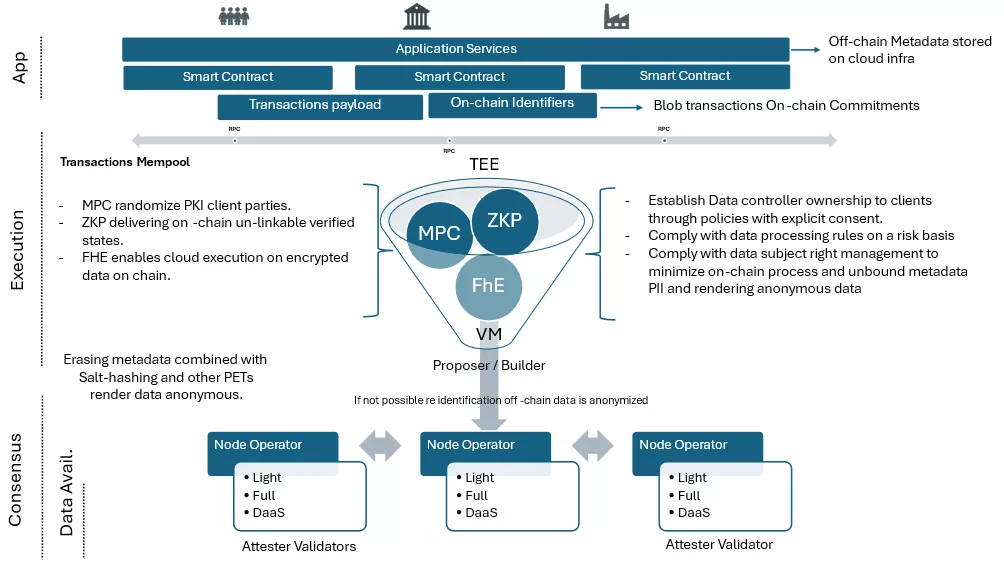
The main goal is to delegate information management to relevant application-level entities that decide to process personal data, noted Reggianini. Meanwhile, the lower-level infrastructure (execution and consensus clients) will handle only anonymous or at least pseudonymous data.
“Essentially, personal data should be transformed or abstracted before reaching the blockchain execution level, and certainly before spreading through the consensus layer,” added the initiative’s author.
He argues that Ethereum’s shift to a modular architecture could enable the integration of various privacy-enhancing technologies (PET) that meet GDPR standards.

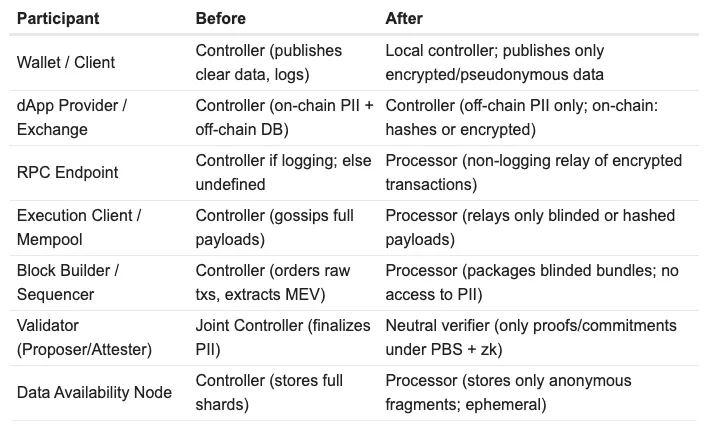
Reggianini also outlined several existing or planned solutions to aid implementation. For instance, proto-danksharding (EIP-4844) limits the lifespan of transaction data blocks to approximately 18 days, ensuring storage minimization.
zk-SNARK technology will also help enhance privacy, as it involves validators confirming succinct cryptographic proofs.
Among other PETs, the expert mentioned fully homomorphic encryption and trusted execution environments, multi-party computation, the separation of “proposers” and “builders,” and peer data availability sampling.
In June, the non-profit Ethereum Foundation reduced part of its research and development team, focusing on key challenges and core protocol issues.