


For Beginners and Pros: A Review of the Veles Platform for Creating Trading Bots
Trading bots are programs for automating trades based on certain market parameters and indicators. They run around the clock, trade without emotions, and do not deviate from the chosen strategy, which is why they often earn more than experienced traders.
Together with the platform Veles, we explain how to create your own bot and automate trading on a crypto exchange.
How Veles Works
Veles is a Dubai-registered company, founded in late 2021 by Vladislav Kriger and Ruslan Molchanov, who hold the positions of CEO and CTO respectively.
In October 2023, Veles raised $500 000 in a pre-seed round with participation from angel investors and the DF101 fund.
The company is developing the eponymous platform for creating bots on the spot and futures markets of Binance, Bybit, OKX, Gate.io, HTX and CommEX. The team will soon add support for Bitget, BingX and KuCoin.
To connect to exchanges, Veles uses an API. In November this year, Binance conducted an audit of the service and provided users the option to connect via FastAPI.
To work with Veles you need to register:
- on the platform’s website. Veles requires only an email and password;
- on one or more supported exchanges. The service will gain access to the exchange account balance after adding an API key.
Veles charges 20% of profits, but no more than $50 per month. Clients pay it in their account using Bitcoin (BTC), Tron (TRX), Polygon (MATIC), BNB, Tether (USDT) and USD Coin (USDC). The platform does not charge if the bots do not generate income.
Each user can receive up to 5 USDT to cover commissions for completing simple tasks such as creating an API key or subscribing to the Telegram service.
Testing Veles: creating and linking an API key
We registered on the platform and received 2 USDT for connecting a Telegram account, subscribing to the Veles channel and completing 10 minutes of training in the chat bot. For creating an API key, launching the bot and inviting a friend via a referral link, the service will grant another 3 USDT.
After that we created and linked an OKX exchange API key. The Veles blog offers instructions for this exchange as well as Binance, Bybit, Gate.io and HTX.
We authenticated on the exchange, navigated to the “API Keys” section and clicked “Create API Keys V5”.
We set the key’s purpose to “Binding third‑party applications”. In “Application name” we found Veles, set a password and enabled the “Trading” checkbox at the bottom of the window. The latter is required so the trading bot can create and close orders.
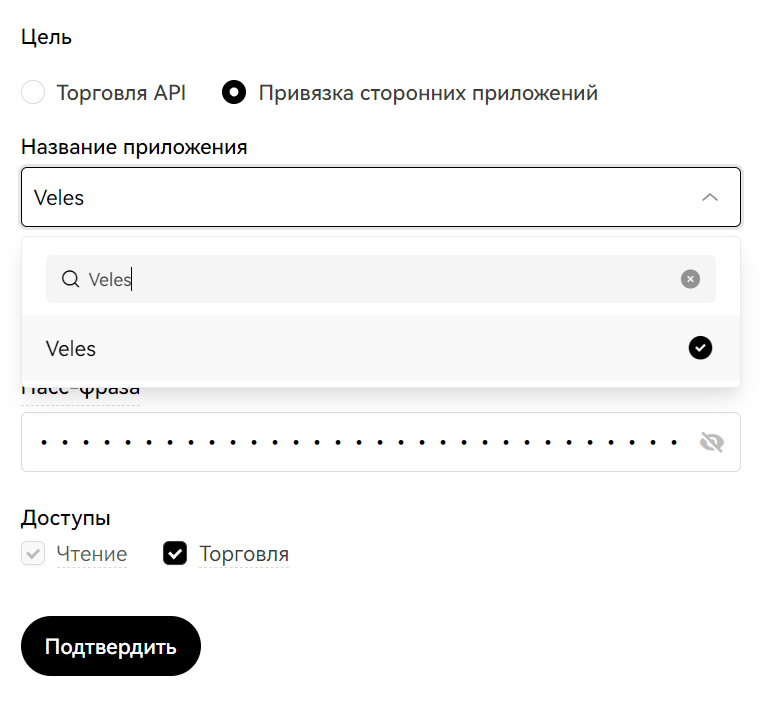
At this stage you can bind the API key to an IP address as an additional security measure. Note that OKX will deactivate IP-unbound keys after 14 days of inactivity. IP-bound or read-only keys are valid indefinitely.
We confirmed the application binding: clicked the appropriate button and completed two-factor authentication.
The exchange generated API keys. We added them to Veles: went to the “Trials” section in the dashboard and selected the task “Create API key”.
We specified the OKX Futures exchange, entered the API keys, secret and password, and clicked the “Check and Save” button. The platform added the key to our profile and credited 1 USDT.
Launching a trading bot with $1
On the main page, Veles offers nine ready-made bots. The platform claims that 85% of users start with a $1 Bot and SrgArt Scalper XRP +.
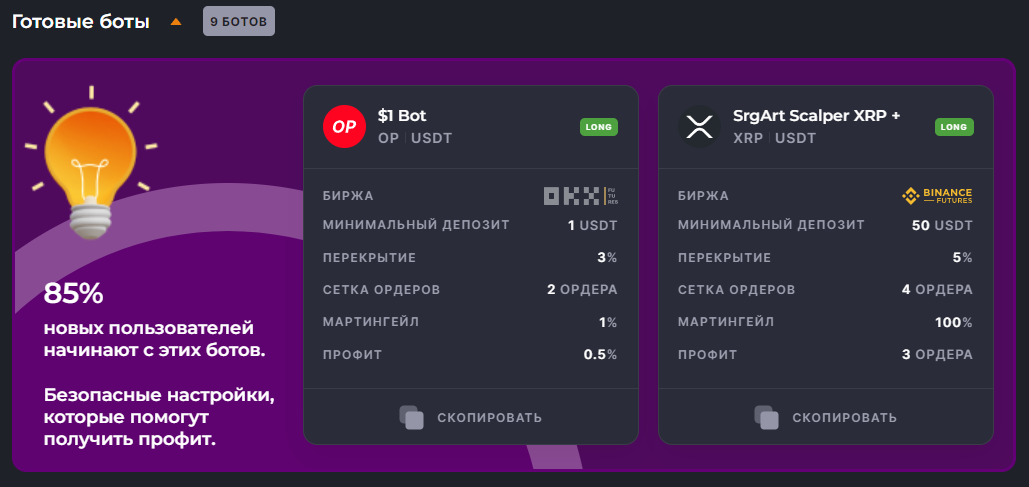
We were not an exception and launched the $1 Bot. We clicked the “Copy” button and set the parameters in the window that opened:
- trading platform — OKX Futures;
- API — selected the previously added key;
- algorithm — long positions (long);
- trading pair — OP/USDT;
- deposit — we specified 5 USDT;
- margin type — isolated;
- leverage — 20x;
- trading mode — conservative;
- filters — moderate (three filters by RSI and CCI levels);
- take profit — 0.75%;
- profit currency — Tether (USDT).
Beyond these settings you can specify partial grid of orders (the bot opens not the entire grid at once, but a given number as requests are fulfilled), an automatic stop of the bot after a certain number of trades, and a stop-loss level in percentage.
After configuring all parameters we previewed the order grid on the OP-USDT-SWAP chart and clicked the “Create bot” button. Veles suggested launching it. We agreed and pressed the appropriate button.
The bot appeared in the “My Bots” section on the platform’s home page. For launching the first bot we received another 1 USDT to cover commissions.
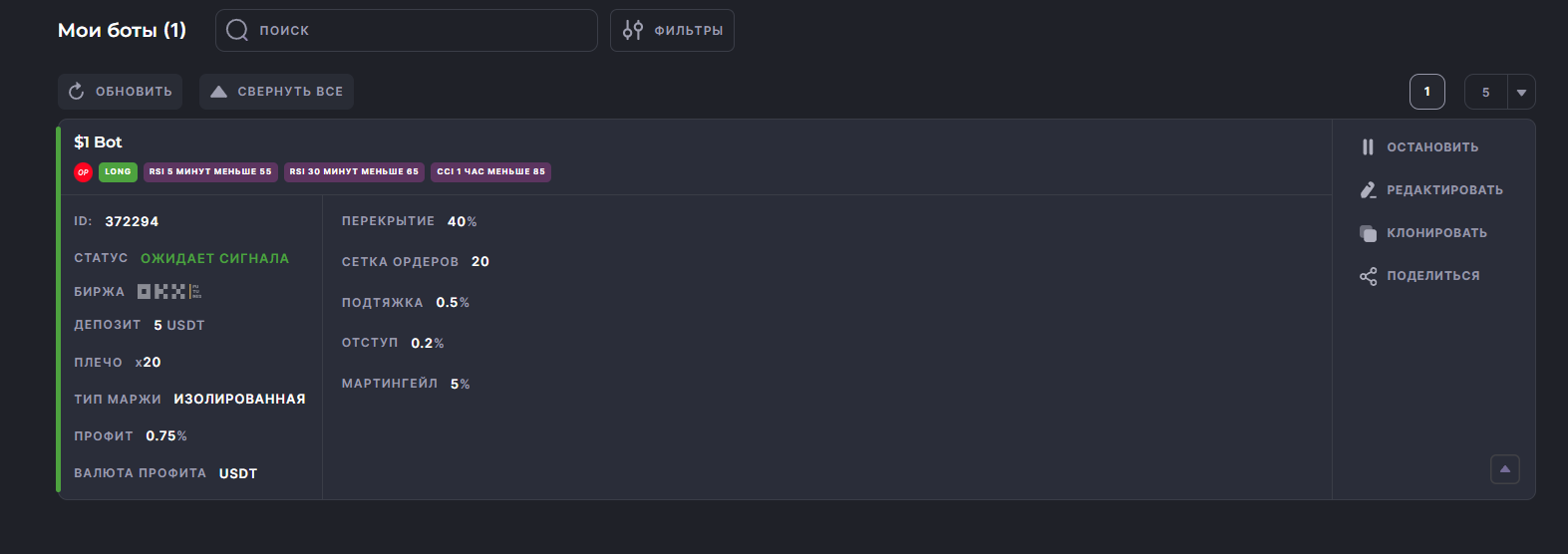
If an error occurs when launching the bot, Veles will send a corresponding message in Telegram. The chat bot will also notify about entering a trade or closing a position.
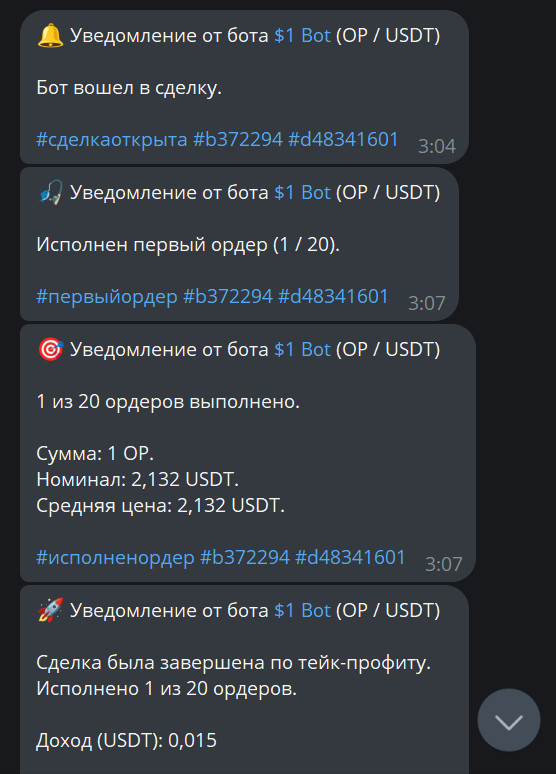
Over two days, the trading bot completed seven trades and generated $0.141 in profit.
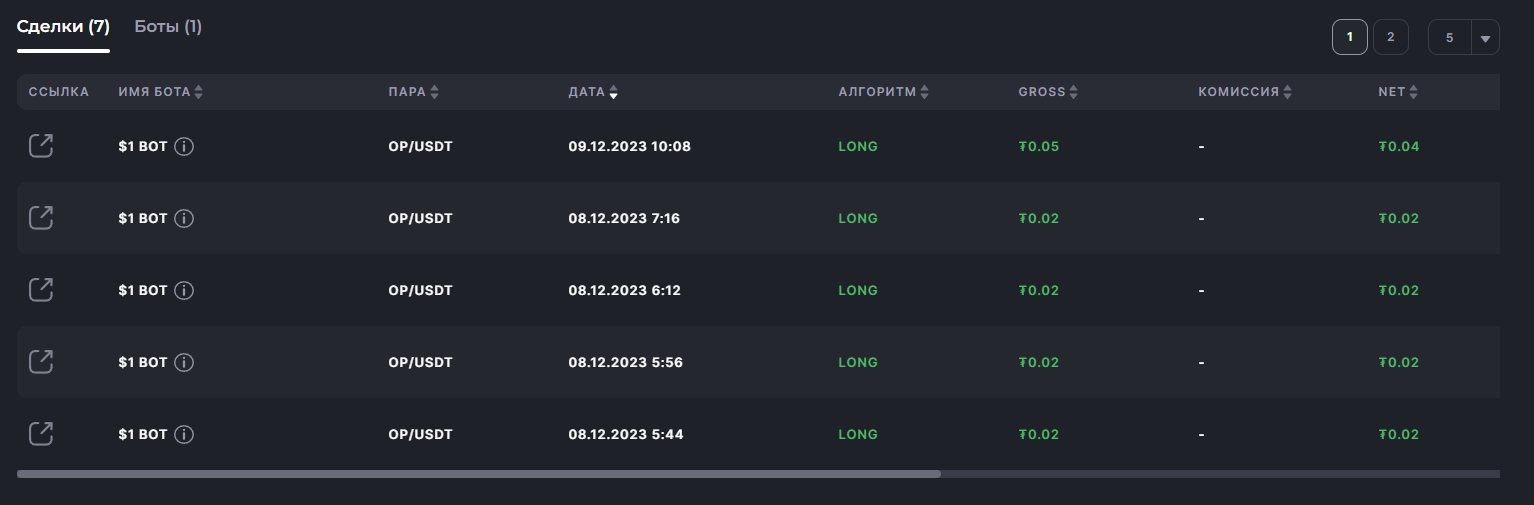
Veles’ commission amounted to $0.028. The history of trades and PnL can be tracked in the Statistics section.
Conclusion
Veles offers an intuitive interface with built-in hints, making it suitable for beginners. Flexible settings and integration with major crypto exchanges may interest experienced traders who want to employ various trading strategies.
For novice users, the project team launched the Academy, where there are articles and video tutorials on creating and configuring bots. In addition, Veles actively develops a Telegram community with over 13,000 subscribers. Participants regularly share useful tips for launching trading bots and ideas for earning in the crypto markets.
Рассылки ForkLog: держите руку на пульсе биткоин-индустрии!