



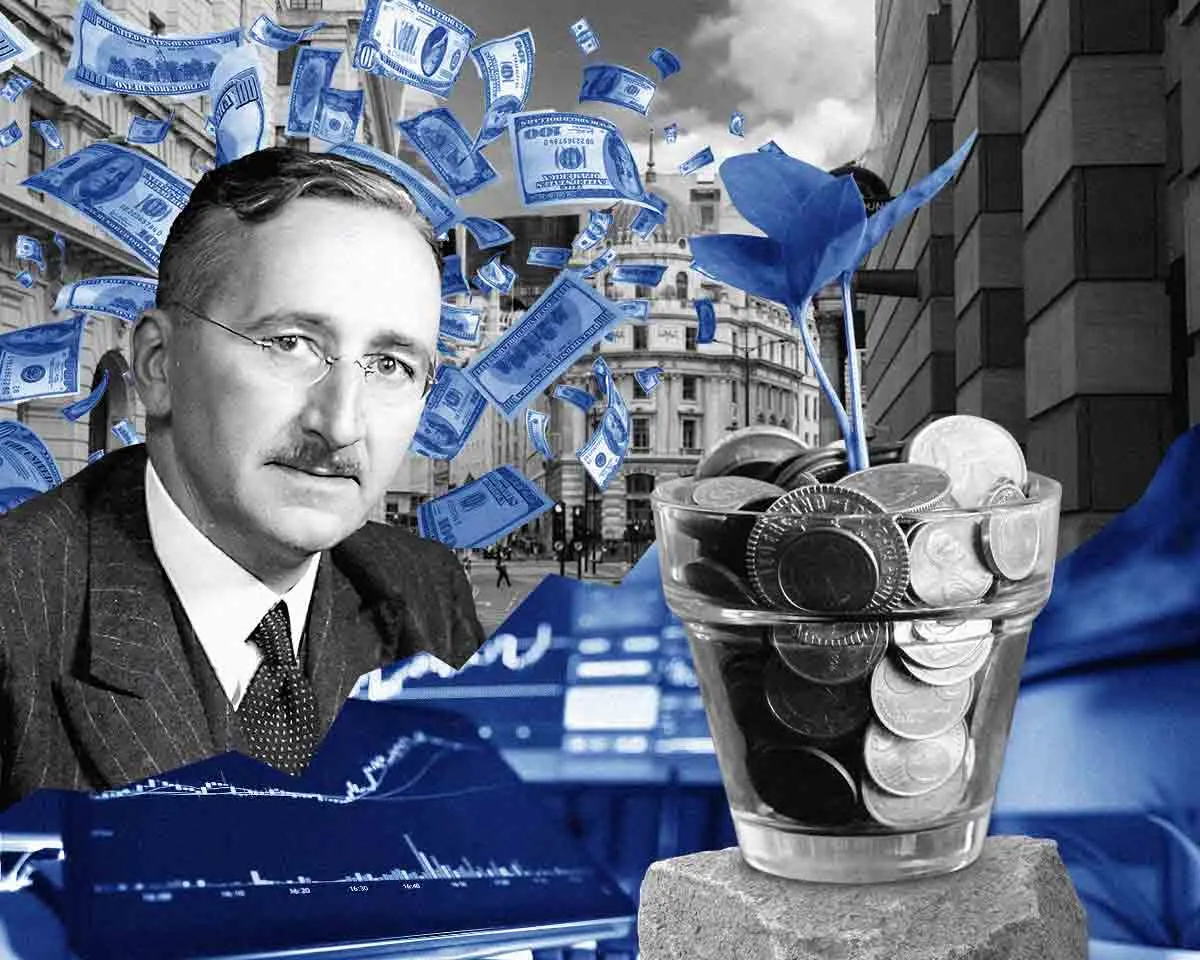
Twentieth-century economic thought was defined by competing visions of an ideal society, each school offering its own blueprint. If Chicago School faith in the market as a universal problem-solver became the emblem of neoliberalism, the Austrian School charted a different course — philosophical, with an emphasis on individual freedom.
Rooted in the ideas of Carl Menger, Ludwig von Mises and Friedrich Hayek, it rejects elaborate mathematical formalism, focusing instead on human nature and spontaneous order. In the digital age, as decentralisation and freedom of choice become central themes, Austrian ideas have renewed relevance.
This article outlines how the Austrian School differs from the Chicago approach and how its principles are manifest in the modern world.
Origins of the Austrian School
In 1871 Carl Menger published “Principles of Economics”, which set out the revolutionary theory of marginal utility. He argued that value is determined not by production costs but by consumers’ needs and perceptions.
Menger’s ideas laid the foundation for the subjective theory of value, developed by his students. One stood out in particular, Eugen von Böhm-Bawerk — author of the monumental “Capital and Interest” (1884–1889).
After the first world war the Austrians also played a key role in developing the concept of the economic calculation problem, a critique of central planning. In their view, socialist planning cannot allocate resources effectively because it lacks market prices that reflect individual consumers’ preferences.
One of the school’s quasi-manifestos in the 20th century was Ludwig von Mises’s treatise “Human Action” (1949). The book sets out the principles of praxeology — a theoretical approach that views the economy as the result of the purposeful actions of rational individuals.
The school’s most celebrated figure, however, was Nobel laureate Friedrich August von Hayek, who, among other contributions, revived the theory of spontaneous order tracing back to Adam Smith.
Chicago’s foil
Unlike the Chicago School, which relies on empirical data and mathematical models, the Austrians favour philosophical and logical analysis. Their ideas rest on three core principles:
- subjective value and marginal utility. Each person decides what is valuable based on subjective assessment rather than an object’s inherent properties. Menger showed that a good’s value depends on its marginal utility — the benefit provided by one additional unit — and that this utility diminishes as needs are satisfied. For example, in biological terms a glass of water is vital whereas works of art are not. Yet a painting can be worth millions to a collector who searched for it for years, while holding no value for most others. Conversely, someone dying of thirst in a desert would give anything for a glass of water that, in ordinary circumstances, would be obtained almost for free;
- spontaneous order. The market is a self-organising system that emerges from many individual decisions without centralised control. Hayek compared the market to language: no one invented it deliberately, yet it coordinates people’s behaviour effectively. In the Austrian view, state intervention often disrupts this spontaneous order;
- individual freedom. Mises held that economics begins with individual action, not abstract models. Freedom of choice is the basis of prosperity, and any coercion — especially by the state — reduces efficiency and suppresses initiative.
Austrians contend that economics is a science of behaviour too complex for precise equations, and they are sceptical of the mathematical models popular in Chicago. Instead they offer praxeology — a deductive, logical analysis of economic phenomena grounded in first principles, notably that people act purposefully to improve their position.
They link crises to artificial credit expansion triggered by central banks. In this vein, Mises and his follower Murray Rothbard advocated abolishing central banks, arguing that their interventions distort natural market signals. They proposed a return to the gold standard or a system of free banking, where money is issued by private institutions based on market demand rather than state control.
Where the Chicago School under Milton Friedman relies on monetarism, the Austrians offer a looser approach. They share faith in markets but see them as complex systems grounded in freedom of choice. Markets, they stress, are efficient only under genuine freedom — not under monopolistic pressure or amid excessive deregulation that can spill into chaos.
Chicago tolerated minimal intervention (for example, managing the money supply), but the Austrians were more radical from the start. Mises and Hayek saw the state as a threat to liberty, especially in economic planning. Yet they did not idealise markets: Hayek warned that without protecting individual rights they can be captured by powerful players such as corporations or monopolies.
Spontaneous order, in practice
The Austrian School’s ideas find expression in the real world, especially in an era of digitalisation, as decentralisation has become a key trend. Consider a few vivid examples:
- Silicon Valley. The rise of technology start-ups such as Google, Amazon or Tesla illustrates spontaneous order. These firms emerged not thanks to state planning but from entrepreneurs’ free initiative. A decentralised ecosystem of venture capital, start-ups and competition produced innovations that changed the world: the market finds efficient solutions without directives from above.
- cryptocurrencies and blockchain. Bitcoin, created by Satoshi Nakamoto, embodies Austrian ideas of freedom from central control. A decentralised network independent of banks or governments reflects the principle of spontaneous order. Smart contracts make agreements self-executing without intermediaries, in line with the Austrian preference for minimal intervention;
- the platform economy: Platforms such as Uber, Airbnb or Upwork demonstrate spontaneous order in action. They coordinate the activity of millions, letting supply and demand adjust without central planning. Yet these platforms face headaches, from local laws to backlash from incumbents, revealing the limits of spontaneous order;
- decentralised autonomous organisations (DAOs). DAOs realise Austrian ideas via blockchains, where communities rather than central authorities govern. They enable participants to take decisions jointly while minimising intermediaries — a clear case of self-organisation.
The path has brought both successes and challenges. Silicon Valley has spawned monopolies that curb competition and freedom, at odds with Hayek’s warnings. Cryptocurrencies, despite decentralisation, have struggled with speculation and instability. These examples suggest Austrian concepts work best where freedom is coupled with safeguards against monopolies and chaos.
Decentralisation in the digital age
Today the Austrian School’s principles animate debates about the future of the economy. The rise of digital technologies has pushed Web3 and DeFi into the limelight. This echoes the Austrian view of spontaneous order, in which decisions are taken by individuals rather than central structures.
Austrian scepticism toward state control also resonates with criticism of big tech. Companies such as Meta or Google, dominant in their markets, restrict freedom of choice, creating digital monopolies. Hayek would likely have favoured decentralised alternatives that return control to users. Projects such as IPFS, for example, seek to build an internet in which data belong to people, not corporations.
At the same time Austrian ideas inspire debates about economic freedom. The growing popularity of libertarian ideas, especially in the United States, owes something to Mises and Hayek. Mises’s “Human Action” or Hayek’s “The Road to Serfdom” (1944) remain touchstones for those who see state control as a threat to innovation and liberty.
Idealism or practicality?
Critics such as the neo-Keynesian Paul Krugman argue that the school is idealistic. Its rejection of mathematical models makes Austrian ideas hard to test and to translate into policy.
Addressing the climate crisis, for instance, demands global coordination — at odds with a radically anti-statist stance. Keynesians fault Austrians for downplaying the state’s role in stabilising the economy during slumps such as the Great Depression or the 2008 crisis, when fiscal and monetary policies softened the blow.
Another weakness is the vulnerability of spontaneous order to monopolies. Without minimal rules, large players can suppress competition, as big tech shows. The 2008 financial crisis, which some link to excessive faith in market self-regulation, underscores the risks of radical deregulation.
Critics also note that Austrian ideas work better in theory than in practice, especially in countries with fragile institutions, where freedom without rules can lead to chaos.
Lessons for the 21st-century economy
The Austrian School offers an alternative to Chicagoan dogma, reminding us that economics is not only numbers but also a philosophy of freedom. Its stress on decentralisation and individual choice is especially pertinent in a digital era, as technology creates new opportunities for emergent order.
Yet these ideas demand balance: freedom is effective only when paired with safeguards against monopolies and with attention to social challenges such as rising inequality and the climate crisis.
For the economy’s future, Austrian principles can be integrated with other approaches. Decentralised systems powered by AI could embody spontaneous order while minimising external interference. In politics, the Austrian emphasis on liberty can counter authoritarian regimes that seek total control.
Like classical liberalism, the Austrians teach us to value the market without worshipping it. Their scepticism toward centralised management encourages the search for models in which technology and human initiative create order without coercion.
In a world where big tech, climate shocks and inequality test the economy, the Austrian School remains a source of ideas, urging a balance between freedom and responsibility. A hybrid approach that combines Austrian faith in spontaneous order with minimal, well-aimed rules could form the basis of a resilient 21st-century economy.
Text: Anastasia O.