



The Gas Free feature has not reduced the cost of Tether (USDT) transactions on the TRON network. This was highlighted by the developers of the Telegram bot for purchasing and renting energy, re:Fee.
In late February, TRON’s founder Justin Sun announced the introduction of Gas Free, which allows network fees to be paid without using the native TRON (TRX) token. He invited wallet teams to collaborate for its integration.
Tron’s Gas Free feature supporting USDT gas payments without the need for TRX will launch within the next week. Teams and wallets wishing to support this feature, please contact support@justlend.org. Keep Building!
— H.E. Justin Sun ? (@justinsuntron) February 25, 2025
On March 7, TronLink developers published a guide on using Gas Free. It turned out that using “gas-free” transactions would be significantly more expensive than a regular USDT transfer, as users must pay 10 USDT to activate the feature. The transaction fee will also be 10 USDT.
“One might assume that after the first transaction, the fee would drop to zero, but even on the second transfer, you will still be charged 10 USDT. Moreover, creating a new GasFree wallet may inconvenience users accustomed to their existing addresses,” comment re:Fee representatives.
For comparison, a standard stablecoin transfer costs $3-6, and with re:Fee, one can save up to 60% on fees. Depending on the number of transactions, the cost of re:Fee energy ranges from 3.5 to 5.8 TRX ($0.80-$1.30) instead of 13.4 TRX ($3).
The Telegram bot team re:Fee also offers the “Always Charged” feature — automatic energy replenishment in the TRON network. It allows sending Tether (USDT) without needing to purchase energy each time.
To enable the feature, simply add a wallet address in the Telegram bot and activate the “Always Charged” option.
“After this, the wallet is credited with 131,000 energy, which automatically replenishes after each transaction. If there are no TRX tokens, bandwidth is added. This allows for free USDT transfers without worrying about energy,” comment re:Fee representatives.
They add that the feature is ideal for those making several transfers a day from one wallet. If no transactions occur within 24 hours, a subscription fee of 131,000 energy is deducted. The feature can be disabled at any time through settings.
Using re:Fee does not require transferring wallet control or undergoing KYC — simply specify one or more addresses in the bot.
For clients with large volumes (exchanges and exchangers), the service offers a system with two types of wallets:
- hot — aggregate user balances and make payments;
- transit — created for each exchange operation or client. They help identify the source of funds and conduct AML checks.
Integration requires connecting the API.


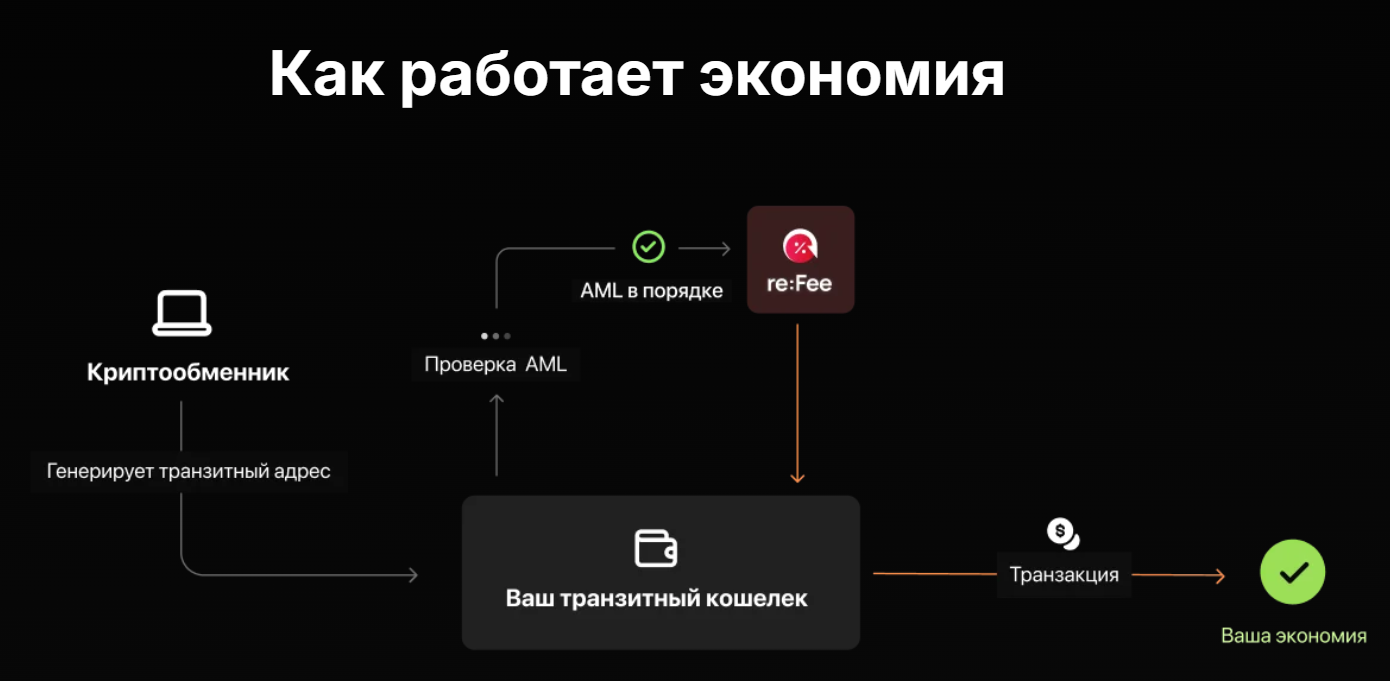
“We supply energy to hot wallets for a period of one day or more, and to transit wallets immediately before sending funds. When creating a wallet and transferring USDT, an AML check is conducted. If everything is in order, our system credits the energy,” comment re:Fee representatives.
Users can independently check the “cleanliness” of funds through the Telegram bot reFee AML and download the results in PDF format.
Earlier, ForkLog published an article on how TRON became a major competitor to Ethereum.