



GBTC Outflows Slow as Google Permits ETF Advertising
- GBTC investors continue to take profits, but at reduced volumes.
- Other issuers are lowering management fees.
- Google has started allowing bitcoin ETF advertisements.
Outflows from the Grayscale Bitcoin Trust ETF (GBTC) have reached $5 billion since its conversion, potentially prompting withdrawals from crypto funds in Europe and Canada, according to a report by CoinShares.
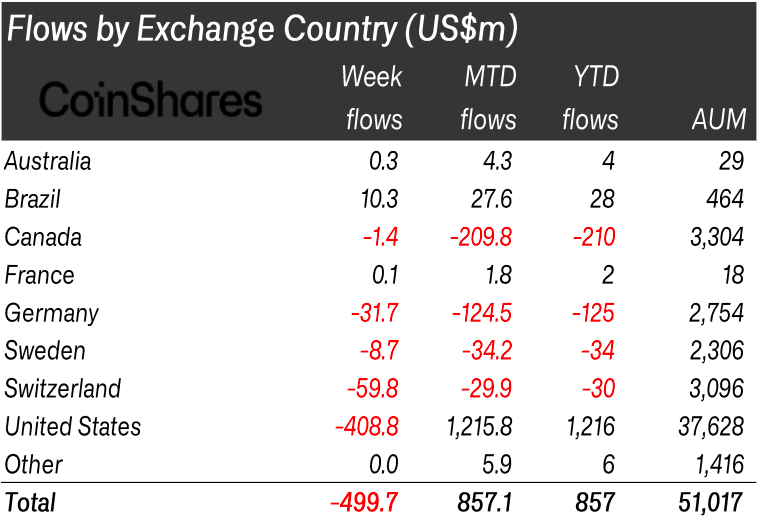
“The recent price decline, driven by significant outflows from the leading ETF issuer in the US — Grayscale — totaling $5 billion, likely triggered further outflows from other regions,” analysts explained.
The study indicates that exchange-traded funds in Switzerland and Germany were the hardest hit, with outflows of $59.8 million and $31.7 million respectively from January 22 to 26.
The largest monthly decline in assets under management (AUM) was recorded in Canada ($209.8 million), Germany ($124.5 million), and Sweden ($34.2 million).
Brazil was the only country with positive dynamics for cryptocurrency ETFs, with $10.2 million over the past week.
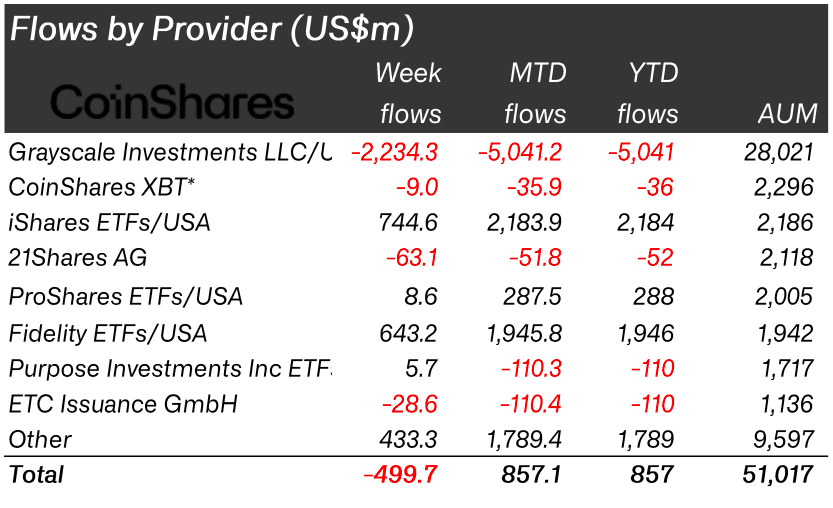
During the second week of trading, nine bitcoin ETF issuers attracted a total of $1.8 billion, yet this amount did not offset the $2.2 billion outflow from GBTC.
CoinShares noted that the negative trend is gradually subsiding.
Redistribution and Fee Wars
Preliminary data from Farside Investors shows that on January 29, Fidelity’s FBTC recorded an inflow of $208 million compared to a $192 million outflow from GBTC. This marks the lowest level for Grayscale since the trust’s conversion to an exchange-traded fund.
On January 24, GBTC experienced a record outflow of $429.3 million. JPMorgan suggested that investors’ profit-taking is nearly complete, which has limited the downward trend in bitcoin.
Currently, nine bitcoin ETFs in the US have reached a combined volume of $994.1 million, nearly double GBTC’s $570 million.
And @Grayscale‘s $GBTC maintains its liquidity crown — trading $570 million and ~$110 million more than second place $IBIT today https://t.co/WIAWKwDnqY pic.twitter.com/ma0CE5szLa
— James Seyffart (@JSeyff) January 29, 2024
BlackRock’s IBIT and Fidelity’s FBTC attracted the largest funds after Grayscale — $460.9 million and $315.4 million respectively, accounting for about 78% of the share of nine exchange-traded funds.
Simultaneously, issuers continue to reduce fund management fees. Invesco and Galaxy reduced fees on their joint BTCO from 0.39% to 0.25%.
This is what the fee table looks like now: pic.twitter.com/LPvd6YwGWJ
— James Seyffart (@JSeyff) January 29, 2024
Currently, eight bitcoin ETFs have a 0% fee, which they plan to increase after several months or upon reaching a certain volume of assets under management. In the future, these products will have fees ranging from 0.19% to 0.25%.
Raising Awareness
On January 29, Google updated its policy regarding cryptocurrency promotion. According to new guidelines, financial products that allow investors to “trade shares of trusts with large pools of digital currency” in the US are deemed suitable for advertising.
Sponsor blocks of products from ETF issuers have already appeared in the corporation’s search engine.

“We want users to have sufficient information to make informed financial decisions. Our policy is designed to provide data that allows weighing the costs associated with investment products and services, as well as to protect against harmful or fraudulent actions,” emphasized Google.
To place cryptocurrency product advertisements, clients must have the appropriate license and comply with the platform’s disclosure rules.
Previously, Grayscale CEO Michael Sonnenshein stated that most bitcoin-based exchange-traded funds are likely to fail.
Earlier, Galaxy Digital CEO Mike Novogratz downplayed the impact of GBTC sales on the prospects of digital gold.
Previously, several experts noted the price dependency on the wave of position liquidations in Grayscale’s exchange-traded fund.
Рассылки ForkLog: держите руку на пульсе биткоин-индустрии!