




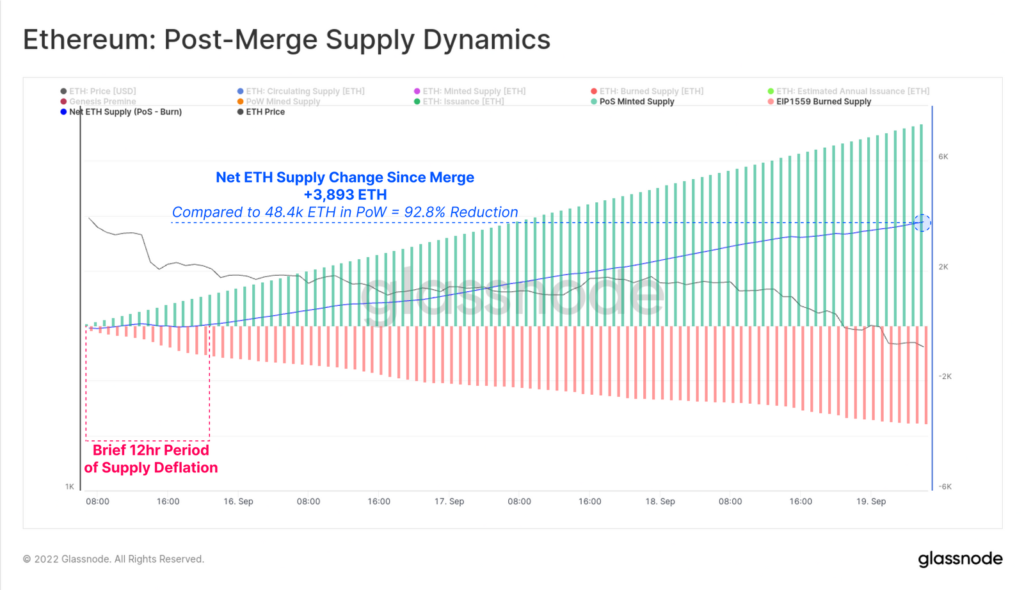
In the four days after the Ethereum transition to the Proof-of-Stake consensus algorithm, daily issuance fell by 92.87% — from 48,400 ETH to 3,893 ETH. Those figures were provided by Glassnode analysts.
The #Ethereum Merge remains one of the most impressive engineering feats in the blockchain industry.
In this edition, we explore the Merge, as it happened, on-chain, and in derivatives markets, where traders paid over 1,200% funding rates to stay short.https://t.co/qLiXOrnzSl
— glassnode (@glassnode) September 19, 2022
Experts noted that immediately after the merger, a surge in demand for blockchain space contributed to a rise in average gas fees, leading to deflation over the next 12 hours.
Subsequently, network activity declined with shrinking transaction fees and a return to ETH supply growth, but at much slower rates than before The Merge.


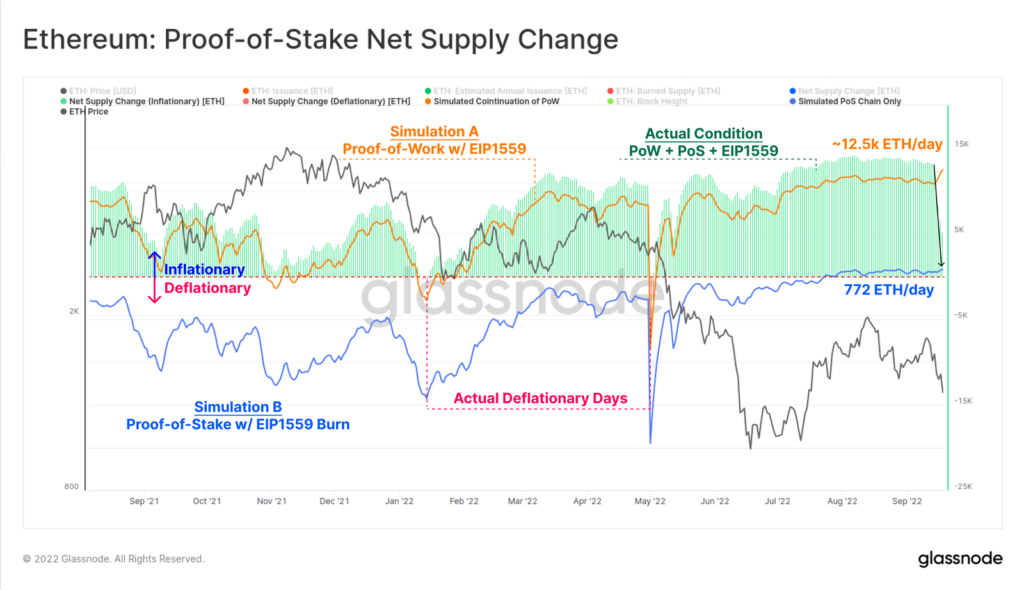
Experts modeled ETH issuance under various conditions since the deployment of EIP-1559:
- green bars denote the inflationary period, red — the deflationary scenario under the burning-fee mechanism and the transition from PoW to PoS;
- yellow curve reflects a hypothetical scenario in which The Merge did not occur and miner rewards remained at 2 ETH per block;
- blue curve shows the transition to PoS simultaneous with the implementation of EIP-1559, with the abandonment of PoW.
“The illustration shows that the PoS model 🔵 has significantly lower emission rates — around 772 ETH per day — than the PoW model 🟠, around 12,500 ETH. The current rate of supply growth remains positive, a consequence of the extremely low network activity,” the specialists explained.
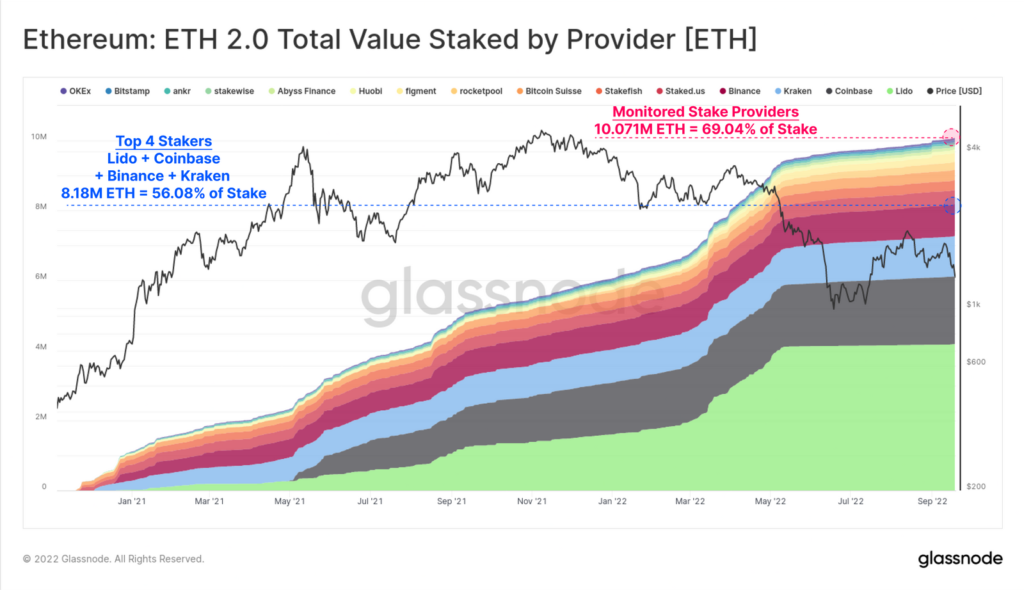
By expert estimates, as of writing there were a total of 429,600 active validators in Ethereum. They had staked 14.586 million ETH, representing 12.2% of the total supply.
10.07 million ETH, or 69.04% of all staked ETH, were held by dedicated staking providers. Among them — Coinbase, Kraken, Binance and Lido Finance — accounted for 8.18 million ETH, about 56.08%.
Earlier, Nansen estimated a 61.25% share of Coinbase, Kraken, Binance and Lido Finance of the total number of ETH blocked in staking.
Prior to that, Merkle Science’s lead researcher Coby Morgan highlighted the risks of government interference and censorship for Ethereum after the transition to Proof-of-Stake.
Earlier, Glassnode analysts concluded that after the activation of The Merge update the second-largest cryptocurrency is likely to become deflationary.
Read Bitcoin news from ForkLog on our Telegram — news, prices and analysis.