




The risk of the market shifting to a bearish trend will arise if the price of the leading cryptocurrency remains below key on-chain indicators, according to analysts at Glassnode.
Bitcoin is currently testing the average entry price of active investors at $88,600. A breach of this level and the subsequent market average of $82,000 would mark the first significant confirmation of a bearish trend since May 2022.
Previously, prices had already fallen below the cost basis of short-term holders ($109,800), exerting pressure on them. Now, the $95,000-97,000 range serves as key resistance.
Experts also noted other negative factors:
- Spot Bitcoin ETFs in the US are experiencing outflows, and new institutional investors are not entering the market.
- Open interest in futures is declining, indicating a reduction in traders’ positions.
- Participants are actively buying puts to hedge against downside risks, leading to increased implied volatility. The market anticipates significant price swings in the near future.
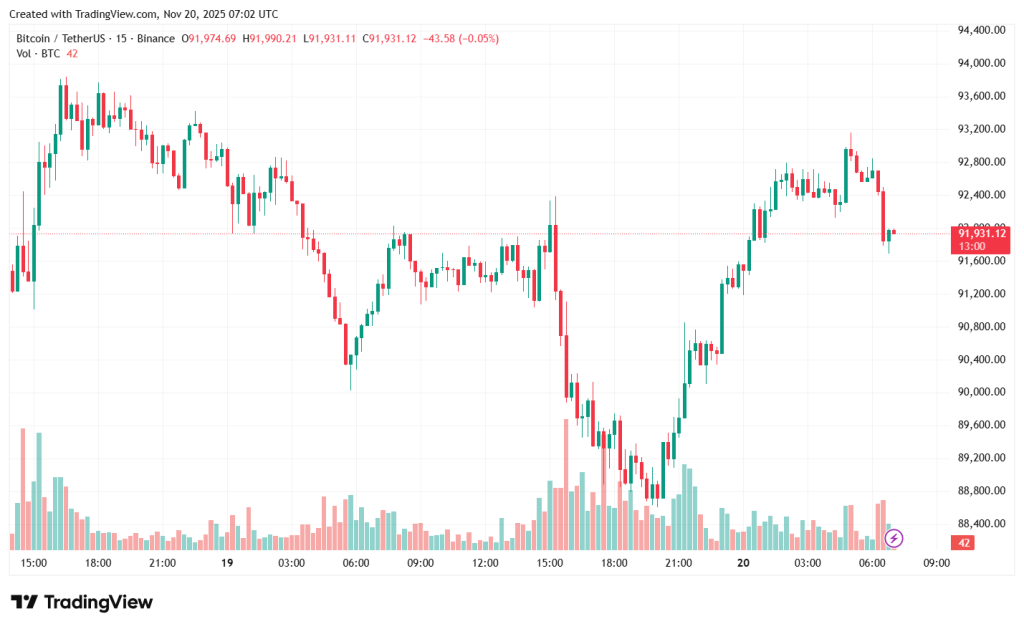
At the time of writing, digital gold is trading around $91,900.


“Most Bearish Phase Since 2023”
Analysts at CryptoQuant reported that market conditions for Bitcoin have become the “most bearish” since the start of the bull cycle in January 2023. They believe the current correction differs from previous ones, as the price has broken a key technical level.
The main signal was the breach of the 365-day moving average (MA). In 2022, a drop below this indicator confirmed the start of a prolonged bear market. In the current cycle, the price has not fallen below this benchmark.
Among other negative factors, analysts highlighted:
- a drop in the CryptoQuant Bull Score index to 20/100;
- a reduction in spot demand;
- a slowdown in the growth of stablecoin liquidity.
Demand from public companies, which was a significant growth driver, has nearly halted. In recent months, their market capitalization has plummeted by 70-90%, falling below the value of their Bitcoin reserves.
Treasury companies are struggling to attract new capital for cryptocurrency purchases. Strategy activity has also noticeably declined.
Experts believe that bull phases depend not on halving or time frames, but on waves of demand growth. The main part of the current rise has likely already occurred.
Catalysts that pushed the price to $100,000 and $120,000 in 2024-2025 have run their course. The emergence of new powerful drivers, such as the creation of a strategic Bitcoin reserve in the US, is unlikely, and a potential rate cut by the Fed is already priced in.
The current situation does not imply a sharp collapse, analysts emphasized. Bitcoin’s price has corrected by 28% and found support in the $90,000-92,000 range. However, the 365-day MA level ($102,600) now serves as strong resistance.
Back in November, analysts at Glassnode stated that bulls need to quickly return the price of the leading cryptocurrency to a level where 75% of coins are in profit—only this has historically prevented a trend reversal.