



2022 proved a difficult test for the cryptocurrency industry — after the Terra collapse and the ensuing bankruptcy of several major firms, the community was shaken by the collapse of Sam Bankman-Fried’s (SBF) business empire.
Practically immediately, some industry figures and regulators drew parallels between FTX and the 2008 crisis. ForkLog revisited what preceded the Wall Street collapse, how events unfolded in 2008 and 2022, and compared regulators’ responses and the consequences for those directly involved.
The 2008 financial crisis — from boom to bust
The catalyst for the events of 2008 was the U.S. mortgage crisis. Problems in the financial sector quickly snowballed, spreading beyond the United States to engulf world markets. But what caused it?
After the Great Depression the financial sector was tightly regulated, but in the early 1980s the approach changed. The phase of liberalisation began with Donald Regan, then chairman of Merrill Lynch, being appointed Treasury secretary, and continued after Alan Greenspan took the helm of the ФРС in 1987.
Former Goldman Sachs chief executive Robert Rubin played a role in deregulation. As Treasury secretary, he proposed removing all restrictions on the activities of commercial banks — enabling them to operate not only with deposits and loans but also to make deals in their own name and in their clients’ names.
Many experts agree that it was deregulation that ultimately led to the global economic collapse. The Guardian later named Greenspan one of the “villains” of the 2008 crash.
“[…] Wall Street, through its influence, lobbying and vast resources, gradually subordinated the political system — both its Democratic and Republican wings,” noted economist and crypto critic Nouriel Roubini in the film Inside Job (2010).
There were no conclusions about the negative impact of deregulation (including the repeal of the Glass–Steagall Act in 1999) and the expansion of banks’ appetites did not abate after the dot-com bubble burst. In this period the derivatives market flourished. According to the same Guardian article, Greenspan actively defended derivative financial instruments, encouraged the issuance of high-risk mortgage loans, and urged homeowners to switch from fixed-rate to adjustable-rate mortgages.
The Mortgage Trap
Interest in the mortgage rose, and deregulation led to the emergence of subprime loans. This significantly boosted demand and sparked a self-reinforcing rise in housing prices. Ultimately there was a trend toward bringing riskier products to the market.
How financial institutions profited:
- CDO — collateralised debt obligations, including subprime mortgage-backed securities. The largest player was Lehman Brothers;
- CDS (credit default swaps) — a financial swap used to insure against credit risk (counterparty default). The largest player was American International Group, Inc. (AIG).
The Snowball
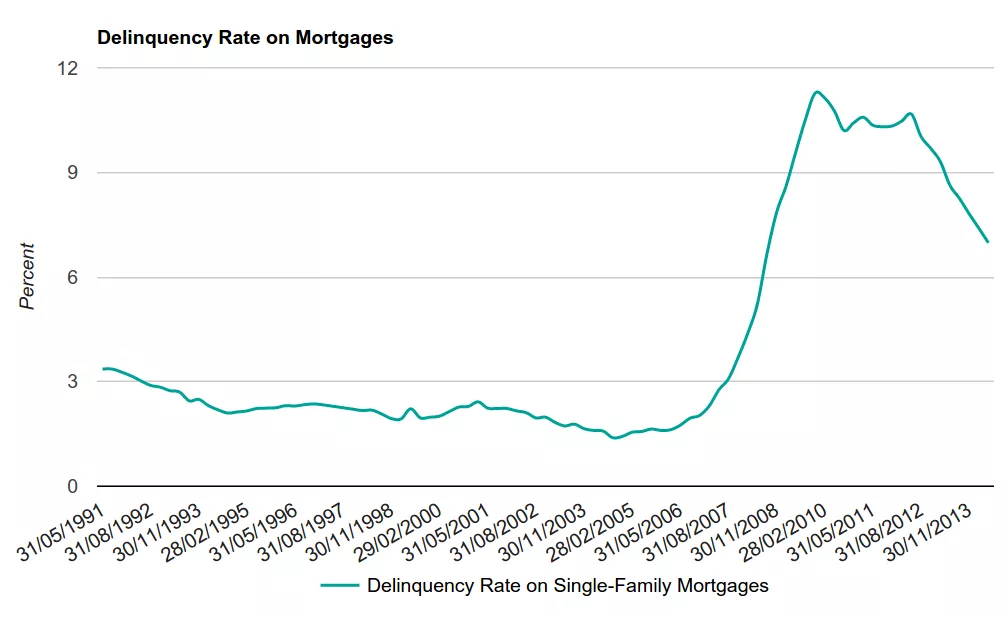
The U.S. housing bubble peaked in 2005–2006. From mid-2006 house prices began to fall, and the adjustable rate rose after teaser periods ended and amid a tightening Fed. People found it harder to service debts and to refinance, which led to a sharp rise in default cases.
Banks began foreclosing on borrowers, putting homes up for sale, which intensified negative trends.


The snowball inevitably swept up the banks — in March 2008 Bear Stearns collapsed. It was acquired by JPMorgan Chase for $236.2 million (about $2 per share). The Fed backed the deal, guaranteeing an influx of emergency funding.
In September the government bailed out the mortgage giants Fannie Mae and Freddie Mac, holders of private mortgage debt worth $14 trillion. It also provided aid to AIG, which proved unable to meet all its insurance obligations.
The next to fall was Lehman Brothers, with debt in excess of $600 billion, which authorities refused to rescue. Merrill Lynch was next, but it avoided bankruptcy thanks to Bank of America.
Companies such as General Motors, Chrysler and others sought government assistance. The contagion spread not only across the United States but the world.
The Rescue Plan
During his U.S. presidential campaign, Barack Obama named greed on Wall Street and regulatory missteps as causes of the crisis. Taking office in 2009, he urged Americans to learn from Lehman Brothers’ bankruptcy and to back financial-regulation reform.
In particular, responses to the crisis in the United States included:
- the Dodd–Frank Act — reform of U.S. financial regulators, bankruptcy rules, the introduction of derivatives oversight. Creation of the FSOC;
- Volcker Rule — part of Dodd–Frank, limiting U.S. banks’ participation in the purchase and sale of securities with their own funds, originally designed to cover obligations to clients;
- allocating funds to stabilise banks, restart credit markets, and government programs for those in need.
These crisis-response measures helped improve the economy, but they also produced massive budgetary outlays and a rise in the U.S. national debt. As discontent with government actions grew, by September 2011 Wall Street saw a prolonged protest movement — Occupy Wall Street.
What the crisis led to
The October 2008 stock market crash was the worst for the U.S. markets in the previous 20 years. Europe and Asia also faced severe pressures.
The crisis triggered:
- fall in oil prices;
- GDP contractions in several countries and rising government debts;
- decreased investment in manufacturing;
- rising unemployment and lower birth rates;
- capital outflows;
- migration;
- inequality and other problems.
IMF experts, in a 2018 study, noted that in ten years most countries had not managed to reach the production levels seen before the economic collapse.
“The 2008 financial crisis has its roots in the mortgage boom in the United States in the preceding five years. Its consequences were felt worldwide — from closed assembly plants in Mexico to restructuring of regional savings and loan institutions in Spain and prolonged unemployment among migrants in the Pearl River Delta in southern China,” the report said.
Crimes and punishments
Soon after the collapse AIG, American authorities began investigations into the insurer. Yet in 2010 the U.S. Department of Justice, and later the U.S. Securities and Exchange Commission (SEC) refused to press charges against former AIG Financial Products head Joseph Cassano.
Losses at Cassano’s unit, which oversaw credit-default swaps, amounted to $11 billion and led to his dismissal. Yet he received multi-million-dollar compensation and a new contract — AIG hired Cassano as a consultant at a monthly salary of $1 million.
Staunch defenders of deregulation and of high-risk mortgage lending, among them Greenspan, did not face punishment. They testified before commissions and Congress, but did not face real consequences.
The collapse of FTX and Terra’s role
As with the 2008 crisis, the collapse of Sam Bankman-Fried’s business empire was the result of earlier events, sequentially infecting connected players.
The main problem for FTX was its close ties to Alameda Research. The exchange, in collaboration with the trading firm, issued and controlled a large portion of the FTT utility tokens (280 million of the initial 350 million). Alameda also acted as one of FTX’s early liquidity providers in May 2019.

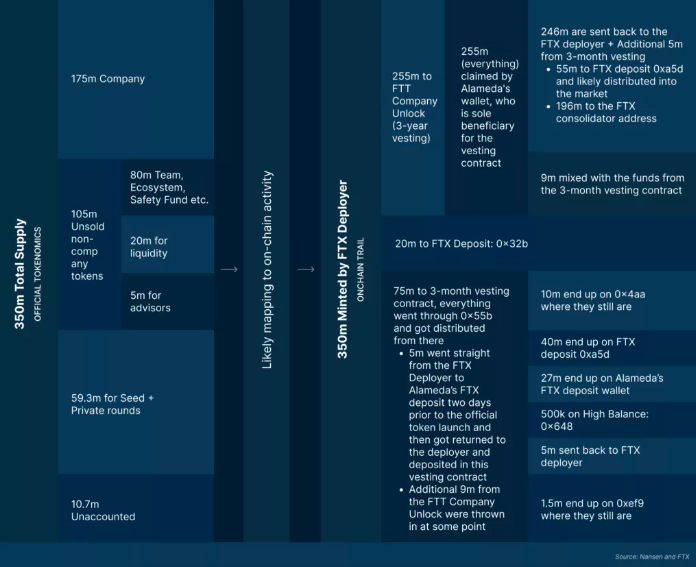
A small share of FTT in the market allowed influence over the token’s price. Its surge during the 2021 bull run (from $0.1 to $84) gave Alameda the ability to use the coins as collateral for borrowings. For example, in September that year the trading firm used FTT valued at $1.6 billion in a deal with Genesis Global Capital.
After the November 2022 events, former Alameda Research CEO Caroline Ellison testified that she knew about the firm’s access to loans on FTX. She said that, together with SBF, she decided to hide such an arrangement from creditors and to falsify financial statements for this purpose.
“This mechanism allowed Alameda to obtain an unlimited line of credit without requiring collateral,” she explained.
The well-constructed scheme ran into trouble in early May 2022, when Terra’s collapse roiled the market. It infected several crypto firms, including hedge fund Three Arrows Capital and lending platform Celsius.
Because they had ties to Genesis Global Capital, Alameda, according to Nansen, faced deleveraging and liquidity crises. It later emerged that FTX provided “substantial” financial assistance to a related firm.
This allowed SBF to mask growing problems within the company through November and even to claim the existence of substantial sums to support affected industry participants.
The domino effect prompted Binance CEO Changpeng Zhao to dump FTT in view of the “recent disclosures.” It is believed he referred to CoinDesk’s investigation revealing details of Alameda’s balance.
On 8 November FTT prices fell by almost 30% amid concerns about the exchange’s financial health. By 11 November the FTX Group filed for bankruptcy, and Bankman-Fried stepped down as CEO.
From that point the community watched as the crisis engulfing FTX and Alameda Research spread to other players: BlockFi, Core Scientific, Genesis Global Capital.
Unlike 2008, crypto firms did not rely on government rescue. Instead, the industry faced intensified scrutiny.
Reactions to the crisis
Lack of proper regulation, according to a number of politicians and crypto participants, also contributed to the 2022 collapse. In November U.S. Senate Banking Committee member Elizabeth Warren not only compared digital assets with subprime mortgages, but urged federal agencies to “crack down on crypto fraud.”
The necessity for tighter controls was also highlighted by Bitcoin advocate and former MicroStrategy head Michael Saylor. He criticised Bankman-Fried for issuing unregistered securities that helped him earn billions from “money-printing” tokens, and said regulation of the industry is a necessary element of its growth.
U.S. Representative Tom Emmer launched attacks on SEC Chair Gary Gensler. In his view, the FTX collapse is a failure of industry regulation, given that the agency should have been able to oversee projects like Celsius Network, Terra and Voyager Digital from the start.
In December 2022 members of the U.S. Senate Committee on Agriculture (which oversees derivatives trading) and the head of the CFTC Rostin Behnam concluded that the Commission’s decades-old rules proved inadequate in the context of FTX.
Meanwhile, the SEC’s chief crypto advocate, Hester Peirce noted that those responsible for problems in the digital-asset industry did not do anything new:
“Many of the failures in 2022 were linked to crypto market participants doing the same foolish and fraudulent things that players in other markets have done for centuries.”
Ultimately the Biden administration urged Congress to “step up efforts” to supervise the digital-asset industry. In turn, the SEC chief included regulation of cryptocurrencies among the Commission’s top priorities for 2023.
However, the first step in that direction did not target the platforms and projects that had destabilised crypto markets. Instead of addressing FTX, the agency’s leadership issued an unexpected move against the Bitcoin exchange Kraken and its staking programs .
These actions drew heavy criticism, and Peirce described the Kraken case as an example of forced regulation in the digital-asset space.
Damage
Unfavourable events in the crypto industry unfolded with less catastrophic consequences than in the traditional economy, mainly due to a lack of direct exposure to it. Yet in ecosystem terms 2022 was a very hard year for market participants and associated TradFi players.
One of the first to draw a parallel with 2008 was Circle co-founder and CEO Jeremy Allaire. He compared FTX’s insolvency with Lehman Brothers’ collapse and noted that a response-era technology had spawned its own copy.
In November Crypto Fund Research analysts suggested that losses of crypto funds due to Bankman-Fried’s bankruptcy could amount to up to $5 billion. At the time, analysts noted that the crisis affected 25–40% of industry investment structures that had placed funds in the platform or FTT.
According to court filings, FTX and related entities owed $3.1 billion to the top 50 creditors. One creditor had claims of $226 million.
A detailed list of creditors filed in January 2023 shows that the insolvent exchange owed the following:
- crypto companies (Coinbase, Galaxy Digital, Yuga Labs, Circle, Bittrex, Sky Mavis, Chainalysis, Messari, Binance units and Anchorage);
- tech companies (Apple, Netflix, Amazon, Meta, Google, LinkedIn, Microsoft and Twitter);
- media (The New York Times, The Wall Street Journal and CoinDesk);
- banks, charitable organisations, the U.S. Internal Revenue Service, and fiscal authorities of several states and various government agencies of Canada, Japan, Australia, Hong Kong, Gibraltar, and Vietnam.
The crypto crisis exposed deep problems with the transparency of platforms, which do not fully disclose the real scale of reserves and their composition. Even before this conclusion could be weaponised against the industry, Binance’s выступил with the Proof-of-Reserves initiative.
Several experts cast doubt on the effectiveness of such checks, noting that metrics do not indicate the safety of user assets. Yet this did not stop some exchanges — OKX, Gate.io and Huobi — from continuing to publish reports.
Unfavourable market conditions catalysed mass layoffs. According to CoinGecko, crypto companies cut 41% of the total layoffs recorded in 2022 in January 2023 alone. June (3,003), November (1,805) and December (649) were notable months for remaining unemployed.
Consequences for the guilty
After the Terra collapse, South Korean financial regulators held an экстренное заседание to assess the incident. Later the authorities issued an arrest warrant for Terraform Labs (TFL) CEO Do Kwon and five others on charges including securities laws violations.
Kwon described the claims as “politically motivated.” On 16 February 2022 the SEC charged him with organizing multi-billion-dollar fraud with securities.
As of this article’s writing Kwon remains at large.
According to some reports, the bankruptcy of 3AC attracted the attention of the CFTC and SEC — the hedge fund allegedly misled investors and was not properly registered. Founders Su Zhu and Kyle Davis explained the collapse by their own overconfidence.
Yet the 3AC failure did not stop them from switching to a new project. In February 2023 Zhu announced the launch of the OPNX platform for trading claims and derivatives on them. Among potential users are clients of FTX, Voyager, Celsius, Genesis, BlockFi and others seeking a solution.
After the collapse of the Celsius Network crypto-lending platform its CEO Alex Mashinsky left the post. In January 2023 the New York attorney general’s office filed suit against him for investor deception worth billions. Earlier the U.S. Trustee reported “numerous questions” to the firm’s management .
At present the hardest hit has been Bankman-Fried — authorities required a month from FTX’s petition for bankruptcy to arrest him. The founder of the exchange was extradited to the United States, where a court agreed to release him on $250 million bail.
U.S. prosecutors charged SBF with eight criminal counts — he has not pleaded guilty to any of them. Civil suits were also brought by SEC and CFTC. They are postponed until the DOJ case is resolved.
In February 2023 the founder of the exchange was charged with conspiracy to commit securities fraud. The former head of Alameda Research Caroline Ellison and FTX co-founder Gary Wang have pleaded guilty to charges related to the collapse of Bankman-Fried’s empire and agreed to cooperate with investigators.
Conclusions
Drawing parallels between 2008 and 2022 reveals similar features — a lack of adequate oversight, ignoring obvious risks, and contagion along the chain. Yet there are also major differences.
Swift banking-sector regulation and softer consequences for direct participants in the former contrast with the enforcement-oriented approach toward the crypto industry, though the scale of the 2008 crisis vastly exceeded the problems that swept it.
It is also true that in the first case the victims were ordinary people who did not understand the risks and fell for assurances from banks as well as government officials. In the second, investors faced the prospect of losses rather than guarantees.
Unlike the 2008 crash, whose instigators largely escaped punishment, the crypto crisis already has a clear villain. If the course of events continues, the Bankman-Fried case may become a landmark.
None of the above excuses the former FTX chief or the executives of TFL, Celsius Network and Three Arrows Capital. But it shows that currently regulators are guided more by a desire to bring the crypto sector to heel, rather than a genuine aim to protect consumers.