



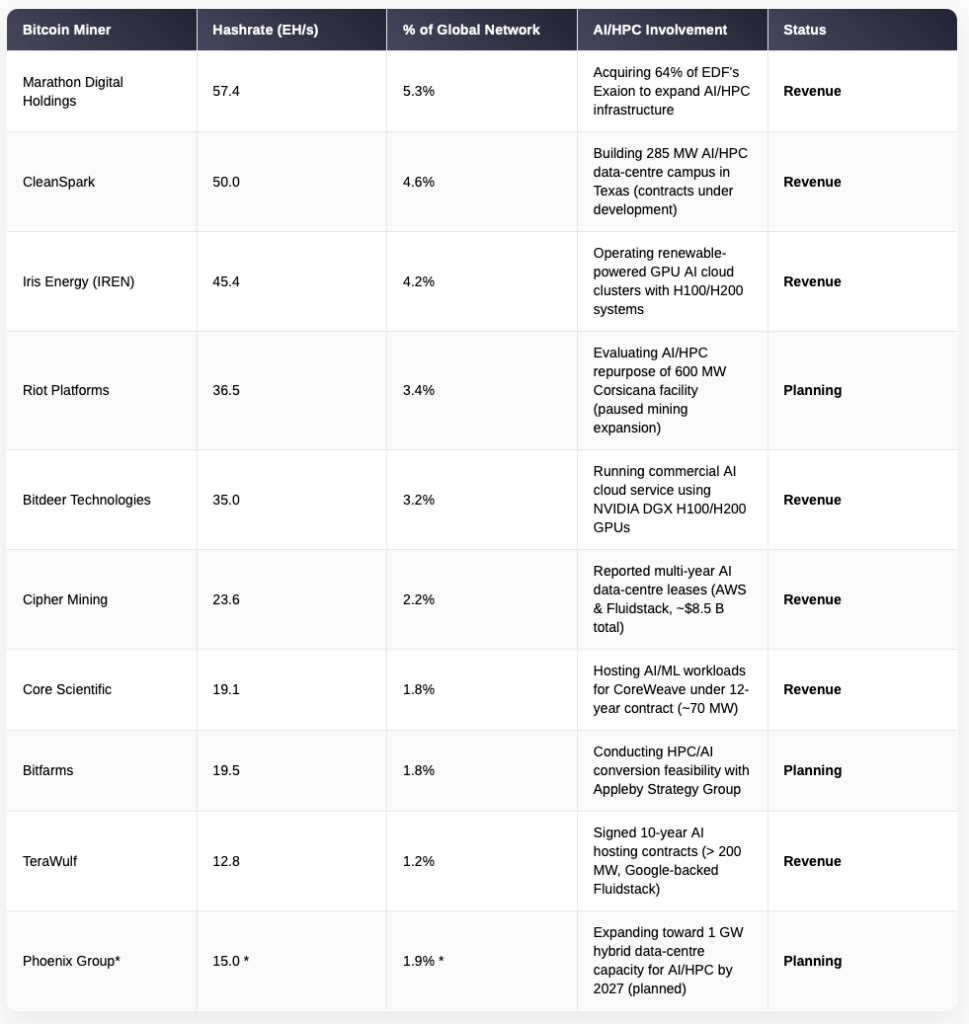
Seven of the ten largest miners by hash rate now derive revenue from AI or high-performance computing (HPC). The other three plan to follow, reports CryptoSlate.


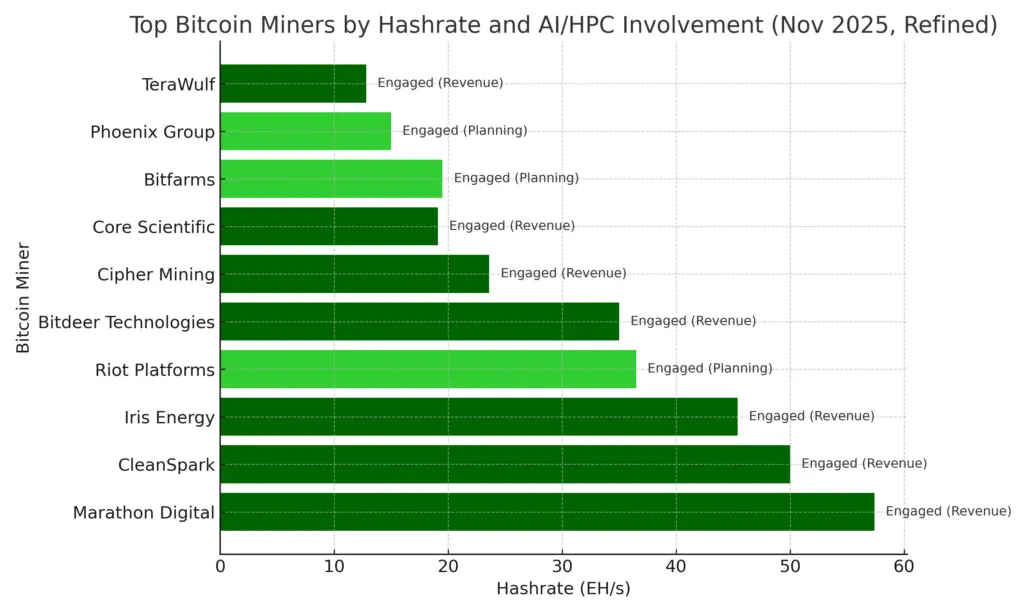
Crypto miners are building a second line of business that competes with traditional ASIC mining and provides contracted income from clients using GPU infrastructure.
A shift in focus
In August TeraWulf signed a ten-year contract with the cloud AI platform Fluidstack. Backed by Google, the miner will provide about 250 MW for a total of $3.7bn.
The firm will offer its Lake Mariner campus in western New York to host high-performance computing capacity. The facility is engineered for liquid cooling of AI loads and built for scale.
The deal envisages roughly $3.7bn of revenue over the first ten years and includes two optional five-year extensions. If exercised, total revenue could reach $8.7bn.
Google will guarantee $1.8bn of lease obligations. In return, the company will receive warrants to buy about 41m TeraWulf shares — roughly 8% of equity.
In June 2024 Core Scientific signed a 12-year contract with AI firm CoreWeave to provide 200 MW of infrastructure for hosting Nvidia GPUs.
Core expects annual hosting revenue from CoreWeave of about $290m, totalling $3.5bn over the term.
In October 2025 CleanSpark acquired 110 hectares of land and 285 MW of power in Texas for a ‘next-generation’ AI and HPC campus.
In August MARA bought 64% of Exaion — an EDF subsidiary — to expand global capabilities in artificial intelligence and high-performance computing.
Riot is weighing converting roughly 600 MW in Corsicana for AI and HPC and has suspended all plans to expand mining. Bitfarms has hired advisers to study the shift and is marketing its sites to AI clients.
Cipher Mining leased its Colorado City, Texas, data centre to the UK’s Fluidstack. Google agreed to guarantee $1.4bn of lease obligations in exchange for 5.4% of the miner’s equity.
Abu Dhabi’s Phoenix Group plans to lift data-centre capacity above 1 GW with an AI focus. It is exploring a US listing to finance expansion.
The economics
Bitcoin’s total computational power is around 1.08–1.1 ZH/s. The network produces 144 blocks a day. Each pays a 3.125 BTC block subsidy plus transaction fees.
Feeding 1 MW into a modern ASIC with efficiency of roughly 17 J/TH yields about 0.059 ZH/s. That share of the network earns roughly $1–1.6m a year before power and operating costs, assuming bitcoin at about $104,000.
TeraWulf’s AI contract implies $1.85m in annual revenue per MW. More stable cash flows and high margins are the main attractions for companies pivoting to neural networks.
Utilities are adapting: American Electric Power has raised its five-year investment plan to $72bn.
The market is voting
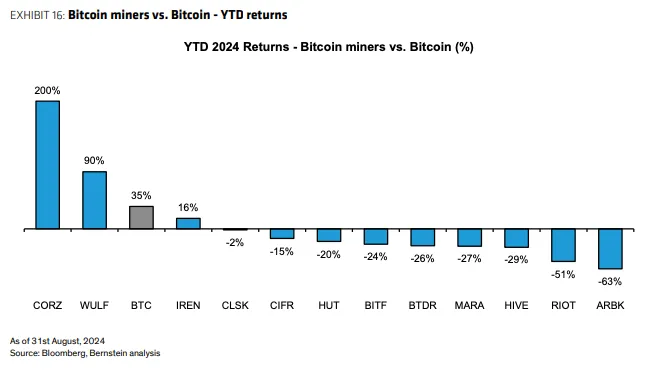
Shares of bitcoin miners with AI sidelines are outperforming peers focused solely on crypto mining.
AI-tilted firms such as Core Scientific, IREN and TeraWulf have fared better, helped by investor confidence in diversified business models, more predictable revenue and greater flexibility.
Analysts note that hash-rate growth at such miners may be slower than at pure-play bitcoin operators. But AI-focused firms are expanding data-centre infrastructure, opening additional opportunities in a fast-growing sector.

Constraints remain. Lead times for power and transformers, and the availability of gas turbines for new peaking loads, govern project start-ups. GPU supply is finite, too.
In crypto mining, shifts in network activity can lift fees, narrowing the gap between mining revenue and AI hosting. A 0.5 BTC increase in average fees per block adds about $0.2–0.3m per MW per year.
New metrics
AI compute contracts and dollars of revenue per MW are becoming the key metrics investors watch. A range of $1.5m–$2m per MW per year is emerging as the benchmark for US hosting centres.
Utilities’ capital plans and interconnection-queue updates now matter as much to miners as ASIC delivery schedules.


If US power markets tighten, miners with existing interconnections will monetise faster than those building from scratch.
Implications for crypto
The upshot may be slower growth in bitcoin’s aggregate hash rate if a significant share of new power goes to GPUs rather than ASICs.
Even so, a high bitcoin price and bouts of fee spikes keep the industry attractive. But hash rate is becoming a less reliable gauge of miners’ market value than in past cycles, CryptoSlate notes.
In August 2024, AI’s power consumption overtook that of bitcoin mining.