




What is Monad?
Monad is a layer-1 smart-contract platform that implements innovative approaches to scaling.
EVM-compatible protocol is designed to accelerate on-chain operations and reduce user costs. It targets fast transaction processing (TPS of up to 10,000), one-second block intervals and instant transaction finality.
High performance is delivered by the unique MonadBFT consensus, while EVM compatibility ensures seamless interaction for developers and users.
By offering a convenient and powerful L1 blockchain, Monad blends advanced technologies such as the MonadDB database, deferred and parallel execution. Developers can use their Ethereum skills and familiar tooling to build on the new platform. Users gain fast transactions with low fees.
What is Monad Labs?
The startup Monad Labs was founded in 2022. The team, with years of experience building high-performance trading systems at Jump Trading, aims to overcome the low throughput and high fees that plague many L1 projects.
The CEO and co-founder is Keone Hon. In his words, the company, using cutting-edge blockchain technology, can set a new industry standard for speed, transparency, security and scalability.
How is parallelism implemented in Monad?
A key feature of Monad is the ability to execute in parallel. It allows multiple transactions to be processed at the same time, unlike the sequential approach used by most EVM-compatible blockchains. Examples include Ethereum, Avalanche and BNB Chain.
The system uses optimistic concurrency control (Optimistic Concurrency Control, OCC) and software transactional memory. This ensures data integrity and maximises network throughput without sacrificing reliability and security, making Monad a high-performance alternative in the blockchain space.
Using OCC, the system assumes all transactions are independent and processes them concurrently. When a dependency is detected, Monad re-executes them with updated data, applying static code analysis to predict such cases.
The new platform preserves Ethereum compatibility by structuring blocks as a linearly ordered set of transactions. This guarantees execution results identical to those on the second-largest network by market capitalisation.
What is Monad’s deferred execution mechanism?
A key feature of Monad is the ability to execute in parallel. It allows multiple transactions to be processed at the same time, unlike the sequential approach used by most EVM-compatible blockchains. Examples include Ethereum, Avalanche and BNB Chain.
The system uses optimistic concurrency control (Optimistic Concurrency Control, OCC) and software transactional memory. This ensures data integrity and maximises network throughput without sacrificing reliability and security, making Monad a high-performance alternative in the blockchain space.
Using OCC, the system assumes all transactions are independent and processes them concurrently. When a dependency is detected, Monad re-executes them with updated data, applying static code analysis to predict such cases.
The new platform preserves Ethereum compatibility by structuring blocks as a linearly ordered set of transactions. This guarantees execution results identical to those on the second-largest network by market capitalisation.
What is MonadBFT?
MonadBFT, an optimised version of the HotStuff algorithm, is the high-performance consensus mechanism of the Monad blockchain. It is designed to simplify communication between validating nodes and block leaders, reducing consensus rounds and increasing efficiency.
The purpose-built Byzantine fault-tolerant (BFT) mechanism quickly verifies transactions even if some validating nodes are faulty or compromised.
To reach consensus on a new block, the leader sends proof of correctness of the previous block to the validating nodes. The latter then send a signed “yes” message directly to the next leader, attesting to the block and signalling readiness to proceed.
If a block leader falls behind and nodes fail to reach consensus, MonadBFT activates a fallback communication path that requires more time and mutual messaging among all validators. This approach ensures consensus is achieved regardless of delays or failures.
What is MonadDb?
MonadDb is a specialised state database for the Monad blockchain. By storing data on the current state of the chain, including accounts, balances and smart-contract code, MonadDb optimises the speed of operations. It is critical for parallel transaction execution on the Monad network.
Unlike most Ethereum clients, which use various data structures, it employs a Patricia Trie both on disk and in memory, enabling asynchronous I/O support.
Parallel execution of transactions requires simultaneous reads and writes to the database. MonadDb’s architecture can efficiently handle many transactions at once, improving the blockchain’s performance and scalability.
What are Monad’s advantages?
Positioning itself as a next-generation smart-contract platform, Monad offers several key advantages:
- high throughput: Monad can process up to 10,000 TPS, far outstripping many existing blockchains. Such performance suits applications that require fast and inexpensive transactions;
- parallelisation: Monad processes multiple transactions simultaneously, boosting network efficiency and reducing latency;
- high transaction speed — instant finality thanks to a “pipelined” consensus mechanism;
- full EVM compatibility, which simplifies porting existing Ethereum applications and encourages an inflow of users from other ecosystems;
- innovative architecture designed to tackle scalability challenges, giving the platform room to support a growing number of transactions and users;
- lower costs: Monad’s efficiency can lead to lower transaction fees, making it an economically attractive platform for users and developers.
The table below compares Monad with popular EVM-compatible systems on key parameters.


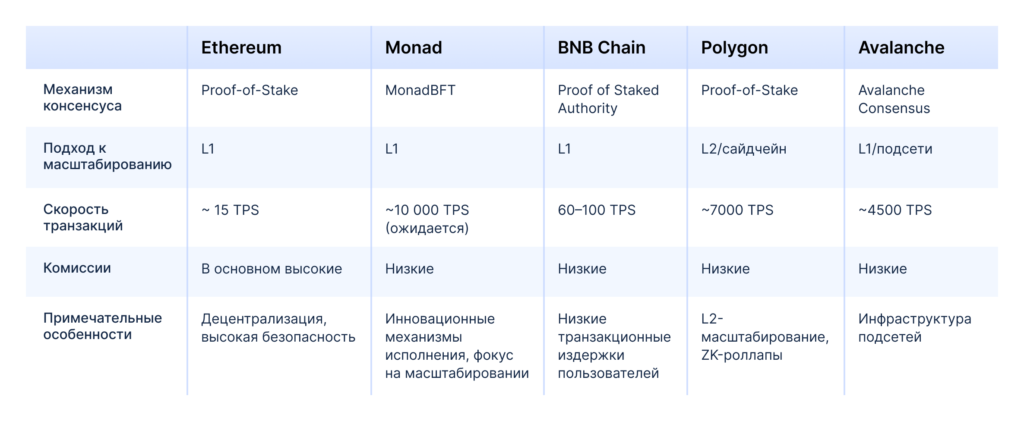
What are Monad’s pitfalls?
Consider the potential issues facing Monad.
Technical complexity
Parallel processing and MonadBFT deliver considerable benefits, but also introduce complexities: the need to maintain data consistency and resolve conflicts between transactions. Debugging and diagnosing issues during parallel execution can be more challenging than with traditional sequential processing.
Centralisation risks
A potential problem for the Monad blockchain lies in the risk of centralisation. One factor is the significant involvement of venture capital in the project, which could concentrate a large number of tokens among a few actors.
This could, in time, lead to an imbalance in governance and decision-making within the network. Large investors may wield significant influence over network upgrades, policy changes and other important aspects.
Novelty and competition
Amid intensifying competition, the Monad platform will inevitably face challenges in attracting users and developers already embedded in large ecosystems.
To gain a foothold, Monad will need to win community trust, demonstrate real-world use cases and provide convenient tools for developers. These steps would help the platform compete with existing blockchains, lowering barriers to entry and strengthening its position in decentralised technology.
How is the Monad project developing?
In April, the Monad Labs team closed a $225m funding round. Paradigm led the round; other participants included Electric Capital and Greenoaks.


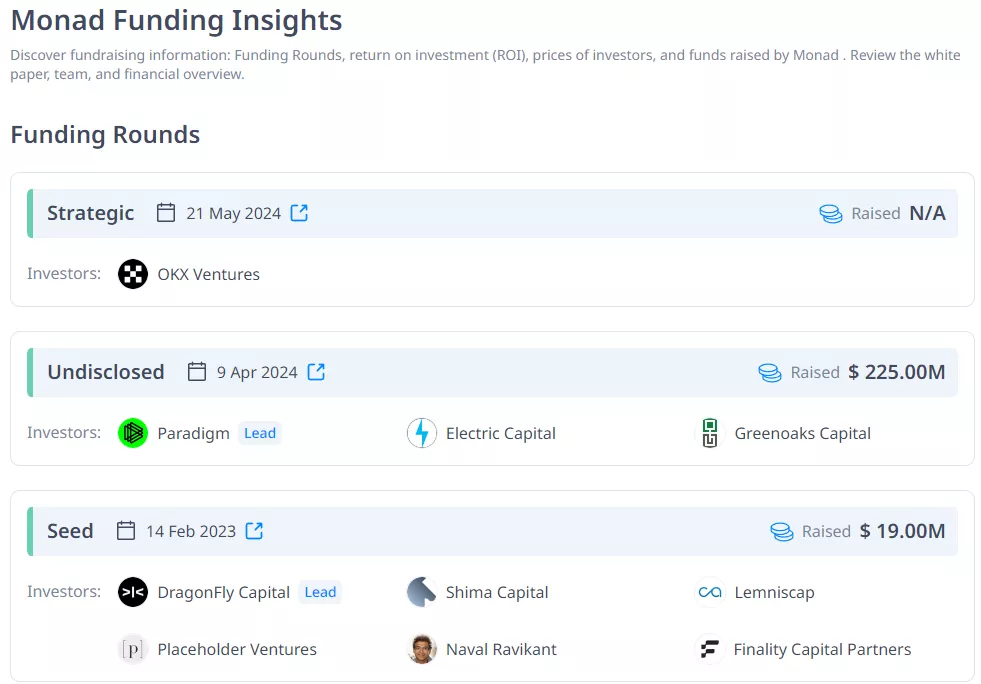
In February, the project raised $19m from Dragonfly Capital, Placeholder Capital, Lemniscap and Shima Capital, as well as several angel investors.
In March, the developers launched a devnet; during testing the network delivered 10,000 TPS.
The team plans to roll out mainnet by year-end, with testnet in the coming months. Monad founder Keone Hon has also not ruled out issuing a native token.