




One of the most enigmatic companies of our era. A secret software developer for the security services. A firm that knows everything about you. This is how various media described the American software company Palantir Technologies, which works with data analytics.
Its clients include the army, police, intelligence services, banks, and, more recently, the U.S. Department of Health and Human Services, which tasked Palantir with building a platform to fight the coronavirus.
What has earned the company the ire of human rights advocates, what services it provides to American law enforcement, how the PayPal hack by a Russian hacker influenced its creation, and why it is accused of facilitating immigrant tracking — ForkLog examines.
- Palantir sells its products to a wide range of customers, but its main clients are the intelligence services and government agencies.
- Palantir’s software allows correlating data from multiple sources, identifying relationships between them and visualising them in the form of various diagrams.
- Human rights advocates say that Palantir’s cooperation with certain American government agencies may violate human rights.
Founded in 2003 Palantir получила its name from the Palantír stones in Tolkien’s legendarium. With them one could see what was happening elsewhere or what had happened.
Palantir is the brainchild of well-known entrepreneur and investor Peter Thiel, so the Tolkien reference is not surprising. He frequently draws inspiration from the Tolkien universe—at least five companies, co-founded by Thiel, borrow their names from Tolkien’s works.
Thiel известен as the “don of the PayPal mafia.” It was during his time at PayPal that the idea for Palantir was born. And this was aided by a Russian hacker.
In his book “Zero to One: How to Create a Startup That Will Change the Future” Thiel described the problem PayPal faced in the mid-2000s — the company could not track a large number of transfers and, due to card fraud, was losing more than $10 million a month.
The automatically designed algorithm for tracking transactions initially did not work — fraudsters quickly adapted to it and changed tactics. Later PayPal rewrote the program using a hybrid approach — “the computer flagged the most suspicious transactions in the user interface, and human operators then made the final call on whether it was fraudulent.”
“We named this hybrid system ‘Igor’ — after the Russian internet fraudster who boasted that we would never be able to beat him,” — writes Thiel.
Thanks to the new solution the first quarter of 2002 turned out to be PayPal’s first profitable quarter. The FBI took an interest and asked for permission to use “Igor” to uncover financial crimes.
After selling PayPal, Thiel continued thinking about the solution and shared with his classmate Alex Karp the idea for a new startup — a synthesis of human and algorithmic data analysis to discover terrorist networks and financial fraud.
This idea would later be realised in the creation of software that enables extracting maximum information from fragmented data sources. It would be named Palantir, and Karp would become CEO.
***
In addition to Karp, Thiel recruited former PayPal engineer Nathan Gettings and two Stanford graduates Joe Lonsdale and Stephen Cohen to create Palantir. They were to develop the algorithm.
Despite FBI interest in the “Igor” solution, government agencies did not immediately pay attention to Palantir, which offered a similar algorithm with an easy-to-use interface.
Initially the development was funded entirely by Thiel himself. Alex Karp, tasked with finding funding, had little luck — dozens of investors rejected the startup.
However Palantir soon attracted interest — the company received $2 million from the CIA’s venture arm In-Q-Tel.
“Investments from In-Q-Tel gave Palantir something more important than money: the CIA’s blessing. When doors in Washington began to open, Palantir started drawing supporters from intelligence and national security organizations,”Intelligencer.
Subsequently Palantir counted among its clients various government services, including the FBI, the Department of Homeland Security, the NSA, the United States Air Force, and others.
Among Palantir’s clients was the Los Angeles Police Department.

Sociology professor Sarah Brayne of the University of Texas at Austin spent more than two years studying how Los Angeles police officers use the system. The Results of her research not only shed light on how Palantir really works, but also raised concerns about the consequences.
The Palantir database contained standard information about citizens — names, gender, place of education and the like. Additional information came into the system from government agencies, for example the U.S. Department of Transportation. It was also augmented with data purchased from private companies.
Not only offenders entered the system, but also their contact people.
“I would warn against the notion that if you have nothing to hide, you have nothing to fear. This logic rests on the assumption that information is entered into the system without errors or bias,”BuzzFeed.
Palantir’s software scans various data sources — financial documents, flight-booking information, mobile phone data, social media messages — and looks for connections that analysts might miss, Bloomberg reports. It then presents the discovered connections in an easy-to-interpret graph that looks like a web.
Journalists studied the user manual for the Palantir Gotham application used by law enforcement.
According to it, police could obtain extensive information about a person with relatively little data about them — for instance, knowing only a name or a license plate.
Some data sources — such as marriage, divorce, birth, and business activity — also included information about other people connected to the individual. Brayne called this a secondary surveillance network.
“When police take an interest in someone, they do not simply collect phone numbers, business relationships, travel histories of the suspect and the like. They also collect information about people connected to him,”Vice.


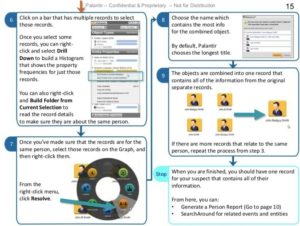
A special tool allowed the police to filter, sort, visualise and export various data. Found connections are visualised using diagrams, histograms or timelines — the tool selects the best option based on the analysed data.



When a person appeared in the system, a police officer could “subscribe” to them, Brayne’s study of the Los Angeles Police Department’s interactions with Palantir shows.
For example, an officer could receive a phone notification when the vehicle of the person of interest was in a “suspicious” area. This was achieved through integrating data from street surveillance cameras into the Palantir system.
“Without public oversight or regulation, Palantir helped the Los Angeles Police Department build an extensive database with names, addresses, phone numbers, license plate details — including information about friendships and romantic relationships — the guilty, the innocent, and those in between,”BuzzFeed.
Another Palantir client was the U.S. Immigration and Customs Enforcement (ICE). In 2014 it signed a $41 million contract with the firm to build and maintain a tracking system.
Human rights advocates are convinced that Palantir played a key role in deporting undocumented migrants. The company, for its part, insisted that it did not work with ICE, which is responsible for detaining undocumented immigrants and deportations.
Yet Palantir’s assurances did not persuade human rights advocates. Amnesty International criticised the contracts with ICE and said Palantir “does not meet its human rights obligations.”
Palantir Briefing Report by ForkLog on Scribd
Attention to Palantir’s collaboration with ICEhas been drawn to it due to Thiel’s ties to U.S. President Donald Trump, who is known for his anti-immigrant rhetoric. Thiel is arguably the only Silicon Valley figure who openly supported Trump.
Karp, who in 2015 sharply criticized Trump, was seen at a meeting with him among the leaders of major tech companies shortly after the latter’s election.
Palantir’s work with ICE sparked internal discontent among company staff. Karp said that collaboration with authorities would continue.
“Silicon Valley is telling the average American ‘I will not support your defense needs’ while selling products to countries that are adversarial to America. That is a loser position.”
— Palantir (@PalantirTech) July 18, 2019
“Кремниевая долина говорит рядовому американцу: «Я не собираюсь поддерживать твою потребность в обороне», в то время, как сама продаёт разработки враждебным Америке странам. Это позиция лузеров,” — заявляет Карп.
This patriotism is hardly the cornerstone of Palantir. In the documents submitted for its IPO, it states that it “does not work with clients or governments whose positions or actions are incompatible with the mission to support Western liberal democracy and its strategic allies.”
The fact that the company’s main clients are primarily law-enforcement and US security agencies fully reflects its devotion to this mission.
As Bloomberg noted, according to some sources, Palantir’s system even helped eliminate Osama bin Laden. The company neither confirms nor denies these rumors. In his book, Thiel merely stated that he “cannot talk about that operation.”
He noted that with Palantir-created software, analysts were able to predict where Afghan insurgents planned to carry out attacks.
At the same time Palantir is trying to reduce its dependence on government contracts and broaden its client base. Commercial clients work with Palantir Foundry — a platform for data integration.
One of the company’s first corporate clients was the financial holding JPMorgan. But initially this collaboration was clouded by a scandal.
In 2009 Palantir specialists worked with a JPMorgan group tasked with detecting insider threats, Bloomberg reports.
Palantir software analysed emails, browser histories, decryptions of phone conversations, identifying keywords and patterns in bank employee behaviour.
For example, Palantir’s algorithm warned the JPMorgan insider-threat team when a employee began arriving at work later than usual, a sign of potential discontent.
Employees were shocked that “neither the bank nor Palantir had put any restrictions,” as the publication notes.
This story ended with top bank managers learning that they were being watched too.
“A platform built to fight terrorists was used against ordinary Americans,” — Bloomberg summarizes.
To meet privacy and security obligations, Palantir catalogs and tags user data — all its actions are documented.
The company also seeks to adhere to certain “ethical norms” — for employees Palantir has created a hotline called Batphone for ethics questions. It allows staff to anonymously report work for clients they consider unethical.
The hotline emerged after the WikiLeaks scandal. In 2011 it emerged that one employee discussed in emails the possibility of tracking WikiLeaks informants to prevent disclosure of documents from Bank of America.
Karp issued public apologies and stated that Palantir supports the right to free speech and the right to privacy.
Karp himself believes the company can balance privacy with security.
“I did not sign up for the government to know when I smoke a joint or who I am dating,” — Forbes quotes Karp.
In his letter to the SEC, Karp virtually directly accused Silicon Valley companies such as Facebook and Google of selling personal data and intruding on private life.
“Software projects with defence and intelligence agencies of our country, whose tasks involve ensuring our security, have become controversial, while ad-supported companies have become commonplace,” — writes Karp.
He noted that the Silicon Valley engineering elite may know more about building software than anyone else, but “does not know more about how society should be organised or what justice requires.”
Yet Intelligencer notes that his argument ignores the fact that Palantir was used to analyse data from social networks, including Facebook posts.
***
In 2020 Palantir carried out a direct listing of its shares on the New York Stock Exchange (NYSE).
We’re excited for @PalantirTech to list on the NYSE today. pic.twitter.com/cz91Acipwt
— NYSE ? (@NYSE) September 30, 2020
According to the SEC documents, in the first half of 2020 the company had 125 clients. Palantir’s revenue for that period reached $481.2 million.
Documents also show that revenue from government contracts rose by 76%, while from commercial contracts — only by 27%. Combined since June 2019 it rose by nearly half.


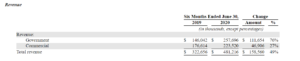
At the same time Palantir has reported losses every year since its founding, the company itself notes in its risk section. A large portion of revenue comes from a small number of clients.
In addition, as Bloomberg Businessweek reports, investors will hardly be able to influence management decisions, as “Palantir was designed so that Thiel, Karp and co-founder Stephen Cohen control half of the voting shares through a trust for eternity.”
The publication notes that the company can afford this partly because its software is “almost perfectly suited for solving problems related to the coronavirus pandemic.”
At the end of April the U.S. Department of Health and Human Services (HHS), responsible for the pandemic response in the United States, signed a contract with Palantir for $25 million. The company is to oversee the operation of the HHS Protect platform for data collection and analysis.
“The deal was among more than a hundred Palantir signed in the early days of the pandemic — 83 of them in March through early April — and it is one of the reasons for the improvement in the company’s financials this year,” — noted Bloomberg Businessweek.
In the wake of this deal several members of Congress asked what data HHS Protect would collect and how it would be used, recalling the ICE scandal.
“We have concerns about how the existing Palantir system, used to track and arrest immigrants, will be augmented by health information arriving from HHS Protect,”
The deployment of large-scale citizen-tracking systems during the pandemic has deeply concerned human rights advocates, especially when the companies building such systems are closely tied to the authorities.
Back in 2011 Peter Thiel told Bloomberg that proponents of civil liberties should welcome Palantir’s creation:
“We cannot afford another 9/11. That day opened the doors to all kinds of abuses and draconian policy.”
According to him, the best way to avoid such scenarios in the future is to give the government access to advanced technologies and to ensure protection against their improper use.
Yet after a series of disclosures about government surveillance, the world seems unlikely to believe in the infallibility of security agencies or governments when it comes to intrusions into private life.
Many years have passed since Edward Snowden’s revelations, but surveillance systems continue to evolve and scale, as numerous studies attest.
The aggregation of data collected by these systems into one database risks creating a tool that will literally know everything about you. But where would privacy stand in such a scenario?
Author: Alina Saganskaya.
Subscribe to ForkLog news on Telegram: ForkLog Feed — the full news stream, ForkLog — the most important news and polls.