


How the Pandemic Is Killing Internet Freedom: A Freedom House Report
Against the backdrop of the COVID-19 pandemic, internet freedom worldwide deteriorated sharply. Governments have seized the opportunity to tighten surveillance of citizens and curb the right to a free internet. The data come from the NGO Freedom House’s report “Freedom on the Net 2020.”
NEW REPORT out today: #FreedomOnTheNet
The 2020 report show internet freedom has declined for 10 straight years — contributing to a broader crisis for democracy around the world.
Read the full report at https://t.co/sGe9DYwUmd pic.twitter.com/9ut8w8xJms
— Freedom House (@freedomhouse) October 14, 2020
- Across the board, internet freedom declined in every country.
- Under the pretext of the coronavirus pandemic, authorities are deploying more tools for mass surveillance and the gathering of personal data, tightening censorship and building a “sovereign internet”.
- Russia and Belarus were rated as not free, while Ukraine was rated partly free.
Freedom House analysts studied 65 countries, whose residents account for 87% of the world’s internet users. The study covers June 2019 to May 2020.
The Internet Freedom Index assigned to countries is based on 21 indicators, including restrictions on internet access, content censorship, and violations of users’ rights.
Based on this, countries were grouped into three categories by level of internet freedom: free, partly free and not free.
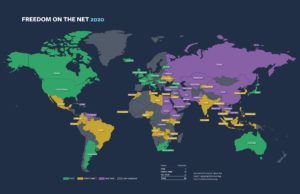
Iceland leads the internet freedom index (95 out of 100). Estonia follows with 94 and Canada with 87.
China ranks worst for the sixth year in a row for the use of centralized infrastructure for “pervasive monitoring and filtering of all traffic entering the country.”
The report notes a general worsening of internet freedom worldwide. Researchers say governments have used the pandemic to expand censorship and broaden systems of control over populations.
Freedom House highlights three main trends:
- governments’ push toward cyber sovereignty intensified, as each country imposes its own rules for the internet to curb cross-border information flows;
- governments around the world used the pandemic as a pretext to restrict access to information;
- under the pretext of fighting COVID-19, the spread of tracking technologies accelerated.
Cyber Sovereignty
The desire of governments to create a sovereign internet and restrict information flows alarms researchers, as the trend is seen worldwide, including in democratic countries.
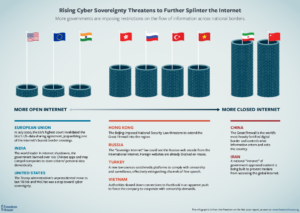
Against this backdrop, analysts noted, among other things, attempts by the United States to ban Chinese apps, law on the protection of national security in Hong Kong, and Russia’s runet-isolation law.
Russia was assigned an index of 30 and classified as not free. Belarus sits in the same category.
Mikhail Klimarov, executive director of the Internet Protection Society (IPS), told ForkLog that Russia is indeed seeing a deterioration in internet freedom.
Recently the IPS released its own report on Russia’s internet-freedom index. For the first time in five years of counting, the index fell below zero.
⚡Наконец-то выпустили большой отчёт по индексу свободы рунета за 5 месяцев. Дно пробито во всех смыслах
Подробнее внутри: https://t.co/4rMWsWf8Xt
— Internet Protection Society (@safe_runet) October 13, 2020
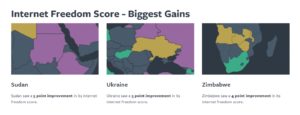
According to Freedom House, Ukraine rose several points over the year — its internet-freedom index stands at 61.
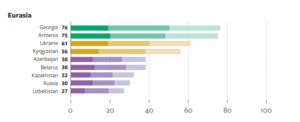
In the report, Ukraine’s improvement is attributed largely to the assessment excluding eastern territories, “because they differ greatly from areas controlled by the Ukrainian government.”
Ukraine emerged among the leaders in index growth, improving by 5 points over the year.
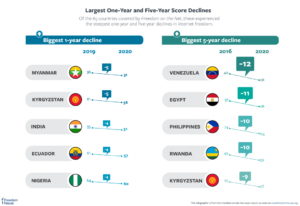
Among the top five countries with the largest declines in the internet freedom index over the year was Kyrgyzstan.
«Rather than protecting users, applying national sovereignty to cyberspace gives authorities free rein to act in the protection of human rights»
Censorship
Governments in at least 28 countries blocked content, “to suppress unfavourable statistics, critical reporting and other COVID-19 content,” the researchers write.
«Nowhere has censorship been more complex and systematic than in China, whose authorities hurried to control information due to their initial reluctance and inability to contain the Wuhan outbreak,» the report notes.
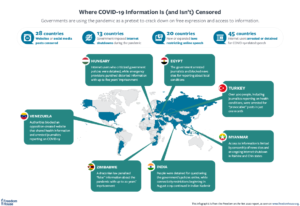
Against the backdrop of the pandemic, suppression of freedom of expression has intensified. Freedom House notes that in 45 of the 65 countries analysed, activists, journalists and ordinary people “were arrested or prosecuted for online statements related to COVID-19.”
In many countries, internet shutdowns were recorded. They often occurred in the areas where historically marginalised groups live, the researchers note.
The report does not reflect internet shutdowns in Belarus, as large-scale access problems began in August and fell outside the period Freedom House studied.
The researchers noted that since the start of the pandemic more people have become dependent on the internet as remote work took hold. Therefore, access restrictions could have far-reaching social, political and economic consequences, Freedom House warns:
«Protecting access to a free and open internet is fundamental to the future of democracy».
Tracking
Different citizen-tracking systems have been rolled out with little scrutiny or resistance, the researchers note:
«It is troubling that authorities in many countries used the public health crisis to introduce new forms of surveillance, gaining new capabilities for social control with few checks and balances».
In 54 of 65 countries, apps to track quarantine compliance by people infected with the coronavirus have been deployed.
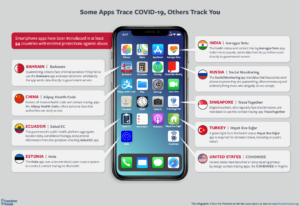
They collect a great deal of personal information and are often transmitted unencrypted, risking leaks and misuse, the researchers say.
In at least 30 countries, authorities cooperate with telecoms providers and other companies to gather information about people’s contacts and to analyse data.
At the same time, in many countries such initiatives lack transparency, proportionality and privacy protections, Freedom House notes.
Vigilance with video surveillance and facial recognition is growing. China again leads in this area. Earlier experts said that the spread of such systems in the PRC is unlikely to slow.
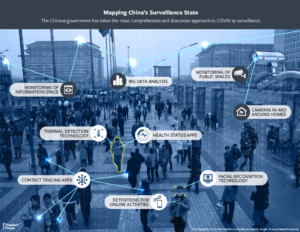
Researchers stress that the trend is not confined to China — Paris’s transport system has begun testing AI-powered cameras. Solutions for remotely identifying infected people are being offered by American and European firms.
Such technologies should be regulated by robust laws and regulations to protect fundamental rights and prevent the normalization of intrusive monitoring, Freedom House says.
***
History has shown that authorities tend to keep the powers and capabilities they gain during emergencies, the report’s authors conclude.
«As with national security questions, government agencies will always argue that they need more data to protect the country,» the researchers note.
For more on the methods governments use to track citizens during the pandemic, read ForkLog’s report.
Subscribe to ForkLog’s news on Telegram: ForkLog Feed — the full news feed, ForkLog — the most important news and polls.
Рассылки ForkLog: держите руку на пульсе биткоин-индустрии!