



Key points
- Almost any asset can be “turned” into an NFT: text, a painting, an audio recording, a domain name, and more.
- Minting and publishing your own NFT is no harder than posting a photo on Instagram. Any user can do it—even without deep knowledge of programming or blockchain technologies.
- A range of services let you create, buy and sell NFTs. The most popular are marketplaces such as OpenSea, Rarible, SuperRare, BakerySwap and Treasureland.
How do NFTs differ from cryptocurrencies?
Cryptocurrencies have a defined issuance; their coins are fungible and can be exchanged one for another. By contrast, every NFT is unique and has no equivalent. Like cryptocurrencies, NFTs are created via a smart contract. A single contract can cover any number of NFTs with shared traits, allowing them to be grouped into collections.
The defining feature—and value—of NFTs lies in the digital items they reference. A token does not store the asset itself; it points to a link to a media file hosted on a server. Thanks to the properties of blockchain, this record cannot be forged or altered, except in legitimate cases such as exchanges or sales. Thus NFTs serve as proof of ownership of a digital item (or a fraction thereof).
The most popular blockchain for creating NFTs is Ethereum. Token metadata is governed by a smart contract built to ERC‑721 or ERC‑1155 standards. Using that metadata, any NFT marketplace and other applications can find each token’s content and display its attributes correctly.
In the State Hermitage Museum’s NFT collection based on the museum’s paintings, every work exists in two copies: a physical one kept at the Hermitage and a digital one presented on Binance NFT. Their authenticity is certified by the museum’s director, and the metadata records the date, time and place of signature.
Which items can have an NFT minted for them?
You can mint an NFT for virtually any object, including in digital form: texts, social‑media posts, images, audio recordings, art objects, in‑game items or characters, domain names, trademarks, and the like.
For example, in February 2022 the National Art Museum of Ukraine began auctioning paintings by various artists as NFTs, and in New York in June the same year Okada & Company put up for sale a single non‑fungible token conferring ownership of an entire seven‑storey office building.
And in May 2022 Madonna released her own NFTs. She created the collection with artist Mike Winkelmann, known as Beeple. Madonna’s NFTs are tied to music videos.
What do you need to create an NFT?
Anyone can mint an NFT; it is straightforward and does not require programming skills or deep knowledge of cryptocurrencies and blockchain technologies.
The simplest way is to upload a file to a major platform, such as OpenSea or Rarible. The platform will then create a unique token and link it to the media file.
To create an NFT you will need:
- the digital asset itself—for example, your drawing or a phone‑shot video;
- registration with the app where you want to mint the NFT;
- a blockchain on which the non‑fungible token will be created (the platform will offer several networks);
- a crypto wallet for authorisation and financial transactions;
- cryptocurrency in the wallet to pay fees for minting and listing the NFT. Fee levels differ by network.
Which blockchain is best for minting an NFT?
Most non‑fungible tokens are minted on Ethereum, but network fees are at least several tens of dollars. There are a number of alternative blockchains often used for NFTs:
Each blockchain has its own NFT standard. The network where a token is minted determines which apps and wallets will support it. An NFT minted on Ethereum can be sold only on platforms that support its token standards, such as Rarible. Another marketplace may support only BNB Chain, like BakerySwap, and you cannot list an Ethereum NFT there.
Popular blockchains offer access to a large audience and deep markets, but transactions are often costlier. Networks with lower fees may have smaller ecosystems.
Which platform should you use to create and sell NFTs?
There are many NFT marketplaces. Not every platform lets any user mint a token. For instance, Nifty Gateway conducts stringent curation before listing a digital asset, so it is often chosen by prominent artists.
Popular platforms, in particular OpenSea or Rarible, are fully open and give any user access to minting and listing NFTs.
OpenSea is the easiest place to find buyers. Its key feature is the variety of categories for items linked to NFTs: art, sport, collectible cards, as well as projects from well‑known artists. OpenSea even lists NFTs for audio files, domain names and 3D objects.
How much does minting an NFT cost?
Each NFT marketplace has its own pricing and charges different fees for minting and listing tokens. As a rule, they levy several types of charges that include two kinds of payment: an upfront fee and a transaction fee.
The upfront fee is a one‑off payment to the platform that the user pays for opening an account or the first NFT listing.
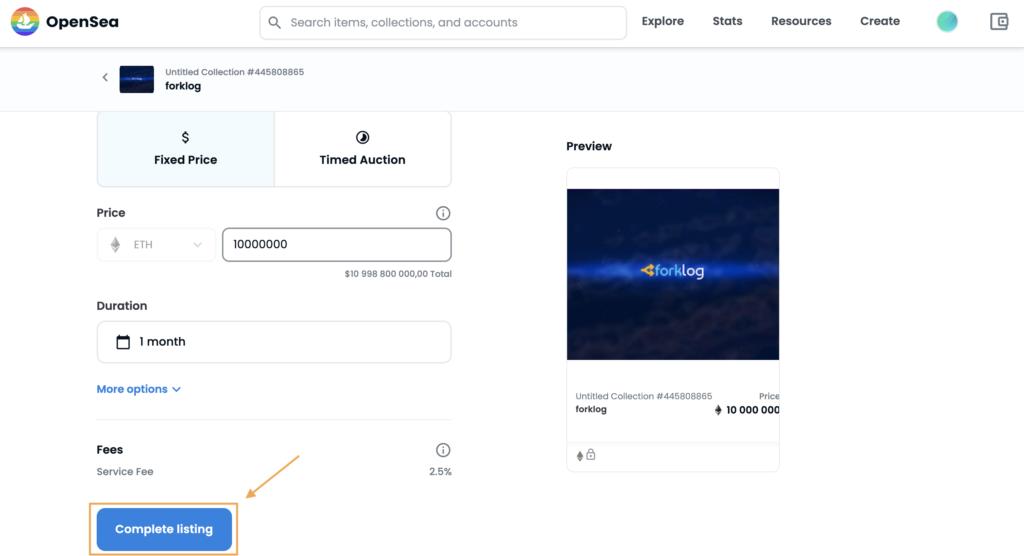
The transaction fee can be fixed and paid only by the buyer, or split between buyer and seller. For example, OpenSea’s standard fee is 2.5% of the NFT price and is charged to the buyer.
The creator can also enable royalties on major NFT platforms. This allows them to earn a commission on each resale of the token. Royalties are fully automated via the marketplace’s smart contracts.
How to create a non‑fungible token on OpenSea?
Here is the process on OpenSea.
1. Go to the home page and click Create:


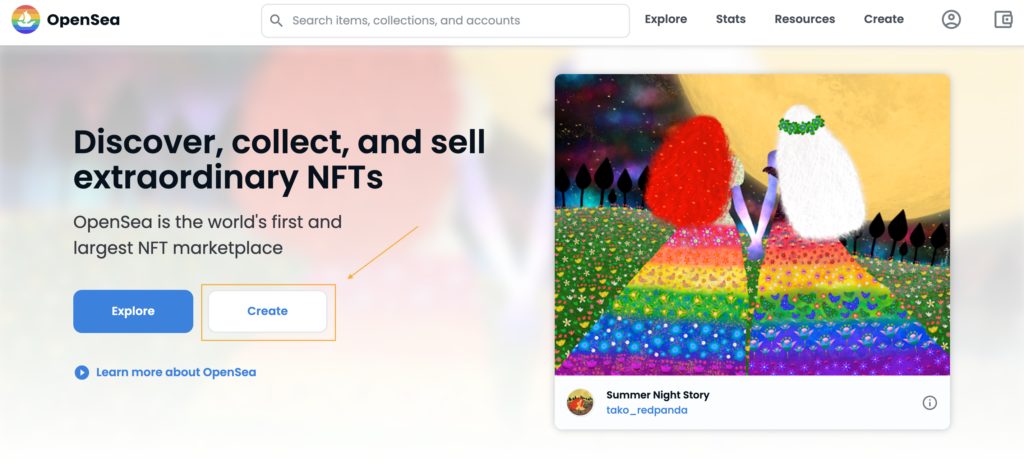
2. The platform will automatically prompt you to connect a compatible crypto wallet. We will use MetaMask.


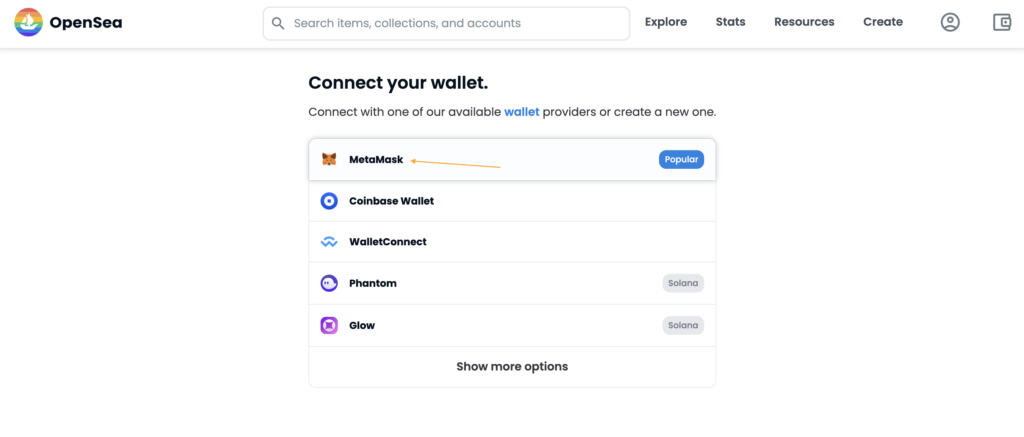
3. The wallet will ask you to sign a message needed to connect it to OpenSea. After confirmation, the platform will automatically create your profile.
4. A new window will open the NFT creation page. Upload the item to be linked to the token: an image, audio, video or a 3D model.


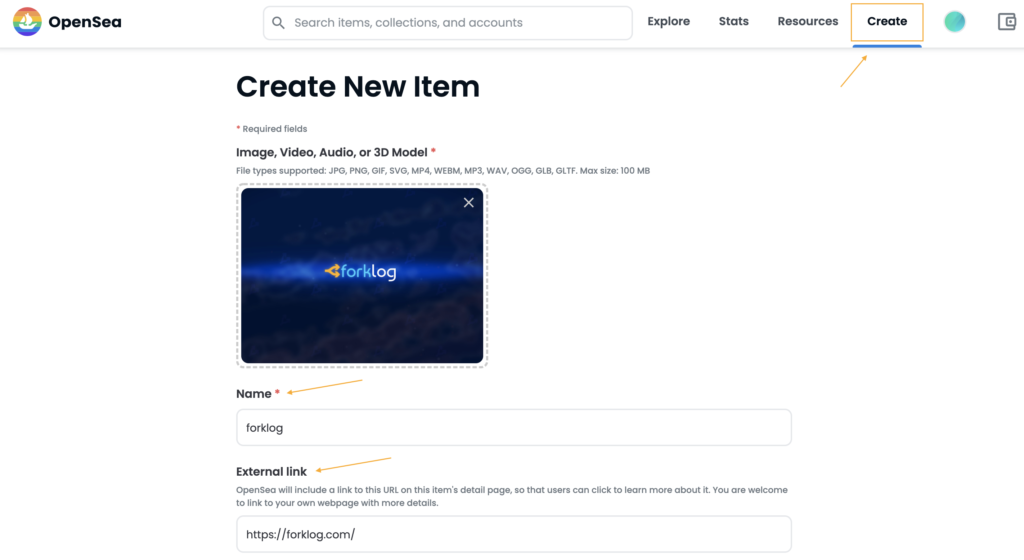
Then enter other details: the token’s name, a link to your website or blog (optional), a description of the item, and choose the blockchain on which it will be listed: Ethereum, Polygon, Klaytn Blockchain or Solana.
You can also use the Unlockable Content option—meaning the token’s metadata will be visible only to its holders.
5. When everything is set, click Create, and the NFT will automatically appear in your collection.
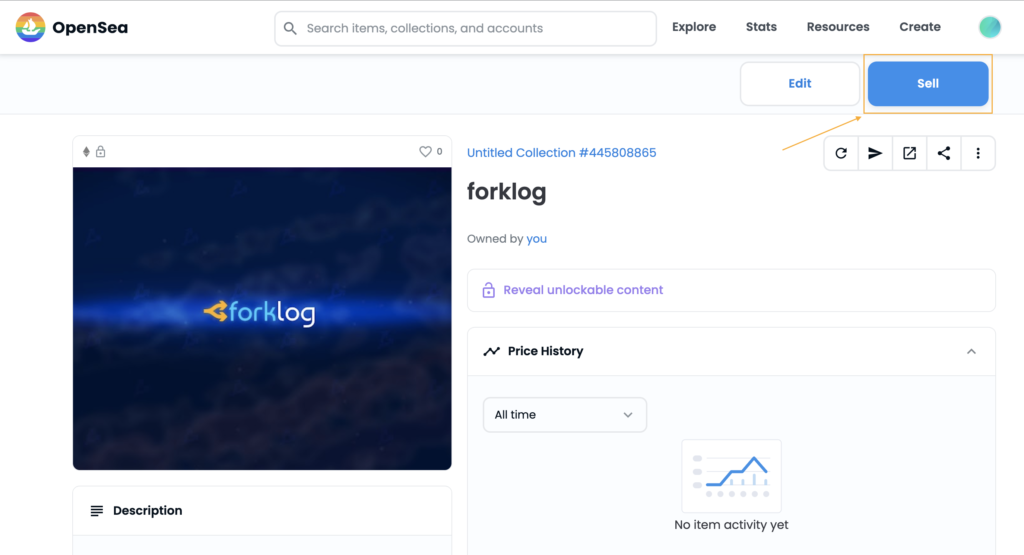
6. To open the sale settings, click Sell in the upper‑right corner of the screen.


A page will appear with settings for price, listing duration and other terms. If desired, the NFT creator can run an auction or set a fixed price. You can also set royalties and choose the cryptocurrencies accepted for payment. Once the parameters are set, click Complete listing.


How to make money with NFTs?
A marketplace does not promise a guaranteed sale, so you will need to promote your NFT and find buyers yourself.
If your priority is building skills in creating digital assets rather than trading, you can join an NFT project as a creator.
Many companies in the field are looking for content creators: artists, musicians, writers and other creative professionals.
What can go wrong when creating NFTs?
It is not feasible to store media files on a blockchain, otherwise its size would become enormous. For example, a copy of Ethereum already exceeds 1 TB. Therefore, off‑chain infrastructure is used to store the files referenced by NFTs.
Often NFT metadata points to a link on a cloud HTTP server where the file is stored. This creates a contradiction: the token is on a blockchain, while the item it references sits on a centralised server. There is therefore a chance (albeit a small one) that the file could be replaced or even deleted.
The InterPlanetary File System (IPFS) partially addresses this. It is a system for decentralised file storage, so files hosted on IPFS are less vulnerable to outside interference. Many hosts—not just a server operator—help ensure the data will not be altered. This is the approach singer Grimes used when selling her collection of unreleased tracks as NFTs.