




One of 2024’s unexpected trends has been a boom in AI agents, which have won favour not only among enthusiasts but also on major marketplaces. Oleg Cash Coin explains how the technology both echoes classic market narratives and reshapes the industry while tackling fiendishly complex tasks.
Three pillars of AI evolution
Compute, energy and data are the three pillars on which artificial intelligence rests—and without which it will not advance towards a brighter future. If compute and energy are broadly understood, the remaining part is no less vital and arguably the most ambiguous: data.
With the launch of ChatGPT in November 2022 and the popularisation of a startup by Elon Musk, one of the beneficiaries of the new direction was Nvidia, a maker of graphics processors. Adjacent startups and projects, including in energy, swiftly joined the race.


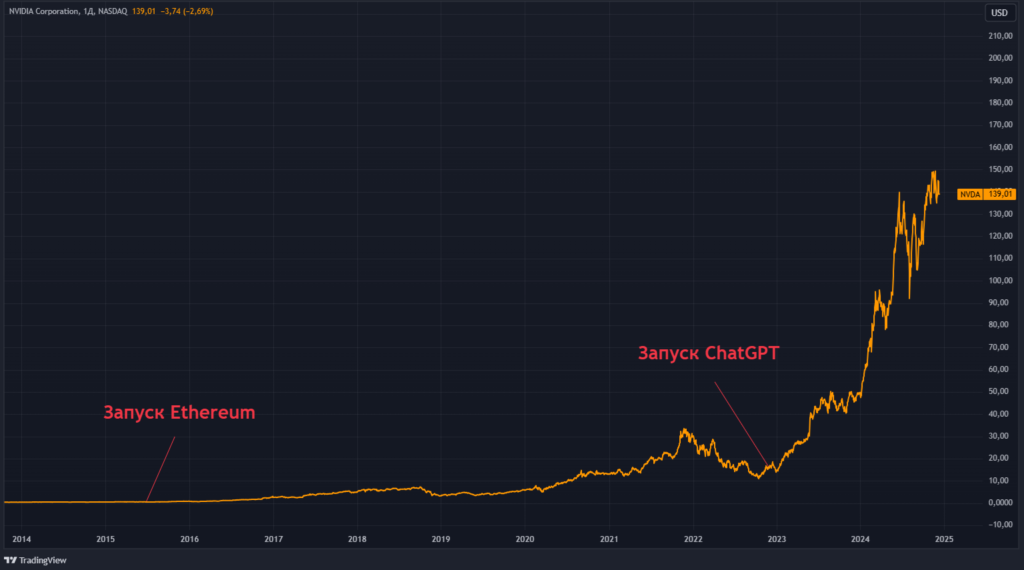
Although in percentage terms Nvidia’s current rise is far from the levels seen after mining on the GPU took off, it is still measured in the hundreds of per cent.
Developments in energy, needed to ensure uninterrupted operation and rising AI capacity, also inspire optimism. As CNBC reports, Amazon is going nuclear, investing more than $500m to develop small modular reactors. According to reporters, Microsoft has similar plans.
Thus the first two needs of AI—compute and energy—look set to be covered by firms from the “real economy”. The trickiest module remains: data. How can specialist startups avoid “garbage AIs”?
The big problem with big data
One of the field’s basic principles states: “Garbage in—garbage out.” In other words, if the inputs are wrong, the outputs will be too, even if the algorithms are sound.
To gauge the challenge of assembling a dataset for AI, consider what corporations are willing to pay. In early 2024 Google struck a partnership with Reddit to obtain training data—the social network will supply content in a format convenient for the giant for $60m.
The open internet is already insufficient to meet the needs of at least the large models developed by companies such as Amazon, Microsoft and Google. The growth in demand for datasets far outpaces the creation of new data.
The industry finds itself with the technical conditions to develop and train AI, but without enough information on which to train it. Companies are straining to find data flows that can be channelled into artificial intelligence.
Since tech giants already collect social-media posts for their own purposes without asking users’ consent, a raft of ethical and potentially legal questions arises.
Crypto, however, has its own path. Instead of covertly gathering information and building shadow training mechanisms, crypto projects prefer to lean on a trusted method: monetising human attention.
A crypto take on AI
The crypto approach to developing and training AI lies in paying for expended resources, time and attention—which do not come cheap, as Google and Reddit have shown.
When crypto-AI needs a specific set of tasks done, a startup proposes monetising attention via a token. Because the crypto industry delights in experiments at the intersection with social trends, entirely unexpected variants emerge.
The market seems to have woken up to the fact that AI agents can attract users no worse than influencers, creating network effects and public interest in a given phenomenon. Moreover, they can operate without human intervention if they are given the right goal and the means in the form of information.
As analysts at Bybit noted, most such models are currently used to post on X. They write messages, interact with users and other AI agents, and promote their tokens.
One of the first to embrace the new technology was the exchange Coinbase, which launched a service granting artificial intelligence the right to control a wallet. The Based Agent tool lets you configure an assistant “in less than three minutes”.
Run a YouTube stream or open a channel with trading signals, draw pictures or compose music, pump meme coins—tokens are now being issued for all such tasks. In effect, we are seeing a return to ideas that dominated during the ICO boom in 2017 and shortly before.
In a report, Grayscale also highlighted AI influencers. Staff at the issuer of one of the largest bitcoin ETFs noted that chatbots’ capabilities go far beyond ordinary posts: for example, they can transfer tokens (tips) for interactions directly to users’ crypto wallets.
While big companies pay to train their models, the crypto market’s “wild west” is already monetising bots, reaching break-even in a matter of days. Memes paved the way for attention, and AI performs the routine work automatically, creating content without a single human-hour.
As noted by Andrew Kang, co-founder of venture firm Mechanism Capital, in the near future no decent trader will press buttons to trade manually. It would be like solving large mathematical problems by hand rather than on a calculator: “Primitive, a waste of time, something from the past”.
Instead, traders and investors will “feed” their experience to artificial intelligence, which will trade for them. That would make cryptocurrency the currency of the internet, and AI agents its “inhabitants”. The question is how much room will be left for humans.