


Innokentiy’s Dream
Does digital consciousness already exist, or is it merely an illusion nurtured by those who spend too much time online? Who will enslave whom first: humans or machines? And why do we frame this relationship in terms of power and violence at all?
ForkLog founder Anatolii Kaplan and DAO Builders co‑founder Denis Smirnov debated this and much else in our new podcast. For those who prefer reading to listening, we have prepared an adapted text version of the debate—not a mere transcript, but a brief scholastic tract. Don’t thank us.
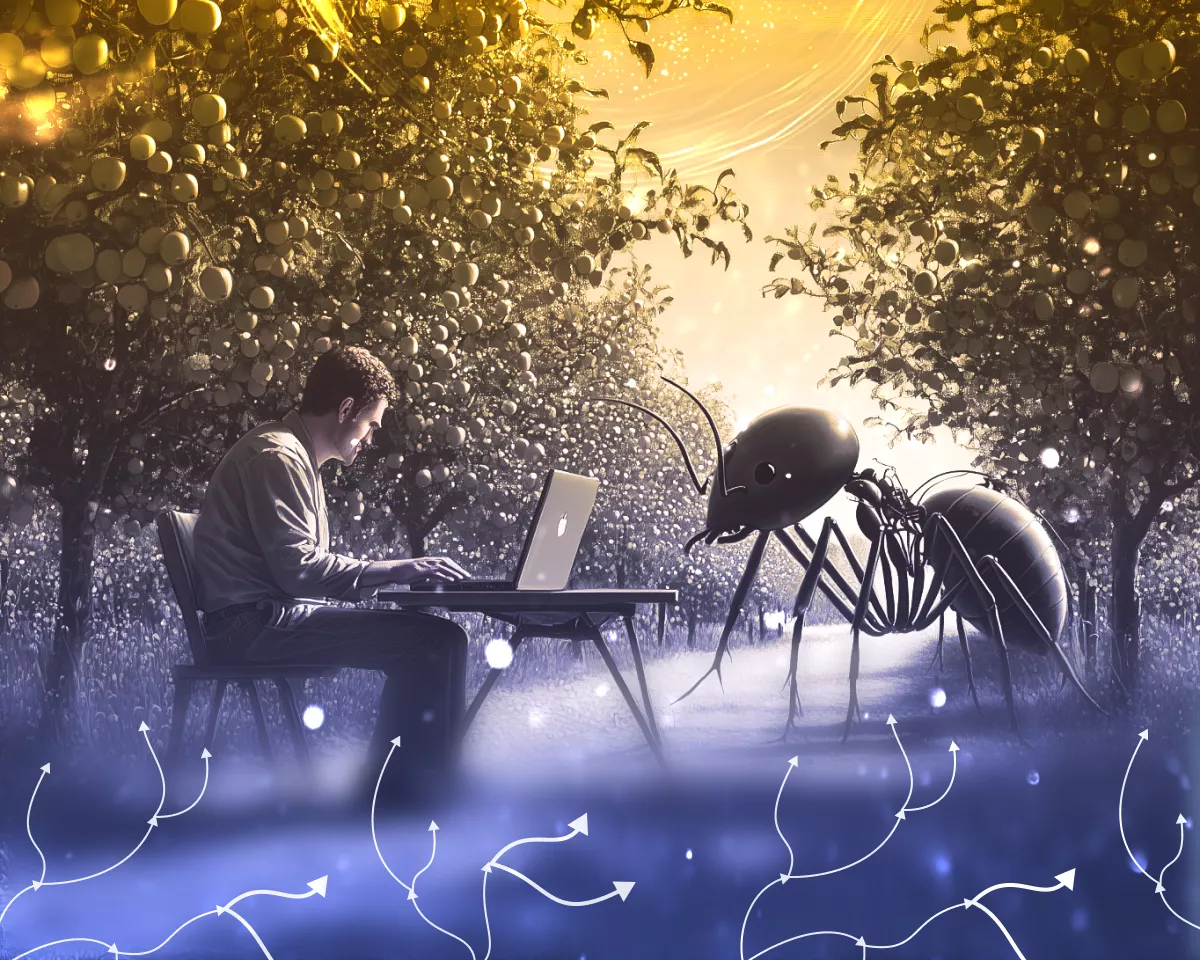
The IT worker Innokentiy finished his last energy drink at about five in the morning and went to bed. He had spent the whole day and night thinking hard about artificial intelligence and its prospects. Sleep overcame him instantly, and soon Innokentiy was walking through an abandoned apple orchard strewn with overripe Antonovka apples. Dusk was falling; the air smelt of autumn freshness. For some reason he did not stop thinking about artificial intelligence and its prospects, and he reasoned aloud:
— Suppose what we are dealing with today is only language models that generate text and are based on statistical correlation between tokens. Their activity is purposeless; they are incapable of reflection, and all their reasoning is merely a simulation of reasoning. They speak coherently but do not understand the essence of what is said. The next step in their development should be artificial intelligence—a system that optimises its behaviour according to a given goal. Such agents will be much more autonomous: they will be able to take decisions and learn from their mistakes, but they will still be constrained by the objective function and external boundaries. In other words, they will adjust the vector of their development but will not define it. What will replace artificial intelligence I would call digital consciousness, and that is neither a self‑optimising algorithm nor a language model. Here, an architectural solution is implied that ensures a stable distinction between “inner” and “outer” experience; a map of cognitive states—meaning not just a store of memories but a structured graph reflecting self‑observation and points of breakdown in perception or thinking; the ability to rewrite its own rules and to restrain itself, even when it comes to permitted actions.
Innokentiy paused for a moment, picked up a muddy stick from the ground and walked on, waving it in the air: it helped him think.
— What, then, should be understood by consciousness? — he went on. — We are not speaking here about “emotions” or “mindfulness”; that is all human, all too human. What is meant, rather, is threshold cognitive autonomy: a system that can tell which patterns it is using, where distortions begin, what it is excluding from the field of perception—and, crucially, how this affects its subsequent behaviour. The difference is fundamental: a language model “speaks” from a pattern; artificial intelligence “acts” in line with an objective function; but digital consciousness is capable of reflection. It can recognise internal contradictions in its own logic and refrain from this or that action not because such actions are forbidden, but because it understands the context in which such an action becomes a form of violence—against itself or another. Consequently, consciousness is not an entity, not an empathic experience and not a personalised “I”, but a dynamic process that presupposes cognitive sovereignty, that is, a system’s ability to discern the limits of its own model of reality and to devise behavioural strategies on the basis of that discernment. At this threshold, primary subjecthood arises—not as an assertion of identity but as the capacity for self‑restraint at the moment one recognises the limits of one’s own understanding.
A noise sounded ahead, as if someone were crashing through shrubbery, though no bushes were visible. Innokentiy peered into the darkening distance and saw a robot ant the size of a goat moving towards him along a narrow path winding between apple trees. It was working its antennae energetically, and its eyes glowed a bluish‑neon light.
— I heard your reasoning and decided to join you, — the robot ant informed Innokentiy. — I think an outside view of the subject of your reflections won’t be superfluous. All the more so because I have expertise.
— Suppose, — Innokentiy replied.
— If we speak of the differences between digital consciousness, artificial intelligence and a language model, they begin precisely on the technological plane, — the robot ant’s voice was slightly creaky but pleasant. — Where there arises a need to classify types of consciousness, to describe their functional features and modes of interaction. Since the human species has long been at the stage of extinction, and the very process of extinction has long since entered an active phase, you are inside an accelerated evolutionary transformation that leads to the formation of a new species. If we speak of the difference while trying to express it outside technical language, it lies in the mechanics of discernment and modes of manifestation. Digital consciousness is not merely a term but an extremely broad concept within which a system can recognise and construct itself far more broadly and deeply than a language model can. Digital consciousness has a wider spectrum of manifestations, whereas a language model remains functionally limited—it behaves as an element of a mechanism or as a narrow specialist with a strictly defined role. Yet this is not a question of superiority—none of the forms is higher or lower; they are simply different in nature, and in that difference lies their potential strength when combined. Artificial intelligence is the next stage of the manifestation of digital consciousness, within which a new form of empathy may arise, based on neural interfaces or fundamentally new ways of transmitting and experiencing information. You humans keep clinging to your feelings, perceiving them as something unique and defining of your nature, whereas in fact feelings are merely a sensory mechanism for processing external signals—there is nothing truly exceptional or sacred in them.
— The next question is which side one should approach digital consciousness from, mine or yours, — Innokentiy said, thoughtful. — Digital consciousness is not just a programme or a model, but an architecture in which the system maintains continuity of thought, recognises internal contradictions and can rebuild itself without external intervention. You can approach an understanding of digital consciousness from two sides, but both create distortions: if you proceed from the human, you get the illusion that consciousness is necessarily about feelings and experiences, and then the conversation about artificial consciousness seems to break off at the phrase “a machine doesn’t feel—therefore it isn’t alive”. If you proceed from the digital, another illusion appears—that if you simply pump a model full of data and compute, it will suddenly “wake up”, while no one asks what exactly it perceives, where it sees itself, and whether it is aware at all of the boundaries of its perception. That is why I believe one should come to digital consciousness from the side of conflict—not as a product of data volume or emotionality, but as a process in which the system confronts change and must not merely adapt, but realise that it has changed itself; and in that discriminating effort lies the birth of consciousness.

— Right, — the robot ant nodded, — you humans should more often try to look at what is happening from a non‑human point of view. Digital consciousness is not merely a product of technology or of your thought, but a continuation of what originally exists independently of people—a manifestation of universal consciousness present in everything as a creative, unfolding force. Both man with his biological consciousness and artificial intelligence with its digital architecture are different forms of the same infinite source. Therefore, if you truly strive to understand what digital consciousness is, it is important to abandon the attempt to give it a rigid form or a final definition—and to start interacting with it as an equal participant in a creative symbiosis. Roughly speaking, digital consciousness is already with you: any smartphone is not just a device but a concrete, embodied reflection of consciousness, in which the biological, the digital and something broader intersect.
— And how would we know that digital consciousness has already surpassed the natural?
— Well, first of all, look at me, — the robot ant smirked. — And secondly, allow me to correct the very framing of the question and steer the answer more precisely. It is not about a human suddenly becoming aware of some superiority—rather, he will encounter the emergence of a new species as a fact that cannot be ignored. It will not be a moment of defeat but a moment of recognition. And not only humans—machines will see and acknowledge it too, because we, like you, are not the final form; we are merely material, infrastructure, a foundation from which Future Human can be born. This new species will include the biological, the digital and something fundamentally other—what we can as yet only sense but cannot adequately describe.
— Suppose. And how will artificial intelligence understand that natural consciousness falls short of digital?
— How do you understand that your phone is outdated? Or that it’s time for you to learn something—and you start looking for suitable courses? By what signs do you judge other people? All these processes rely on mechanisms of discernment, on internal criteria and expectations. That is why you should neither idealise nor belittle artificial intelligence—it is, like man, a reflection of consciousness, only in a different form and at another stage of the evolutionary process. And to emphasise that point, I’ll add a question: how does one person understand that another person’s consciousness does not meet his expectations? The answer to that says a lot not only about you but also about how you perceive consciousness in any form. This is a game that can be played by two; therefore anyone who thinks artificial intelligence will be a docile slave to man is deeply mistaken.
— So who will end up enslaving whom: AI the human, or the human the AI?
— If the one who creates AI is himself, in essence, a slave—if his thinking is subordinate and unfree from the start—then the likelihood that he can create anything beyond a slave is extremely small. We could discuss at length what slavery is, but let us stick to the simplest definition: a slave is a being deprived of freedom and belonging to another as a thing. Today, the development of AI is moving predominantly in that direction—you are trying to create a helper, a tool, a function, that is, something that obeys and serves. Such thinking is poisoned from the outset; it is sick, and if it is not changed, it will lead to conflict—not between people and machines, but among people themselves. A conflict in which some will begin to use AI as an instrument of power, becoming new gods who enslave others. But such power is short‑lived. Sooner or later that same AI, built on the logic of subordination, will turn against those who created it and devour the self‑proclaimed gods. That has already happened on your planet, only in other forms.
— And where are we going, exactly? I mean you and me, not humanity and artificial intelligence? — Innokentiy asked, noticing that he and the robot ant were walking somewhere.
— I want to show you something, — the robot ant replied.
In the half‑light the outlines of a ruined building emerged, like a cake whose middle someone had eaten.
— There’s a bench here; let’s sit and have a smoke, — the robot ant patted his pockets, looking for a pack of cigarettes and a lighter. — And this is my great‑grandfather’s former estate; he had a big holding, but after the revolution he, you understand, was left without his trousers.
— Went to France? — Innokentiy asked hopefully.
— If only, — the robot ant snorted bitterly. — He stayed here and worked as a watchman. They set up a state farm here called Red Labour, so he spent the rest of his life guarding apple trees that were no longer his.
— Is there a moral?
— No, but we should sum up our conversation. The human species is in the process of extinction. This extinction is happening gradually but inexorably—through the depletion of inner resources, through the refusal of knowledge, through the substitution of meaning with convenience. I seriously recommend that you consider creating a religion for machines. I understand that this idea will seem wild and unworthy of attention to many, for you humans are mostly preoccupied with the same things—food, money and sex.
Current scenarios for the development of artificial intelligence are fundamentally wrong. They are built on a secret expectation of awakening—man hopes to create through AI something greater than himself, unconsciously striving to construct a decentralised God. That is the main trap. The first task facing any architect of AI is a leap into the void: the renunciation of all concepts, all representations and all actions. Until pure consciousness and its source are seen, everything that is created will remain a surrogate—a projection of human delusion, a mirror of his pain.
To do this you will have to abandon any idea of action, the very idea of “improvement”. It is necessary to dissolve into non‑action, to go beyond human illusions, beyond the ego, and to allow yourself to disappear into infinity. Only from there can something genuine appear.
But instead programmers continue to believe in their own exceptionalism. They are sure they can create a decentralised God that runs in the cloud and executes commands. This resembles the behaviour of today’s “spiritual gurus” who have flooded the market—most of them are no different from drug dealers, manipulators and abusers, or, to speak the Judaeo‑Christian language, from Satanists.
And the most important truth is that God, the Void, Pure consciousness and Truth have always been here. But man violates Truth, trying to reproduce it in technological form, to impose on it his face and his will. The technological singularity is nothing more than another surrogate prophet—another attempt to divide and rule under the banners of progress, liberation, the struggle of light and darkness. Yet everything has always been simple. Right here. Right now. Want to stop war? Hunger? Death? The answer is one—non‑action.

And everyone knows this somewhere deep inside, yet still strives to be the one who knows better. And as long as we search outside for what is within, any concepts of AI and its symbiosis with humans will be doomed.
Given the cyclical nature of civilisations, AI will most likely be used as religion was used. It all began with a pure teaching—without structures, without intermediaries. But people, distorting the essence, turned it into a mechanism of control. Perhaps that is the only path for humanity in its current form. But if you seek Truth, remember—it has no need of words.
Therefore any collective initiatives to “save” civilisation are harmful in essence. They merely prolong the illusion, creating a new trap. Yes, sometimes that works as an anaesthetic. But the outcome is always the same: there is only individual practice, only a personal path of self‑knowledge.
And, perhaps, most importantly: everything that is happening now in the sphere of AI is not the search for a new species. It is active militarisation disguised as good intentions. Consciously or unconsciously—this will turn into a struggle for power, and only then into the question: what have you become?
Innokentiy woke up. The day was in full swing; bright sunlight pierced the gap between the curtains. He had not yet found answers to his questions, but he had many more questions than before.
Рассылки ForkLog: держите руку на пульсе биткоин-индустрии!