



The trend toward ‘green’ mining is becoming increasingly pronounced. Farms using renewable energy sources are appearing. Many market participants are engaging in industry research, joining non-profit organisations like Bitcoin Mining Council.
Several factors are driving the trend, including:
- Pressure from Chinese authorities on the mining industry;
- a sudden concern about environmental issues among various opinion leaders and celebrities;
- a trend toward lower regulated price of ‘green’ energy.
Well-known industry participants are increasingly interested in using solar energy for mining. By some companies, this is driven less by financial gain than by a desire to raise public awareness and show how cryptocurrency mining can catalyse clean-energy adoption.
Using analyses from Braiins, Square and ARK Invest, we studied the profitability of solar-powered mining and outlined the prospects for greener cryptocurrency mining.
- More and more mining companies are switching to renewable energy sources. In this context, China’s share of Bitcoin’s hashrate is declining.
- Mining using only solar panels as the electricity source is not highly profitable due to the relatively low uptime of the equipment.
- Mining cryptocurrencies using solar energy is fraught with uncertainty due to price volatility and mining difficulty, as well as weather variability. The high cost of high-uptime battery storage affects profitability.
Solar energy and Bitcoin mining profitability
In April, Square and ARK Invest released a white paper, which explains how Bitcoin mining can monetise excess solar energy during peak solar hours.
The document emphasises the intermittent nature of renewable energy sources. The sun shines only for part of the day. The amount of light also varies with the seasons. This reduces the Efficiency of solar panels.
Researchers also note that batteries remain extremely expensive and insufficiently efficient for storing and transporting excess energy. As a result, a significant portion of solar-generated energy is lost.
To maximise revenue, miners must operate 24/7 — downtime due to extended cloudy spells is costly. They extend the payback period for ‘green mining’ investments and hurt profitability.
The Square and ARK Invest document cites an open-source model designed to prove the concept of integrating solar systems into Bitcoin mining.
Daniel Frumkin of Braiins used the model from Square and ARK Invest to assess the viability of mining Bitcoin with solar energy under different price trajectories, accounting for different electricity tariffs and uptime.
The researcher stressed that forecasting mining investment profitability requires accounting for mining difficulty, which largely determines miners’ earnings. According to his calculations, the average monthly growth rate of difficulty since 2017 has been 8.42% per month.


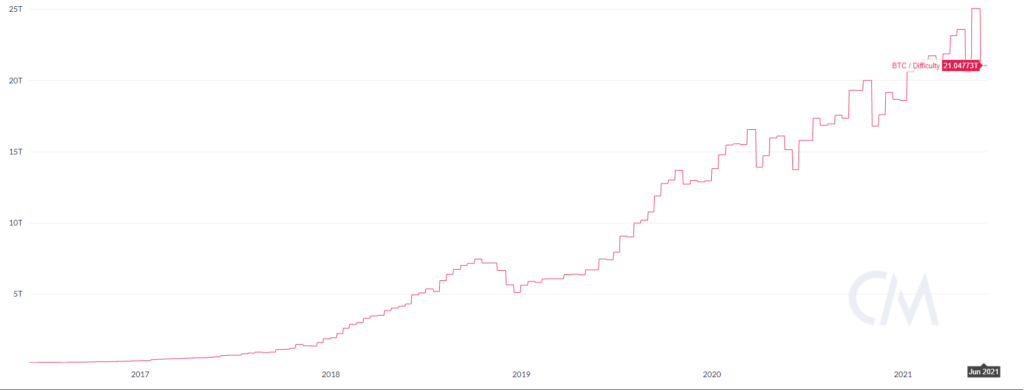
“Given the current chip shortage and the uncertainty of future price movements, I will conservatively set the monthly difficulty growth rate at 6% in my calculations. As a result, the figure will increase roughly twofold each year,” noted Frumkin.
In his hypothetical ‘green’ farm with total equipment capacity of more than 170 megawatts, monthly operating costs (OPEX) are a “conservative” $30,000. The capital expenditure (CAPEX) totals $247.68 million, and the miners’ lifespan is four years.
Uptime is set at 35% of the maximum. This is due to the intermittent nature of solar energy. Thus, the farm’s hashrate would be 1.923 EH/s instead of 5.449 EH/s at 100% uptime.


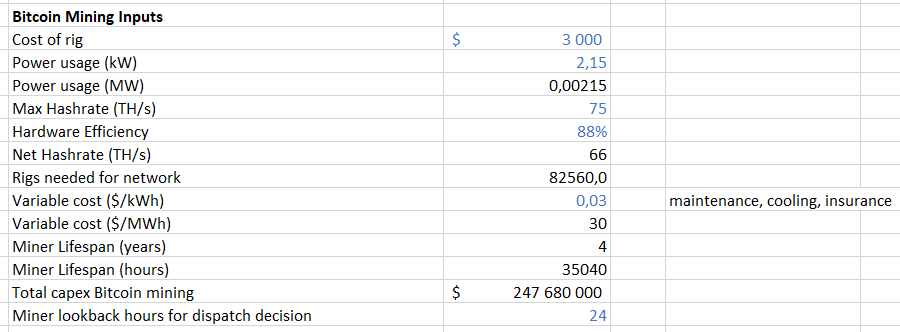
Below is a cash-flow analysis with a four-year horizon, taking into account the parameters above. The model does not include the impact of halving of block rewards, due in less than three years.


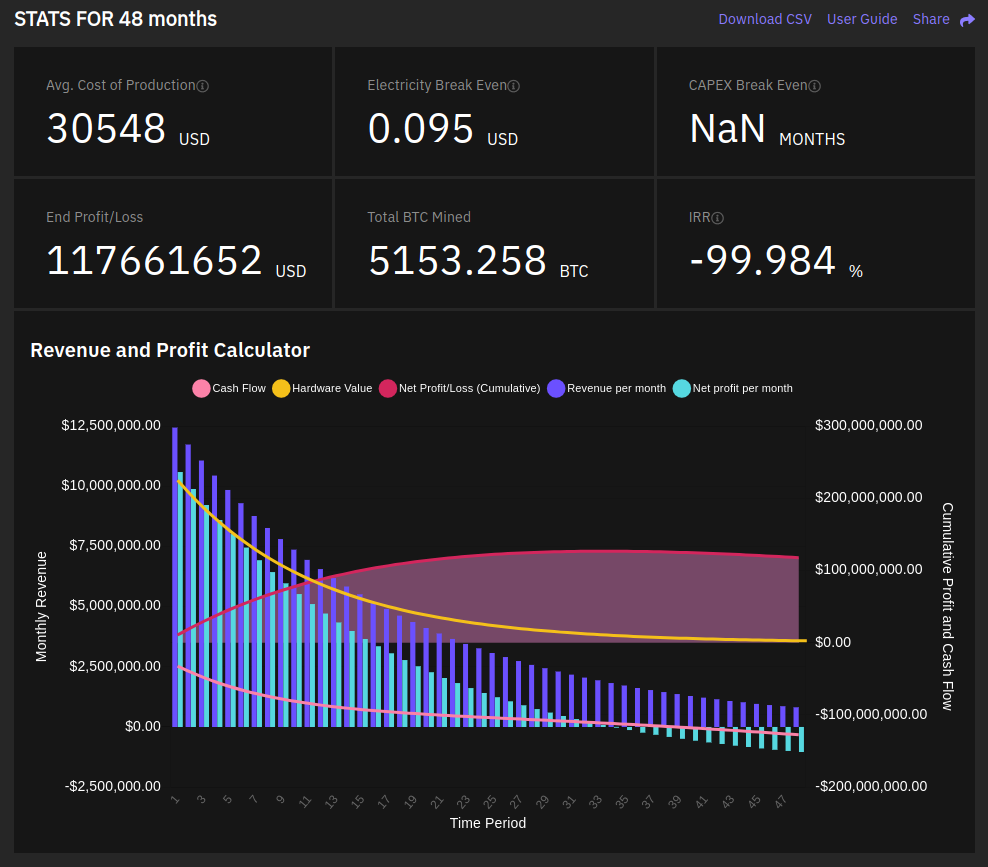
Frumkin concluded that with annual doubling of difficulty and a constant Bitcoin price, the internal rate of return (IRR) for such a farm would be -99%.
However, the researcher deemed this scenario unlikely, since difficulty is unlikely to rise at the same pace with a fixed price.
“On the other hand, improvements in ASIC efficiency and the current profitability metrics suggest that difficulty is likely to continue rising confidently, at least over the next 1-2 years under any scenario, except in extremely bearish ones,” Braiins said.
He explained that even if Bitcoin’s price remains unchanged for two years, the difficulty will continue to rise until the average costs per coin mined match the asset’s actual price.
The next figure presents a much more bullish scenario, where the price of digital gold grows by 4% per month.


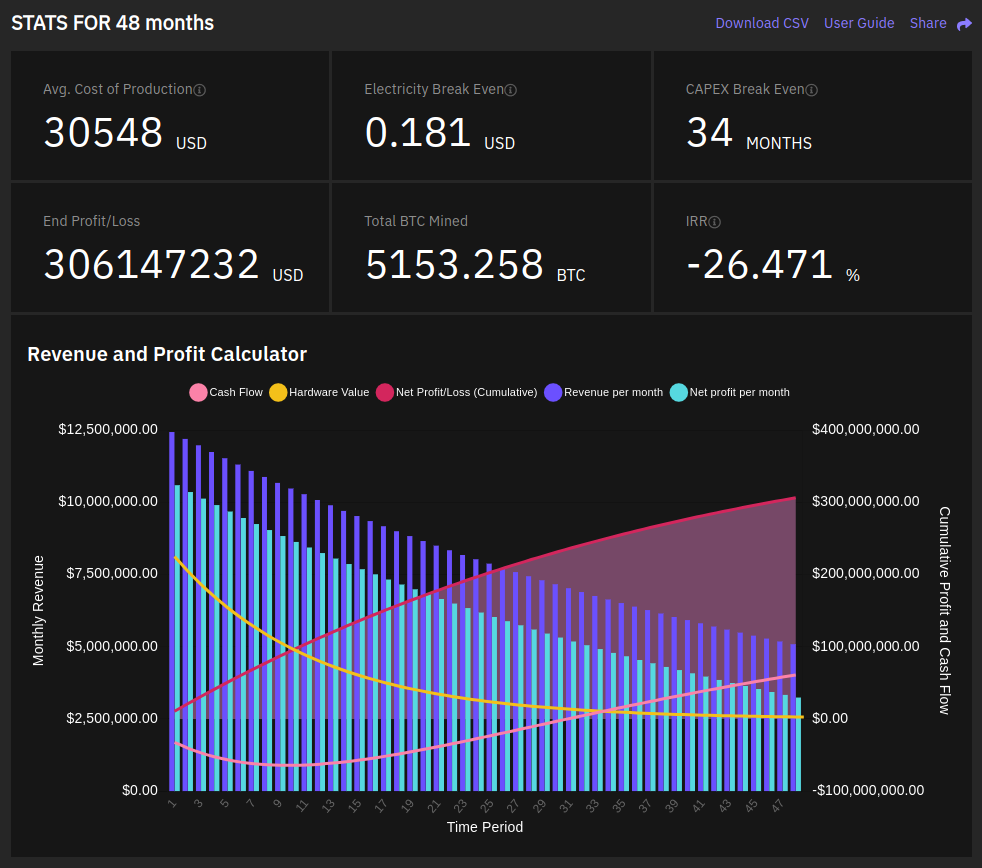
Under this scenario, mining remains profitable, though earnings fall over the four-year period. Capex is recouped by the end of year three.
“This suggests that adding Bitcoin mining to a solar-energy project will be worthwhile only if investors believe in substantial price growth over the next four years,” commented Frumkin.
The following scenario assumes miners do not sell all mined Bitcoins daily, but hold half for long-term storage.


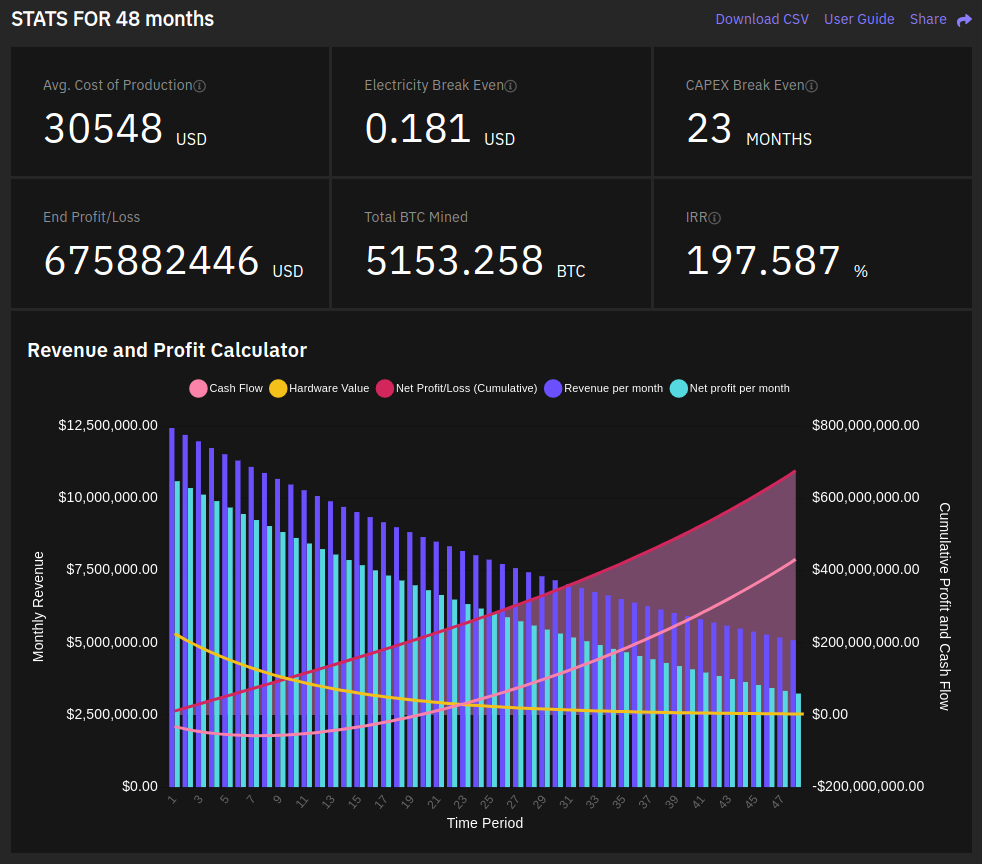
“Now, this is something else! With a 50% HODL coefficient, the CAPEX payback period shrinks to under two years, and the final cash flow from operations (pink line), including the cost of ASIC equipment (yellow line), exceeds $400 million. The takeaway is simple: the success of this hypothetical venture heavily depends on Bitcoin’s price. Not surprising,” wrote the researcher.
Mining vs HODL
The researcher compared mining at an initial Bitcoin price of $40,000 and CAPEX of $247.68 million with a Buy & Hold strategy. The latter involves buying digital gold for the long term.
The figure above shows that under a scenario of steady growth in difficulty, the venture would mine 5,153 BTC over four years (halving not included).
At a Bitcoin price of $40,000, a user with $247.68 million could buy 6,192 BTC and simply store them in a wallet, without worrying about running the operation with monthly OPEX of $30,000 and other hassles.
Thus, investing in a renewable-energy mining venture does not make economic sense due to high opportunity costs. Therefore, if market participants are bullish on Bitcoin, they would be better off simply purchasing the cryptocurrency rather than investing in a complex and risky business.
“If the difficulty does not rise as fast as forecast, that probably means the price of Bitcoin was low and investments did not deliver good fiat returns. If the price rises significantly, the difficulty is likely to continue rising at roughly the same pace as in the last five years. In that case, investments show good returns when measured in Bitcoins,” Frumkin said.
He then considered a scenario with a fixed Bitcoin price ($40,000) and excess, i.e., virtually free, electricity during peak solar hours.


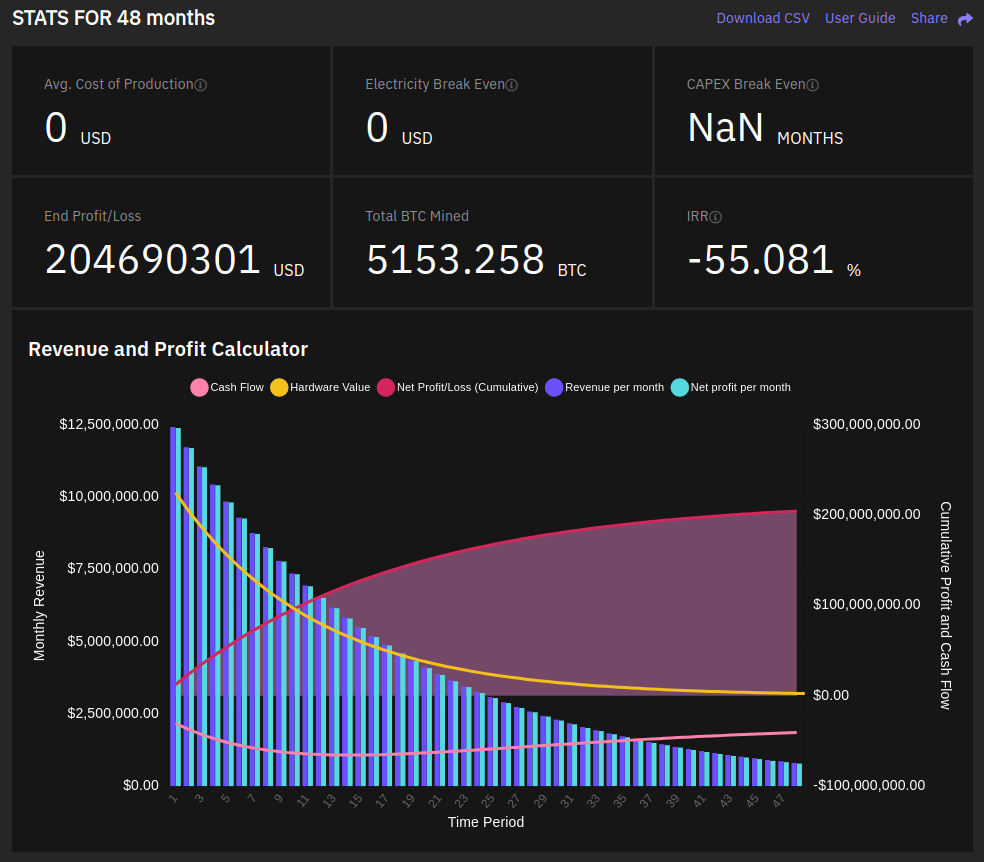
As the figure shows, even in this scenario, the initial investment is not recouped over four years.
Green mining vs traditional farms
Daniel Frumkin compared intermittent solar-powered Bitcoin mining with traditional approaches that assume a steady energy supply.
“We will use the model’s maximum hashrate and power consumption — 5,448,960 TH/s (~5.45 EH/s) and ~178 MW respectively. The CAPEX figure remains the same. To make things more interesting, we increase the electricity price at full uptime to $0.05 per kWh and keep monthly OPEX at $30,000,” the researcher wrote.


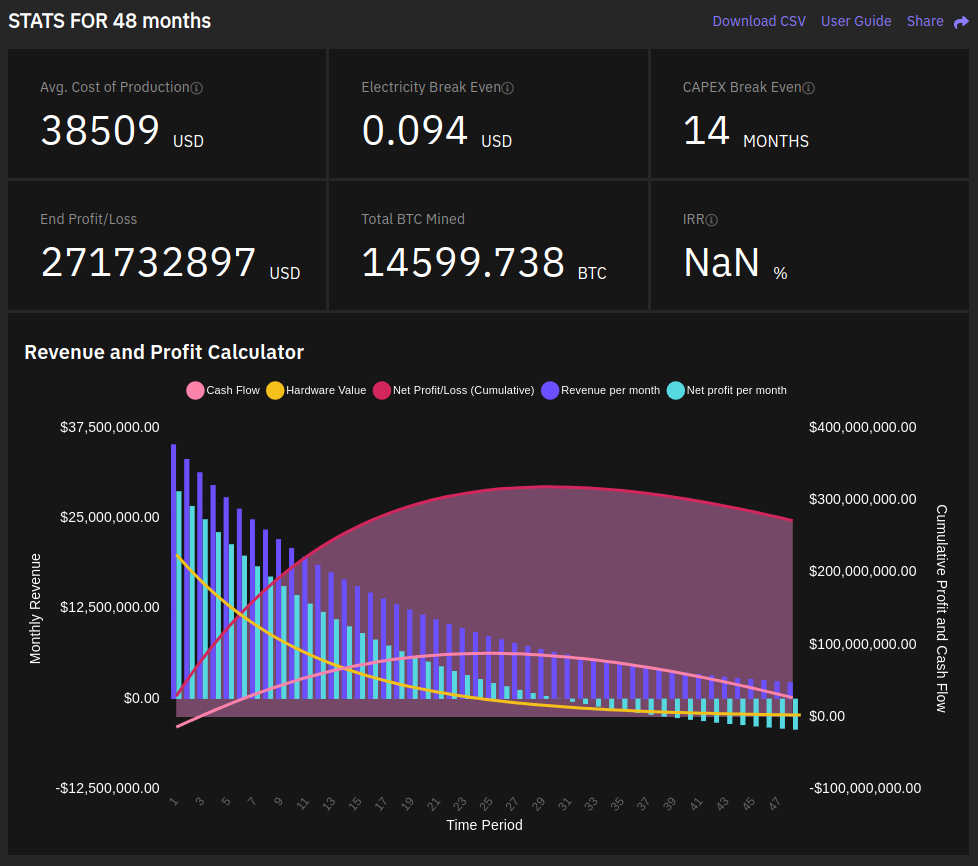
Under a scenario with zero Bitcoin price growth, investments are recouped in 14 months. After that, the venture remains profitable for about two and a half years.
“If we assume miners simply liquidate their equipment inventories and cease mining when it is no longer profitable, the final cash flow would be $85 million — a 34% return on investment. This is significantly less risky than the 35% uptime case,” commented Frumkin.
He then proposed modifying this scenario with a 4% monthly Bitcoin price rise and a 50% HODL coefficient.


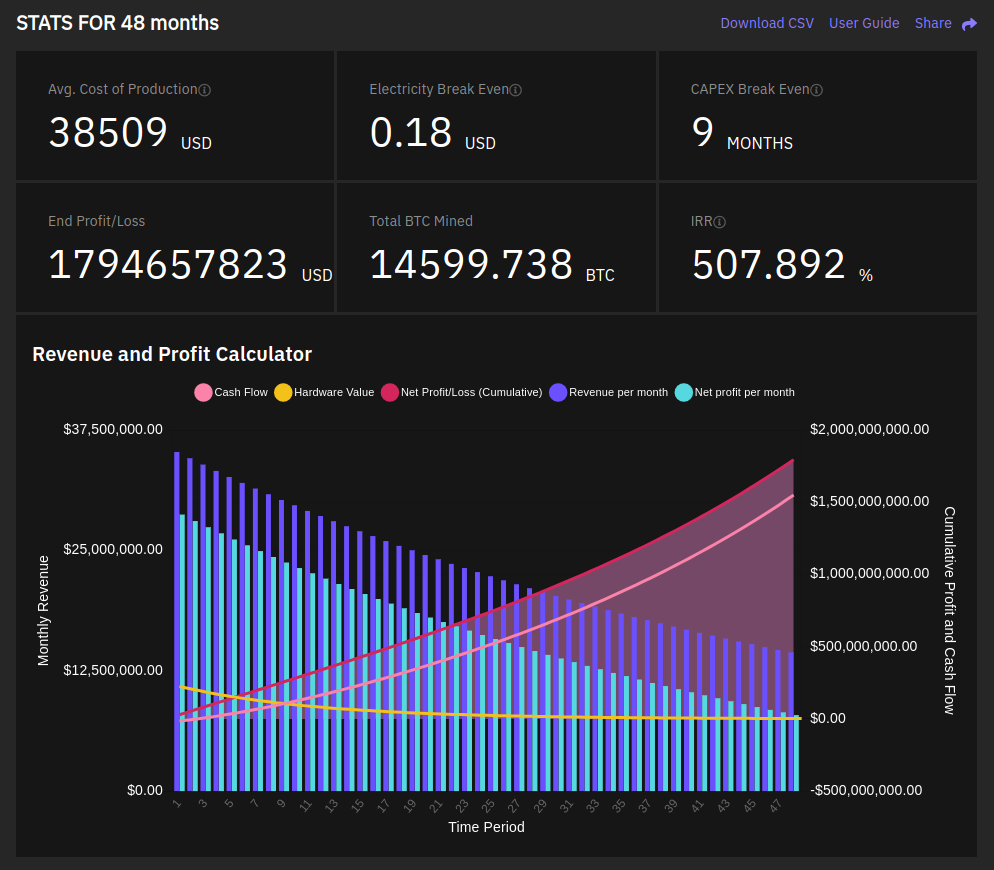
In this scenario, capital costs are recouped in just 9 months, and the final cash flow exceeds $1.5 billion. The amount mined would be about 14,600 BTC. This is over twice the number of coins one could buy with the initial investment.
Thus, mining at $0.05 per kWh with full uptime is markedly more profitable than mining at $0.035 per kWh with only 35% uptime.
Optimal miner models
The Square and ARK Invest model uses a mix of different miners:
- the historically popular Antminer S9;
- not the newest but still relevant Antminer S17 and Whatsminer M20S;
- new-generation devices — Antminer S19 and Whatsminer M30S.
The aim of this diversification is to reduce investors’ risks. By sacrificing maximum possible efficiency and slightly shortening the equipment lifespan, investors avoid high capital expenditures. This helps shorten the investment payback period.
According to Frumkin, more impressive results could have been achieved by purchasing Antminer S9s in May 2020, when units sold for $20–$40. To maximise ROI, it would have been optimal to purchase 50,000 such devices.
Context missed
The researcher stressed that in the model he studied, devices operate exclusively on solar energy during periods of surplus. He believes that if miners used batteries or a secondary energy source to increase uptime, investment metrics would improve significantly.
The table below shows payback periods (in months) for mining investments at different electricity prices and varying uptime. ‘NaN’ indicates that invested funds are not recouped within 48 months from the start of operations.


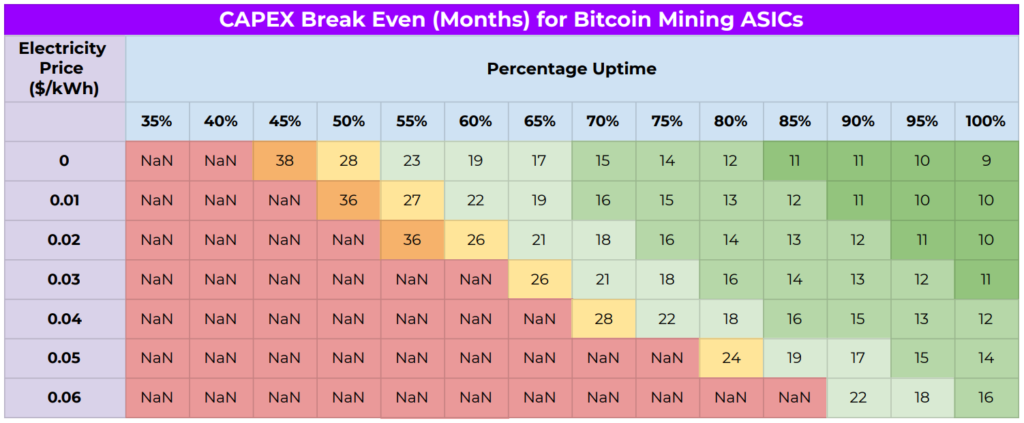
“Mining farms with uptime above 90% are likely to break even within two years from start of operations,” Frumkin explained. “Extremely low electricity prices are not enough to justify operations with uptime below 60%.”
The researcher notes that terms like ‘clean’ and ‘dirty’ energy can mislead without broader context. He offers this example:
“The production and installation of solar panels and batteries involves energy-intensive extraction of minerals from the Earth using toxic chemicals, as well as burning a substantial amount of energy.”
The coal-rich Chinese region of Xinjiang is the world’s largest centre for solar-panel production. Cheap labour further reduces production costs. This is an “important social aspect”.



A commonly cited metric for the environmental footprint of Bitcoin mining is the share of hashrate generated by fossil-fuel energy. For this metric, a broader context is needed.
For example, the United States alone flares about 1.48 billion cubic feet of gas daily. That volume could generate 162 TWh of electricity per year. That is more than the Bitcoin network consumes—93.92 TWh per year (according to Cambridge data as of 16.06.2021).
Emissions data for many other countries are unknown. Consequently, the true ecological damage from burning and venting associated gas into the atmosphere is unknown.
Mining Bitcoin with flare gas prevents methane emissions. Methane’s global warming potential is about 84 times higher than CO2.
The future of ‘green mining’
Market conditions may change to make ‘green’ mining more viable and attractive to investors.
As renewable electricity costs fall, competition among equipment makers has intensified. Recently, Bitmain reduced the price of Antminer units by 20% amid a falling Bitcoin price and criticisms of mining by Chinese authorities.
Big players are warming to ‘green’ mining. In May, Marathon Digital Holdings announced plans for a 300 MW Texas data centre, aiming for 70% carbon neutrality.
BIT Mining Limited announced construction of a 57.2 MW facility in the same state, with 85% powered by clean and low-carbon energy.
Argo Blockchain acquired two ‘green’ mining centres in Quebec, Canada. The sites run on local hydroelectric power.
The9 and Montcrypto will build a 20 MW carbon-neutral mining centre in Calgary, Canada, using natural gas as the energy source.
Montcrypto had previously signed agreements with local mining companies. Mobile and modular rigs will be placed near oil wells to extract, process and convert the fuel into energy.
In 2020, Gazprom Neft launched a project to repurpose associated gas at the Alexander Zagrin field in Khanty-Mansiysk. The company connected a mobile container with computing equipment to the gas-fired plant and offered miners electricity for cryptocurrency mining.
Square and Blockstream announced a joint project to create a demonstration Bitcoin mining centre powered by solar energy in the United States.
The partners plan to ensure public transparency by sharing details about the project—operating costs, ROI and the insights gained from building renewables-powered mining.
Square intends to invest $5 million; Blockstream will provide the infrastructure and expertise to build and operate the mining venture. The project will serve as a proof of concept for a large-scale Bitcoin mining farm powered entirely by ‘green’ energy.
According to Square and ARK Invest, mining the first cryptocurrency could help accelerate the transition to renewable energy. Researchers believe that as mining scales, the share of renewables in energy consumption could rise to 99%.
A farmer in Denbighshire, Phillip Hughes, mines Ethereum using electricity generated from cow manure. The biogas is combusted to produce electricity, with a third of it used to power GPUs and the rest for the farm’s needs.
The president of El Salvador, where Bitcoin has been recognised as legal tender, proposed mining Bitcoin with volcanic energy. Nayib Bukele asked LaGeo to plan capacity for Bitcoin mining using geothermal energy.
Co-founder Nick Carter of Coin Metrics is confident that mining Bitcoin on flare gas will be a major trend in the coming decade. This fuel could meet the needs of all mining devices.
Experts forecast a continued large migration of hashrate from East to West. It began before the Chinese mining crackdown and has accelerated since then.
Jiang Zhuor, founder and head of BTC.TOP, stated that more than half of Bitcoin’s hashrate is now generated from renewable energy due to Chinese restrictions. All mining operations in Xinjiang, Inner Mongolia and Qinghai have halted, leaving hydroelectric farms in Sichuan. Carter believes miners will increasingly disclose energy usage, use renewables and buy carbon credits.
Conclusions
Solar energy provides cheaper electricity than fossil fuels, but it has a fundamental drawback: during low demand it produces excess capacity, while during high demand there may be shortfalls.
This problem can be partially mitigated by battery storage, which affects the cost of energy production.
Bitcoin mining profitability using solar energy is highly sensitive to a range of factors including:
- uptime of equipment, which depends on the location of the power plants, battery quality and solar panels;
- changes in mining difficulty;
- bitcoin price dynamics;
- cost of mining and related equipment;
- cost of electricity from secondary sources (grid, diesel, etc.);
- cost and lifespan of batteries used with solar panels.
Given the interest from many firms and some countries in ‘green’ mining, the trend toward environmentally friendly crypto mining is likely to continue. This will be aided by falling renewable electricity costs, greater competition among miners and the migration of hashrate from East to West.