




The National Supercomputer Centre Alemcloud in Kazakhstan has inaugurated a supercomputer powered by Nvidia H200 GPUs. The event was attended by the country’s president, Kassym-Jomart Tokayev, according to inbusiness.kz.


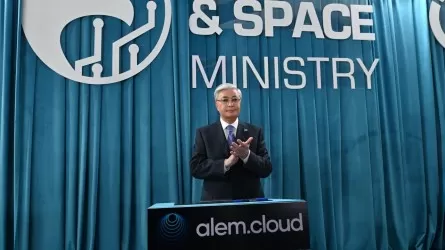
The installation and launch of the system took place at the new data centre of the Ministry of Digital Development, Innovations, and Aerospace Industry, with participation from international partners.
The new high-performance GPU cluster boasts a capacity of up to 2 exaflops using FP calculation methodology. This makes the supercomputer the most powerful computing solution in the Central Asian region.
Tokayev noted that this step is a significant milestone towards the digitalisation of key industries. Startups, universities, research centres, and both public and private companies will have access to the supercomputer.
A supercomputer is a high-performance computing system designed to handle extremely complex and resource-intensive tasks beyond the capabilities of ordinary machines. They are most often used for scientific calculations, modelling, and analysing large volumes of data, including:
- climate and weather modelling;
- aerospace and nuclear calculations;
- bioinformatics and drug development;
- training and simulation of AI models;
- quantum simulations.
Applications of Supercomputers Worldwide
Supercomputers are also used in military applications globally. In 2024, the United States’ Lawrence Livermore National Laboratory launched El Capitan with a performance of Rmax around 1.742 exaflops and a theoretical peak of ~2.79 exaflops.
It is funded by the National Nuclear Security Administration and ensures the reliability of the country’s nuclear arsenal in the absence of nuclear testing. The system is also used for scientific research in the interest of national security.
Another example is Frontier, installed at the Oak Ridge National Laboratory. In June 2022, it became the world’s first confirmed exaflop computer, achieving about 1.102 exaflops Rmax on the Linpack test. By 2024, its scaling efficiency increased to ~1.353 exaflops Rmax with peak capabilities around 2.05 exaflops.
In this case, the supercomputer’s application is purely civilian—it is a platform of the U.S. Department of Energy for open research in climatology, materials science, astrophysics, nuclear physics, and other disciplines.
Located at Argonne National Laboratory in Illinois is Aurora with ~1.012 exaflops Rmax and a theoretical maximum of ≈1.98 exaflops. It is focused on scientific research and is available for public use. Its capabilities are intended for peaceful applications: brain structure modelling, fusion research, development of new materials for batteries and solar cells, subatomic particle studies, cancer drug discovery, cosmological modelling, and more.
China has its own supercomputer, Tianhe-3, developed by the National University of Defense Technology. Unofficially, Tianhe-3 was launched in 2023 and has a peak performance of about 2–2.1 exaflops with an estimated performance of ~1.3–1.57 exaflops Rmax. These figures make it one of the most powerful computers on the planet, although China does not publish results in international rankings.
The official applications of Tianhe-3 include high-performance computing tasks, big data, and AI training. Given that the supercomputer was developed by a military university, it likely has defense significance.
In May, China launched into space 12 satellites as part of a project to deploy a network of orbital supercomputers.