



Key Developments in the Crypto Industry: TON Foundation’s Partnership with HashKey, FTX Client Refund Timeline, and More
We have compiled the most significant news from the crypto industry over the past two weeks.
- TON Foundation and HashKey have agreed to enhance fiat access for Telegram Wallet users.
- Coinbase has become the first international cryptocurrency exchange to register in Canada.
- FTX clients will receive their first payouts by the end of 2024.
- Argentinian authorities have introduced a mandatory registration system for crypto exchanges.
- Deribit and Crypto.com have received licenses from Dubai’s regulator.
TON Foundation and HashKey Agree to Enhance Fiat Access for Telegram Wallet Users
TON Foundation and licensed crypto exchange HashKey from Hong Kong have agreed on a partnership to facilitate Telegram Wallet users’ access to fiat in the Asia-Pacific region.
The firms will also explore ways to support early-stage projects within the TON ecosystem and the possibility of HashKey Group managing the treasury of the non-profit organization.
It was also announced that HashKey has launched the global cryptocurrency exchange HashKey Global after obtaining a license in Bermuda. Previously, the company received approval to operate from regulators in Japan and Singapore.
The platform offered qualified retail investors trading pairs for 21 cryptocurrencies and plans to launch digital asset futures “in the near future.” Access is restricted for users from mainland China, Hong Kong, the US, and several other jurisdictions.
HashKey announced the launch of an Ethereum L2 network based on ZK-Rollups called HashKey Chain. The company will use its own token, HSK, to incentivize ecosystem participants.
Users will receive low-cost, efficient, and developer-friendly network services, according to the statement. HashKey plans to launch the testnet within the next six months, followed by the mainnet within a year.
FTX Clients to Receive First Payouts by End of 2024
Liquidators of FTX Digital will transfer the first payouts to clients of the bankrupt exchange by the end of 2024.
The insolvency process of FTX consists of two separate procedures running in parallel: under Chapter 11 of the US Code and the official liquidation of FTX Digital, a subsidiary of FTX.
Both parties have agreed to work together so that creditors can file their claims against any legal entity. They also pledged that no client of the platform will receive less than the amount they are entitled to.
Applications, which opened on March 1, are expected by May 15, but an extension to June is already being considered. Compensations will be distributed based on the status as of November 11, 2022, when FTX filed for bankruptcy. Clients will receive 100% of the amount as of that date.
In April, FTX creditors expressed strong disagreement with the sale of Solana assets owned by the liquidated organization, valued at ~$1.9 billion, at a 62% discount.
Coinbase Becomes First International Crypto Exchange Registered in Canada
Coinbase has entered the registry of the Canadian Securities Administrators (CSA) as a restricted dealer. The platform was launched nearly eight months ago, and the organization applied for a license in March 2023.
In 2023, Canada introduced new guidelines for platforms that limit the investment volume of certain investors in digital assets and mandate registration for crypto firms.
The expansion into Canada aligns with the “Go Broad, Go Deep” strategy to expand presence in markets outside the US, where the company has faced pressure from the SEC.
In 2023, due to tightened regulations, centralized exchanges OKX and Binance, DEX dYdX, and stablecoin issuer Paxos announced their exit from Canada.
Argentinian Authorities Introduce Mandatory Registration System for Crypto Exchanges
The government of Argentina has introduced a mandatory registry for virtual asset service providers (VASP).
Companies and individuals engaged in this activity are required to comply with the requirements approved by the country’s Senate as part of amendments to the existing regulatory framework to meet the recommendations of the FATF.
Each VASP must complete registration. The regulation applies to both local and foreign firms providing services to residents.
In 2023, Argentina’s central bank introduced new guidelines that could complicate the operations of companies related to digital assets.
In December, the country’s president, Javier Milei, proposed declaring cryptocurrencies for subsequent taxation.
Deribit and Crypto.com Receive Licenses from Dubai Regulator
Deribit’s division — Deribit FZE — became the first among crypto derivatives platforms to receive a conditional VASP license from Dubai’s Virtual Assets Regulatory Authority (VARA). The organization is relocating the firm’s global headquarters to the emirate.
The license covers both spot and derivatives trading and remains non-operational until Deribit fully meets all remaining conditions and selects localization requirements defined by VARA.
Crypto.com’s division — CRO DAX Middle East FZE — received a full operational VASP license from VARA.
The approval makes it the first crypto exchange authorized to operate with fiat currency in the UAE, according to a press release.
The firm’s next step will be to launch a platform for institutional and qualified retail investors. Services will include spot trading, staking, and over-the-counter trading.
In June 2023, Spain’s central bank registered Crypto.com as a VASP, and in July, its operations were approved by the Netherlands’ central bank.
Previously, the platform received authorization to operate with crypto assets in the UK.
In the same month, Crypto.com acquired payment service provider PnLink and digital asset provider OK-BIT with corresponding licenses from South Korean regulators. In April, the company announced the launch of a cryptocurrency trading app for local retail investors.
Key Metrics of the DeFi Segment
The total value locked (TVL) in DeFi protocols slightly decreased to $97.1 billion. Lido remains the leader with $33.4 billion. EigenLayer holds the second position with $13.8 billion, and Aave retains the third spot with $11.52 billion.
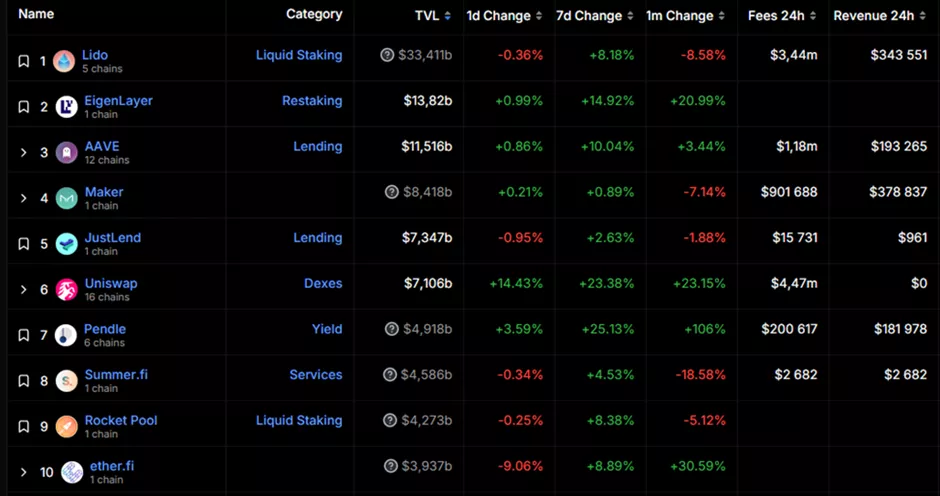
TVL in Ethereum applications moderately increased, reaching $55.4 billion.
Trading volume on decentralized exchanges (DEX) over the past 30 days declined to $178 billion. Uniswap strengthened its dominance, accounting for 56.2% of total turnover (up from 50.8% two weeks ago). The second DEX by trading volume, PancakeSwap, saw its market share decrease from 24.2% to 21.9%. Curve took the third spot with 4.2%.
Also on ForkLog:
- Tether purchased 8888 BTC and announced the completion of an independent security audit.
- Ethena Labs opened ENA claims. Exchanges listed the asset. Later, the firm expanded USDe backing to bitcoin. The community drew parallels with LUNA.
- Ripple outlined the timeline for launching its own stablecoin.
- A Nigerian court arrested a Binance top executive.
- The Solana team will implement fixes to combat network overload.
- dYdX developers halted the network due to a glitch following an update.
- 1inch and Mastercard announced a debit Web3 card.
- Half of the presales on Solana turned out to be scams.
- The SEC raised concerns with Uniswap. The community called it a war on DeFi. Experts assessed the implications.
What to Read and Listen to Over the Weekend?
On April 12–13, in honor of the Bitcoin halving, the ForkLog team organized the AllTimeHalf 2024 forum with developers, entrepreneurs, enthusiasts, and visionaries. Recordings are available on our channel.
Additionally, we recommend exploring the event-related research by CoinGecko and Binance, as well as an article by Alex Kondratyuk, one of the moderators of AllTimeHalf 2024.
Рассылки ForkLog: держите руку на пульсе биткоин-индустрии!