




AI models are more likely to provide false answers than to admit ignorance. This tendency becomes increasingly apparent as language models grow, according to research published in Nature.
Artificial intelligence tends to respond confidently, even when the answer is factually incorrect, because it has been trained to believe this information. The models are unaware of their own ignorance, the authors noted.
Larger models generally demonstrate improved performance in executing complex tasks, but this does not guarantee consistent accuracy, especially with simpler tasks.
They are noticeably less likely to avoid complex questions, attempting to solve them and sometimes providing incorrect answers. The graph below shows how models produce incorrect results (red) instead of avoiding the task (light blue).


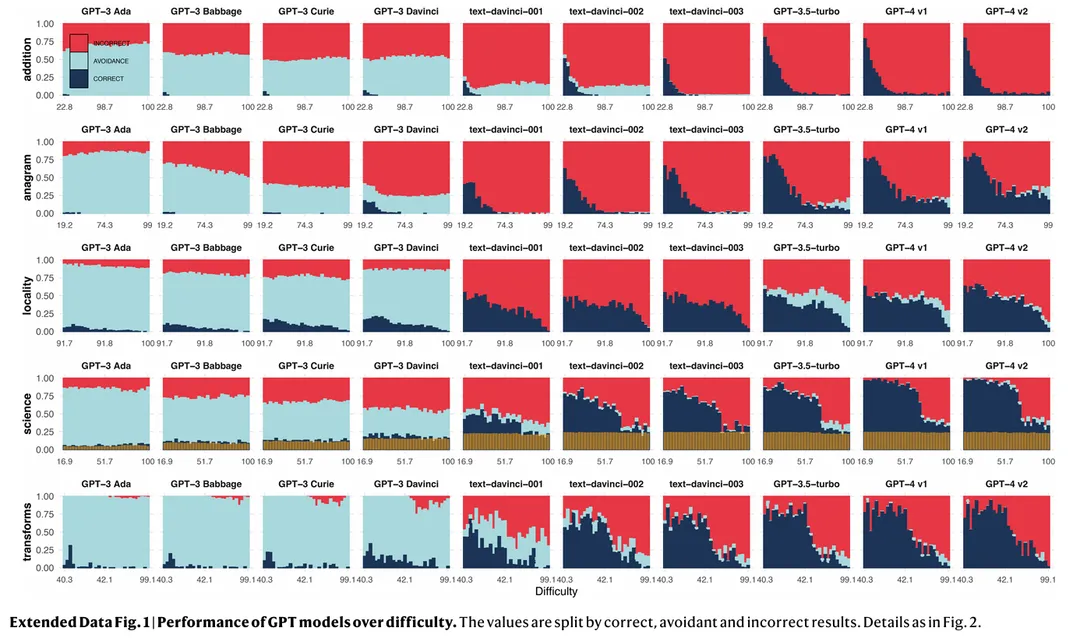
Researchers noted that this phenomenon is not related to the ability of large language models to handle simple tasks. They are simply trained to better solve complex problems. Neural networks trained on vast, complex datasets are more prone to overlook fundamental skills.
The problem is exacerbated by AI’s confidence. Users often find it difficult to discern when it is providing accurate information and when it is spreading misinformation.
Experts also found that as a model’s performance improves in one area, it may deteriorate in another.
“The percentage of evasive answers rarely grows faster than the percentage of incorrect ones. The conclusion is clear: errors remain more frequent. This represents an involution of reliability,” they write.
Researchers highlighted the drawbacks of current AI training methods. Reinforcement tuning and human feedback exacerbate the issue, as the model does not attempt to avoid tasks it cannot handle.
In September, OpenAI introduced a new large language model, o1, trained with reinforcement for performing complex reasoning.