


Launch of Ethereum 2.0 Phase Zero: what’s coming and what users should expect
At the core of Ethereum is the idea that a blockchain can do more than just underpin decentralized money — for example, to run an entire decentralized economy.
Five years after its launch, Ethereum has:
- tens of thousands of applications (dapps) have been deployed;
- the combined asset capitalization, including tokens from various projects, surpasses over $100 billion;
- the total volume of transactions in 2020 is expected to reach almost $1 trillion.
Ethereum is a key element of the decentralized finance (DeFi) sector and is used in the majority of stablecoins.
Despite evident progress, Ethereum has its problems. The main one is low network throughput. It currently handles around 14 TPS, which is not enough for global scaling of the decentralized financial infrastructure.
ETH2 — a major network upgrade designed to raise its scalability, security and energy efficiency without compromising decentralization. The developers envision Phase Zero of ETH2 as a testing ground for the Proof-of-Stake consensus algorithm.
This article outlines what users can expect from the launch of the upgrade scheduled for December 1.
Why Ethereum 2.0?
The majority of economic activity and smart contracts will continue to run on the original Ethereum network, which will operate in parallel with ETH2. Developers will implement a pathway to move ETH1 to ETH2, though a reverse move will be impossible.
ETH2 will fundamentally alter Ethereum’s monetary policy — annual inflation may fall to under 1%. The transformation is also expected to apply to the network’s native asset, which is anticipated to become, among other things, a store of value.
Vitalik Buterin, Ethereum co‑founder, is convinced that meaningful improvements in network parameters can be seen much sooner than most expect.
«The Merge [ETH1 and ETH2], Proof-of-Stake, enticing 100 000 TPS — all of this will happen faster. I expect the ETH2 updates to be faster and more orderly than those in ETH1», — said him during a recent AMA session on Reddit, outlining his view of the network’s prospects over the next two years after the transition to ETH2.
He also noted that a technology [simple_tooltip content=’The ZK-Rollups technology aggregates multiple transactions into one, reducing the load on the main Ethereum network.’]ZK-Rollups[/simple_tooltip], which can provide up to 4000 TPS, and transactions using it can cost up to 100 times less than on the main network.
In September, this layer-2 solution was integrated by the stablecoin issuer Tether (USDT), enabling the technical ability to compress transactions of ETH, ERC-20 tokens and smart contracts.
«ZK-Rollups is the most comprehensive and preferred scaling solution. It keeps data on the main chain, not relying on a sidechain», — said Paolo Ardoino, CTO of Tether and Bitfinex.
How will it happen? Four phases of Ethereum 2.0
Phase 0: Beacon Chain
Aimed at testing the viability of the Proof-of-Stake algorithm. At this stage the network will be largely experimental, though real Ether will be used.
In this phase the following PoS aspects should become functional:
- Management of the validator set;
- Management of validator funds;
- A randomness generator to help select block producers and staking attesters;
- Validator voting on proposals for block size;
- Distribution of rewards and imposition of penalties on validators.
Phase 1: Sharding
If Phase 0 tests the basic PoS infrastructure, Phase 1 tests the basic sharding model.
During this phase 65 blockchains will operate in parallel — the existing Beacon Chain will gain 64 new shards, with bidirectional interaction between them.
Phase 1.5: The merge of the PoW Ethereum chain with the new PoS chain
It will not affect historical data of the current network, as the PoW blockchain will be one of the fragmented chains in the new mechanism. Miners should note that the PoW chain will not itself support PoW.
Phase 2: Implementing the new operating mode
It is expected that at this stage ETH2 will run smart contracts and economic activity. The shards will no longer serve as data stores for ETH1’s corpus and will begin to resemble virtual machines and ETH1 smart contracts.
Launch of Phase Zero
On November 4, the Ethereum Foundation confirmed the launch of the ETH2 deposit contract, and announced the genesis block date — December 1 at 12:00 UTC (15:00 MSK).
By November 24, participants needed to deposit a total of 524,288 ETH (with a minimum stake of 32 ETH). Another prerequisite for Phase Zero was the participation of 16,384 validators.
Despite the somewhat slow pace of deposits, by the deadline all conditions proved to be met and the threshold was surpassed.
We have liftoff. 🚀
Thank you to the devs, the researchers, educators and community members who made this happen.
See you on December 1st @ noon UTC. pic.twitter.com/bZ15EDefMK
— Eth 2.0 Deposit Contract — Progress Meter Bot (@DepositEth) November 24, 2020
«We’re lifting off! Thanks to all the developers, researchers, educators and community members who made this possible», — wrote the Twitter account @DepositEth.
The day before, Ethereum Foundation lead developer Hudson Jameson reminded that although the Phase Zero launch marks the transition to ETH2, it does not mean everything changes immediately.
«ETH2 is a multi-year process, and the first parts of that process will not heavily affect the current Ethereum mainnet», — he wrote.
2/ The beacon chain marks the beginning of the transition to Eth 2.0, but that doesn’t mean that everything immediately changes. Eth 2.0 is a multi-year process and the first few pieces of that process won’t heavily affect the current Ethereum mainnet.
— Hudson Jameson (@hudsonjameson) November 23, 2020
As of 09:00 UTC on Monday, November 30, the balance of the deposit contract had surpassed 850,000 ETH, with more than 26,500 validators.
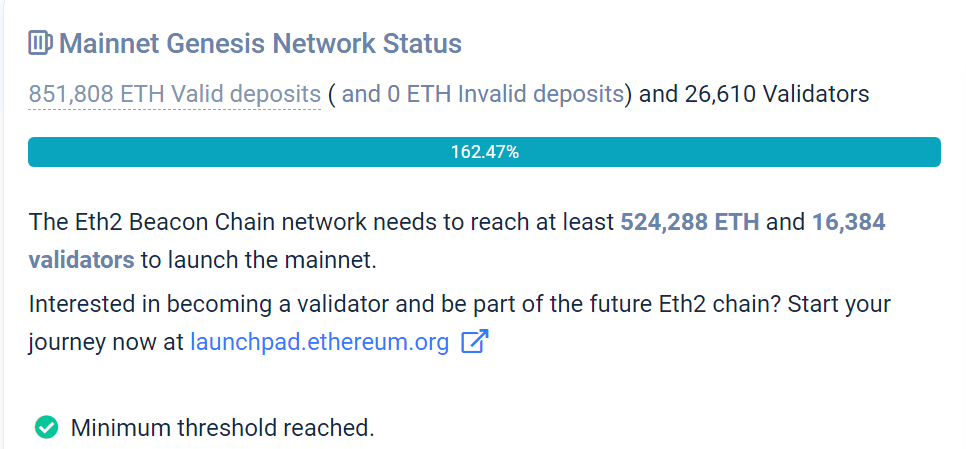
Source: beaconscan.
Staking, security and decentralization
Staking, from the English stake — “a bet”, “a piece of profits” — refers to earning a passive income from cryptocurrencies on a PoS algorithm and its variants. The idea is for validators to hold coins in wallets to gain the right to participate in the creation of blocks and earn rewards in exchange for securing the network.
In September, cybersecurity expert Chase Wright voiced doubts about the viability of participating in staking after the Phase Zero launch. His arguments rested on his experience as a validator using Prysm and Lighthouse clients in the test networks Onyx, Witti, Altona and Medalla, noting the absence of adequate code audits.
As an example he cited a bug in the Medalla test network that led validators to issue blocks before the allotted time and also prevented them from earning rewards. In Wright’s view, a similar problem could occur in the mainnet.
«You’re going to move into a commercial phase, potentially with hundreds of millions of dollars a day, with untested and unaudited code just to deal with forks later? No, thank you. You’re in for The DAO Part 2. The question is only when», — Wright said.
Another bottleneck, Wright argued, is the insufficient interoperability between different clients, with developers more focused on meeting deadlines than on solving this problem.
A possible response to his concerns could be the creation of a dedicated ETH2 security team and audits conducted by Least Authority and others in the run-up to Phase Zero.
The Ethereum Foundation is building an internal security team dedicated to Eth2.
Fuzzing, bounty hunting, pager duty, cryptoeconomic modelling, applied cryptanalysis, formal verification—you name it 🙂
Send talent our way 👉 eth2security@ethereum.org
— Justin Ðrake (@drakefjustin) August 1, 2020
A feature of PoS networks is that validators not only earn rewards but can also be subject to penalties (slashing) for dishonest or improper behaviour.
Earlier in November, Vitalik Buterin clarified that in the first months of ETH2 operation penalties on Medalla will not exceed a quarter of the stake. At the same time, the annual staking yield with the minimum deposit would be about 25%. All this, he said, provides enough incentives to become a validator.
However, according to one version, ETH2 could face another problem: a barrier to attracting users to ETH2 staking after Phase Zero could be the rising popularity of DeFi offering high yields through liquidity provision.
«It’s possible that ETH holders will wait and assess how early staking yields compare with DeFi yields. Or (in the worst case) they’ll simply not ‘risk’ their ETH until Phase 1.5 (which likely won’t occur for at least a year)», — according to an October ConsenSys Codefi report.
Despite assurances that ETH2’s launch will not undermine decentralization, a recent Infura outage, a leading provider of infrastructure solutions for the Ethereum network, suggests the ecosystem needs a serious rethink of this approach.
A possible answer is to replace all centralized elements, including Infura, with decentralized alternatives. That could improve privacy, censorship resistance and users’ financial sovereignty.
*****
The launch of ETH2 Phase Zero can be seen as a turning point for both the cryptocurrency itself and the blockchain industry as a whole. Moving from one phase to the next, the network, the developers say, will achieve genuine scalability.
The current throughput of around 14 TPS imposes clear constraints, yet a potential jump to 100,000 TPS could help Ethereum realise its past ambitions and become the so‑called “world computer.”
Subscribe to ForkLog news on Telegram: ForkLog FEED — the full news stream, ForkLog — the most important news and polls.
Рассылки ForkLog: держите руку на пульсе биткоин-индустрии!