


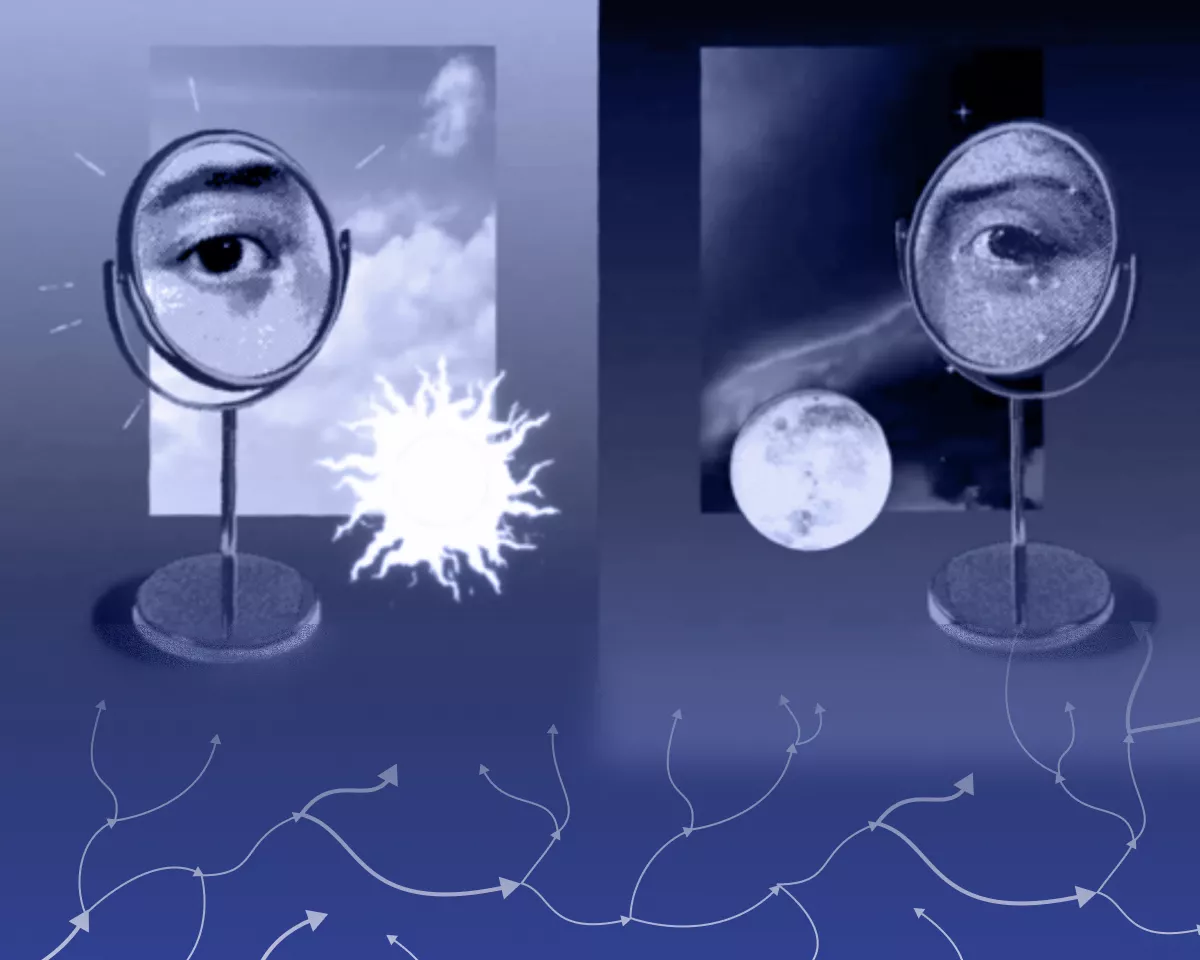
Lunarpunk: The Future of Cryptocurrencies in Regulatory Hell
Solarpunk and lunarpunk are not merely opposite aesthetic concepts, but fully fledged philosophical systems with markedly different attitudes toward interactions with the state and within the community. The dark ‘lunar’ economy as the antithesis to the ‘solar’ ideas, embodied by the Ethereum platform, is the subject of the final chapter of the Slovak hacktivist Juraj Bednár’s Cryptocurrencies — Hack your way to a better life. We present its translation into Russian.
While in school, as the ‘battle of ideas’ raged around me—Nazis (hello, Central Slovakia!), metalheads and punks, hippies and normies—I read William Gibson and Neal Stephenson, immersing myself in the world of cyberpunk.
This genre of science fiction describes a dystopian future of high technology and low living standards. There are no enormous Star Trek starships, and the protagonist is a poor journalist or a drug addict who receives a technology that alters the surrounding reality.
Cyberpunk ‘invented’ the first Internet, often called the Matrix (Gibson) or the Metaverse (Stephenson) in literature. The genre explored the possibilities of immersion in a ‘collective hallucination’.
The technologies in these works have interesting features. The first of them is the change in the power asymmetry between the system and the individual in favour of the latter.
In Stephenson’s The Diamond Age, a poor girl receives ‘Illustrated Primer for Noble Daughters’ — a book (today we’d call it a tablet) with artificial intelligence that educates the reader. Mastering such technology can change the world around them, even if this pleases not all — governments or corporations (in cyberpunk they often merge, and this resembles today’s reality), and sometimes even the inventor himself.
The second interesting feature is that the technology cannot be ‘canceled’. If it is created, the world must adapt. But governments do not understand this. They try to regulate browsers or cookies, online payments, cryptocurrencies and social networks…
And here Lunarpunk enters the stage, in direct conflict with the authorities. It is partly represented in Stephenson’s Cryptonomicon, Paul Rosenberg’s The Room for Wanderers or the anonymous work #agora.
Lunarpunks work on encryption and anonymization technologies (PGP, Mixmaster, Tor, P2P networks), as well as electronic money (e-cash). The latter were the most important element of the crypto-anarchists’ vision described in the Cryptoanarchist Manifesto Timothy May. But their implementation proved the most challenging.
Crypto-anarchists anticipated that governments would try to thwart their ideas using traditional justifications for regulation — fighting terrorism, drugs and tax evasion. They even foresaw the emergence of prediction markets, about which we have already mentioned, and the impossibility of preserving governmental and corporate secrets (WikiLeaks).
The cryptopunk technologies are already here. And they have indeed changed the power asymmetry. It can be said with confidence — they cannot be truly ‘canceled’. Any critique of cryptocurrencies, encryption and anonymity, based on the premise ‘these technologies are bad, they should be banned’, will not lead to a reversal of technological progress.
Guns and printing presses are freely available, despite attempts to regulate their use. In July 2022, former Prime Minister Shinzo Abe was assassinated in Japan. The country is known for its strict restrictions on weapon ownership. But the attacker manufactured it himself — at home.
Manufacturing weapons is simply the realization of information about an object in physical space using technologies like 3D printing. It was not possible to ban the printing press, no matter how much the rulers of that era hated Gutenberg’s invention.
It is unclear how the conflict will unfold, but one thing is certain: we will not forget about Bitcoin, Tor or encryption. Governments are trying to ban marijuana, but they have forgotten to tell millions of consumers. Or, more precisely, they do not pay attention to the ban.
When the editor of Reason magazine asked the author of the ‘Crypto Anarchist Manifesto’ what he thinks about using technologies to finance terrorism or extortion, he answered simply: ‘We must come to terms with it’.
We must learn to live with and respond to the challenges. Technologies will not disappear. ‘Ban Bitcoin!’ — is no longer a viable option for various reasons, good or bad.
Solarpunk and Lunarpunk
Solarpunk is a positive, vibrant reply to cyberpunk dystopia. Proponents of the genre explore a world in which humanity has solved all global problems: built a sustainable environment, halted climate change, found ways to coexist with nature, etc.
Unlike the marginalised heroes of dark cyberpunk, solarpunk characters fly on electric planes and happily live in organic buildings in green cities. It resembles Tolkien’s elves with advanced technology instead of magic.
In the world of cryptocurrencies, a sunny future is reflected, for example in Ethereum, where people raise funds for “public goods” and create a fully transparent parallel financial system. They respond to a ban threat by the state with: ‘How could you ban such a good thing, why would they want to?’
This question, if well thought out, inspires fear. Ethereum and solarpunk do not oppose power, but want to cooperate with it. They naively assume the other side is also interested in cooperation and will behave rationally.
Solarpunk flourishes in a bull market. Projects receive crazy valuations from investors and promise to solve all the world’s problems: climate change, urban planning, transport, access to financial services, international trade, direct democracy, funding NGOs, etc.
Solarpunk straddles the line between cooperative progress and centralized planning. Architects, artists, scientists, programmers and designers, as best they can, invent a better future using their knowledge. The question of who might be uncomfortable in such a world is not considered. Solarpunk’s solutions are so good that they are virtually unassailable.
And then a bear market hits. Collapse. Chaos. States must rescue ‘investors in the public good’. Regulation. Everything is visible. Everything is on public blockchains. There is no need to hide until it suddenly becomes necessary. But it’s already too late. Repression follows.
Lunarpunk is the natural response to the inevitable threat — the growth of demands from states, corporations and criminal groups for monitoring, taxation and regulation. It prescribes the use of anonymity and encryption technologies, creating invisible, unregulated financial flows and other forms of communication.
The demand for regulation grows (‘look, they evade regulation, it’s time to tighten control!’), which, in turn, leads to improvements in technologies to evade surveillance.
The NOR D Cycle — Why Crypto-Anarchy Works
The history of privacy technologies (anonymity, encryption, digital signatures) begins at least with the crypto-punk movement, whose heyday was in the early 1990s.
Of course, encryption existed long before. It is tied to the aforementioned crypto-anarchy of Timothy May. In his manifesto he explains that privacy technologies allow reducing the role of governments in our lives.
But can Lunarpunk, crypto-anarchy and cryptopunk influence what laws actually apply de facto, i.e., what laws are binding?
If we communicate, work and pay anonymously on the Internet, state regulation, which rests on the premise of violence against the body, becomes unnecessary. But how can software override the force of laws?
The conflicts (including the clash between an individual and the state) unfold within the NOR D cycle. It consists of four parts: Observance, Orientation, Decision and Action.
Both sides pass through the NOR D cycle. Different ways of expanding freedom focus mainly on the last two stages. For example, legal reforms or decriminalisation change the approach of the attacking side (the state). The law allowing marijuana possession influences judges’ decisions in cases where its possession is established.
Crypto-anarchy in a narrow sense and cryptopunks in a broad sense focus on the first two parts of the NOR D cycle. For example, a programmer from Belarus operates on the Internet and does not pay taxes. This does not mean the state will refrain from applying violence. But thanks to encryption, privacy technologies and anonymous payments, the state may not even know that something happened (the Observance stage of the NOR D cycle yields no results). And if it knows, it will not know exactly what happened — it will not be able to determine who did what, for whom, for how much, and whether there was payment.
If it is impossible to identify the person against whom the state must apply violence (imprisonment, confiscation of property), the law has no force — it cannot be applied.
It should be noted that the crypto-punk vision runs into operational-security issues. In practice people often make all kinds of mistakes: register email under their own name, mis-encrypt data, and so on.
I write about cryptopunks because this philosophy implies certain cryptographic techniques. And not only about the basic encryption that makes reading messages impossible. Some communication tools use other techniques such as blind signatures or perfect forward secrecy (PFS).
Let’s take a closer look at the latter term. If we exchange a key (a password), and then somehow reveal it, an intruder can decrypt all our messages. But with PFS the hacker will only be able to decrypt messages sent after their intrusion into the communication.
Another technique — ring signatures in cryptocurrencies. They complicate the determination of which coins were used in a transaction. Or ‘plausible deniability’, by which it is impossible to prove which side sent the message.
All of them increase the privacy of communications. On the basis of these techniques, one can also create social networks and conduct business on them with the help of cryptocurrencies — outside the control of governments and the old financial system.
The above increases the sovereignty of individuals, whose business and communications are separated from their physical identity. And thanks to reputation systems they can interact with people knowing only their nicknames.
The concept of DAO allows creating organisations from anonymous participants who manage assets worth hundreds of millions and even billions of dollars. They do not know each other’s real names and understand that they cannot go to court in case of problems in the DAO: it is unclear who is in what country. Therefore, relations must be organised to stop conflicts at their roots.
Unlike reforms (legalisation of drugs, prostitution) or hindering control (drug lords killing law enforcement), crypto-anarchy aims to prevent conflicts at the outset. Pseudonyms, privacy, encryption and anonymous payments help remove from situations the regulators who provoke conflicts: they do not even know what happened.
Crypto-anarchy is like crossing an intersection on a red light in a completely empty street. An example could also be travelling to another country to carry out a prohibited operation (medical tourism) or undeclared income that no one will ever know.
However this strategy works only for ‘victimless crimes’. If you harm someone physically or financially, the NOR D cycle moves to the next stage. The victim learns of the violation — the ‘Observance’ begins.
Crypto-anarchists challenge the very existence of victimless crimes. It is a fictional norm that has no basis in ordinary interpersonal relations and in society’s sense of justice. ‘Live and let live’ and the ‘golden rule of morality’ ‘do not do to others what you would not want done to you’ do not prohibit victimless crimes, as there is no harmed party.
Tools of anonymization and cryptocurrencies make the crypto-punk vision a reality and raise the level of personal sovereignty for everyone who uses them. Punishment for opinions and censorship becomes practically impossible even in non-democratic countries. We still live in a physical world, but much of our activity can take place in the realm of mind — in crypto-space, cipher-space.
Lunarpunk is the path of development of these technologies. After an attack (regulation, prohibition, enforcement) comes a reaction (collapse, bankruptcy of brittle services), but most of the market shifts to robust services, and the Lunarpunk ecosystem improves.
Thus an ecosystem of many brittle elements becomes anti-fragile if there are products that can withstand attack.
Who will prevail?
I do not think there are obvious winners in history. Did the Allies win World War II? If you judge by signed capitulations, the winners are clear. But if you look at ruined economies, the number of lives lost and the rebirth of communism in Europe, you can still see the consequences of that conflict today.
Regulators, solarpunk and lunarpunk will coexist in parallel.
Solarpunk will try to improve the world with new, interesting approaches. In the past we have already seen various DAOs and new ways of funding ‘public goods’ or projects (Ethereum was one of the first ICO), decentralized exchanges on the basis of liquidity pools and so on.
Regulators arrived and started explaining how exchanges should operate and how ICOs should be conducted. And then Lunarpunk approaches entered the game. Projects that proved their viability adopted dark ‘lunar’ forms. Anonymous cryptocurrencies appeared, cryptography based on zero-knowledge proofs, homomorphic encryption and mixers.
This cycle is likely to repeat again and again. And there will be no obvious winners. I am glad that solarpunks are trying something new. But I am also glad that regulators motivate lunarpunks to create more robust variants of effective solarpunk solutions.
I do not anticipate global consensus on deregulation: the cycle will repeat until someone runs out of strength (or money). Demand for lunarpunk services may disappear. Or solarpunks will invent everything. Or no one will take regulators seriously. Perhaps regulators themselves will decide not to obstruct progress, and lunarpunk solutions will not be needed. This is unlikely, but in any case we will win.
Lunarpunk is not only new opportunities for a parallel economy, but also new frontiers in computing. ‘Engineering of anonymity’ is far more complex and substantially different from ordinary programming.
Crytocurrency has made lunarpunk a means by which we can improve our lives (if we own private keys and follow basic security rules). They serve as an asymmetric weapon against dictators, unjust laws and arbitrary confiscation of property.
This option would not apply if we live in a democratic environment. Yet it is worth keeping in reserve for when authoritar ianism rises.
Рассылки ForkLog: держите руку на пульсе биткоин-индустрии!