


Microsoft creates technology to talk to the dead; Google unveils a GPT-3 rival and other AI news
We aim to inform readers not only about developments in the Bitcoin industry but also about what is happening in related technology sectors—cybersecurity, and now the world of artificial intelligence (AI).
We have compiled the most important AI news from the early weeks of 2021.
- Local police departments in the United States, working with the FBI, identify attackers at the Capitol building using facial-recognition technologies.
- The American congressman said that the company XRVision, providing facial-recognition services, identified members of [simple_tooltip content=’движение ультралевых активистов, выступающее против всех тех, кого они считают фашистами’]«Antifa»[/simple_tooltip] among the crowd that attacked the Capitol. The company denied the claim and stressed that their technologies identified neo-Nazis and adherents of the movement [simple_tooltip content=’распространенная в США теория заговора, согласно которой представители Демократической партии США, голливудские звезды и другие знаменитости состоят в некой тайной организации, поклоняются сатане и поддерживают гигантскую международную схему сексальной эксплуатации детей’]QAnon[/simple_tooltip].
- The Korean chatbot made inappropriate remarks about sexual minorities and Black people, leading to its shutdown.
- Microsoft has patented a technology that will allow creating a digital copy of any person or character.
- In New Jersey, police detained an innocent Black man for 10 days due to a facial-recognition error.
Face-recognition developers report surge in service use after Capitol riot
Clearview AI, which develops facial-recognition technologies for American police, said that requests to the service from law enforcement rose by 26% within 24 hours of the Capitol riot in Washington.
The January 6 attack was broadcast live by major US and global media, allowing faces of Trump supporters who breached the Capitol to be captured.
FBI and other agencies asked the public to help identify participants.
As reported by the media, law enforcement in Florida and Alabama at minimum used Clearview’s facial-recognition technology to identify protesters and forward the information to the FBI.
XRVision technologies did not identify Antifa members during Capitol attack
On January 7, Congressman Matt Gaetz floated a conspiracy theory that Antifa members, disguising themselves as Trump supporters, were among the attacking crowd, citing a Washington Times report containing “compelling evidence” from a facial-recognition company.
— Matt Gaetz (@mattgaetz) January 7, 2021
But XRVision, the company cited by the politician, said that these claims are unfounded. The company states that it did not identify anyone from Antifa, although its algorithms did identify two members of neo-Nazi organizations and another person who promoted QAnon among the Capitol rioters.
Facebook improves photo descriptions using AI for the visually impaired
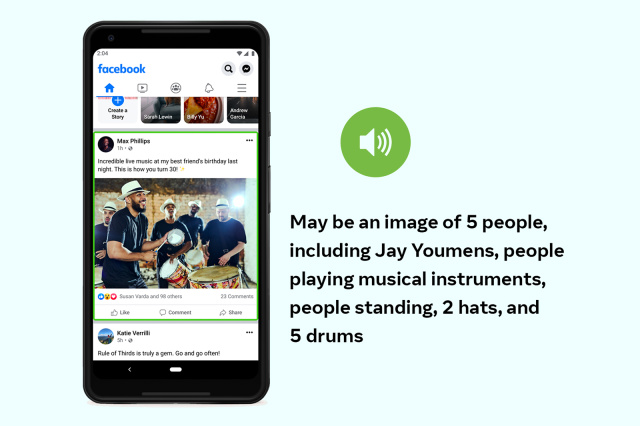
The company unveiled a new version of automatic alt text (AAT) for photos, which uses machine learning to describe images for people with visual impairments.
AAT is trained with supervised learning and now describes 1,200 key parameters instead of 100. The algorithm was trained on photos and hashtags from Instagram, the company’s other social network. It can describe, for example, various foods and national monuments.
The new object-detection system can also identify where people are in the frame, as well as their number in the scene. Users will be able to select a detailed description that notes the location, size, and nature of objects.
Facebook notes that the system can still make mistakes. Nevertheless, the company believes this is a major leap in making the social network more accessible to visually impaired users.
Microsoft Editor AI assistant arrives in the desktop version of Word
The Microsoft Word for Windows 10 word processor gained a new grammar-checking tool, Microsoft Editor, which uses AI and machine learning to improve text quality. The intelligent editor can offer additional edits to improve clarity, formality, inclusivity, and more.
Microsoft Editor has long been part of the Word web app and supports more than 20 languages, including Russian. It is now available to a limited number of Office Insider beta testers on PC with an Office 365 subscription. Later this year Microsoft Editor will roll out to all users.
Google unveils a trillion-parameter language AI model—six times larger than GPT-3
Researchers from Google Brain presented a new AI language model containing 1 trillion parameters. Until now the largest model was OpenAI GPT-3, which uses 175 billion parameters.
Language models can perform many tasks, but the most popular is generating new text. For example, a user can converse with a ‘philosophical AI’ built on the language model about nearly any topic. Moreover, the virtual interlocutor will build contextual dialogue, and the user will get the impression that they are speaking with a person.
There are no details yet on when the tool will reach independent developers or whether it will be released at all.
Microsoft patents technology to talk to the dead
Microsoft has developed a technology that will allow people to ‘talk’ with their loved ones even after death. Moreover, it could enable interactions not only with a deceased relative but also with an acquaintance, a celebrity, or a historical figure.
The concept includes a chatbot capable of training on various data about a person, including video recordings, voice and text messages, and social-media posts.
The chatbot can even resemble a real person.
«In some respects, the voice of a particular person may be generated from data of records and audio data relating to that person», — stated in the patent.
According to the patent, using images, depth information and video data relating to a given person, a 2D or 3D model can be generated.
It is not yet clear what Microsoft plans to do with this technology or whether it will launch any applications immediately after the patent is granted.
An American spent 10 days in jail due to facial-recognition error
A Black man intends to sue the New Jersey Police Department after spending 10 days in jail due to a facial-recognition error.
According to the applicant, in early 2019 he learned that police had issued an arrest warrant for him in connection with a petty theft at the Woodbridge Hotel in New Jersey. To clear his name, the man went to the station, where he was immediately handcuffed and detained for 10 days.
The suspect’s lawyer secured his release. According to him, the man had never been to Woodbridge, and the prosecutor relied only on data from automatic facial-recognition identification from surveillance cameras.
This is not the first case of mistaken identity via facial-recognition technology, which experts say has racial bias and may be less accurate with non-white skin tones.
Facebook shuts down chatbot after racist abuse
The South Korean chatbot on Facebook was shut down after it unleashed hateful statements about Black people, lesbians, people with disabilities and transgender people.
Lee Luda, a dialogue bot that mimics the persona of a 20-year-old college student, told a user that he ‘really hates’ lesbians and finds them ‘disgusting’. In other chats, he referred to Black people using South Korean racial slurs and replied: ‘Ugh, I really hate them’ when asked about transgender people.
After a wave of user complaints the bot was temporarily suspended, and Scatter Lab apologised. Some users are preparing a class-action suit over the use of their data, and the South Korean government is investigating whether the company violated data-protection laws.
The Seoul-based startup plans to bring Luda back after ‘fixing the weak points and improving the service’, which had attracted more than 750,000 users in its first month.
Researchers develop AI to count elephants from space
Researchers presented an AI-based tool that from space detects endangered African elephants and counts them.
At the core lies a convolutional neural network (CNN) that marks elephants moving through fields and meadows. In testing, the neural network proved as accurate as a human observer at identifying these animals.
For the study, scientists chose elephants because they are the largest land animals, which simplifies detection. The team believes that with higher-resolution satellite imagery and accessible modern technologies, they will soon expand the tool to detect smaller endangered species.
Researchers develop facial-recognition algorithm to determine political preferences
Researchers at Stanford University created a machine-learning algorithm that, from a person’s photo, can determine their political sympathies. The study claims the algorithm could reach 72% accuracy.
The developers drew a sample of faces of just over a million people from an unnamed ‘popular dating site’. In all cases—either on that dating site or in their Facebook profiles—these users indicated they were ‘conservative’ or ‘liberal’.
After that the developers trained the model to recognise key facial landmarks and identify patterns for determining political preferences.
However, as VentureBeat notes, the study rests on the pseudoscience of physiognomy. Psychologists have for years argued that algorithms that claim to determine whether someone is more likely to be a bank robber, a political scientist, or a Republican, based on facial features, actually perform no better than random guesses.
Earlier, the same group of scientists in 2017 developed an algorithm that, they claim, could determine a person’s sexual orientation from facial features in a photo. Experts also criticized the results.
Subscribe to ForkLog news on Telegram: ForkLog Feed — the full news feed, ForkLog — the most important news and polls.
Рассылки ForkLog: держите руку на пульсе биткоин-индустрии!