




Monthly trading volume on decentralised exchanges for perpetual futures surpassed $1trn for the first time, according to DeFi Llama.


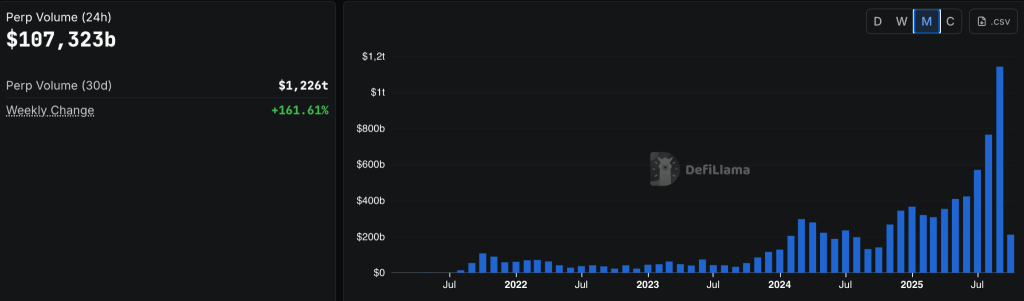
Most of the volume went to Aster — $493bn. Hyperliquid — the former segment leader — ranked second with $280bn. Also in the top three was Lighter, launched in April, with $165bn. The venue earlier announced the launch of its mainnet.
The Aster phenomenon
Aster showed the biggest surge in trading volume. Over the month, the platform’s figure jumped from $9bn to $420bn. The exchange’s TVL rose more than sixfold — from $340m to $2.2bn.
The frenzy was sparked by active discussions of Binance founder Changpeng Zhao’s (CZ) possible involvement in creating the platform. The community suggested the entrepreneur might have launched a DEX in the BNB Chain ecosystem in response to Hyperliquid’s success.
He later commented on the rumours, saying that several former Binance employees work at Aster and that YZi Labs owns a minority stake in the venue. Amid the hype, the exchange even topped DeFi Llama’s protocol ranking by fees, ahead of Tether and Circle.
At the time of writing it had slipped to second place, at $148m over the past 30 days.



Hyperliquid ranks fifth on this metric. Over the month, the platform’s fees totalled $87m.
On 17 September Aster also launched its eponymous token. Since then, its price has risen by more than 1,600% — from $0.09 to $1.8 — at an FDV of $14bn.


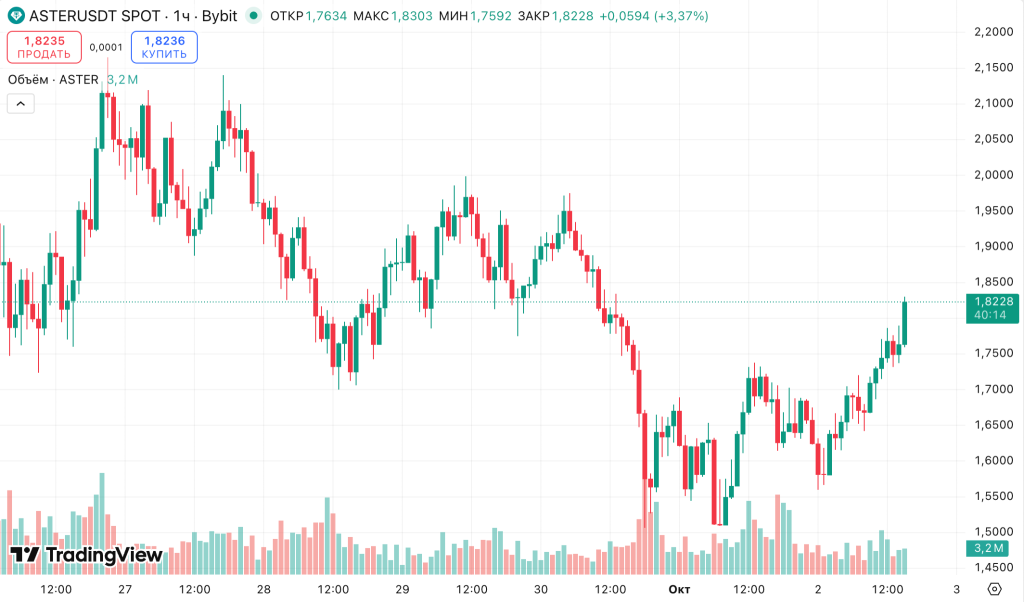
ASTER’s market capitalisation reached $2.9bn. Earlier, experts predicted that the asset would soon overtake Hyperliquid’s HYPE on this metric. For now, it remains far behind — the rival’s market value exceeds $13bn, according to CoinGecko.
Meanwhile, Justin Sun announced the launch of a perp-DEX on TRON.
Amazing first day!🙌
Great to see @Trondao lead the way as Title Sponsor at @Token2049 and get the opportunity to share the launch of @Sunperp_Dex with the community today! https://t.co/R8Z8UQYp8O
— H.E. Justin Sun 👨🚀 🌞 (@justinsuntron) October 1, 2025
Perp-DEX hype may be short-lived
BitMEX CEO Stefan Lutz believes the excitement around decentralised exchanges could quickly fade. He said so in an interview with CoinDesk.
The expert compared perp-DEX economic models to a classic Pump and Dump scheme. According to him, their growth is driven primarily by aggressive incentive programmes rather than fundamental value.
“The original goal of such platforms is to provide access to markets without intermediaries, but the current growth is driven mainly by artificial incentives. This is not fraud, but a transparent economic model in which all participants understand the rules of the game,” Lutz explained.
He also drew a parallel with marketing campaigns that buy audience attention. According to him, platforms similarly attract traders with rewards and fee rebates, creating a “self-sustaining” ecosystem of trading activity.
In late September, a project by DeFi developer Andre Cronje raised $200m to build a “full-cycle” decentralised exchange.