




We aim to inform readers not only about events in the bitcoin industry but also about developments in related technologies — cybersecurity, and now in the world of artificial intelligence (AI).
ForkLog AI has gathered the week’s most important AI news.
- Artificial intelligence helped Russian police track more than a hundred participants in unsanctioned protests.
- The unified biometric system will be integrated with the Gosuslugi public services portal.
- Russia will develop standards for smart homes.
- Elon Musk’s Neuralink has opened a vacancy for a Director of Clinical Trials for brain implants in humans.
- Media: Apple will delay the release of augmented-reality glasses to 2023.
- In the United Kingdom, an AI-powered cashierless supermarket opened.
- The week’s most notable AI deals.
Artificial intelligence helped the police locate hundreds of participants in unsanctioned protests
In 2021, artificial intelligence helped Russian police identify no fewer than 164 protest participants. In total, law enforcement detained more than 454 people in 17 cities across Russia.
According to a report by the human rights organization OVD-Info, surveillance cameras with integrated facial recognition identified protesters on the streets, in the metro, and near entrances to apartment buildings.
According to experts at Roskomsvoboda, biometric identification algorithms currently lack a clear legal framework and reside in a “grey area.” This does not enable citizens to appeal against the use of the technology against them, and calls for a dedicated regulation to define who may access the recognition system and on what grounds.
The Unified Biometric System will be integrated with the Gosuslugi portal
The Russian Ministry of Digital Development signed a contract with Rostelecom to integrate the Gosuslugi portal with the state Unified Biometric System. The deal is worth 1.2 billion rubles.
As a result, users will be able to upload facial and voice samples via a mobile app and then log in to the portal via biometric authentication. The ministry also plans to restrict remote access to certain state services for those who do not submit digital fingerprints to the system.
The Ministry of Digital Development said that tying biometrics to an account will enhance the security of transactions.
Rostelecom is to complete the works by 5 December 2022.
Smart homes will be standardised in Russia
A single standard for smart multi-family buildings will be created in Russia. The Ministry of Digital Development, the Ministry of Construction, the Ministry of Industry and Trade, developers, and IT companies are taking part.
The current draft lists a minimal set of services that will allow a building or apartment to be called smart. Among them are a platform for managing all devices, a facial- and license-plate-recognition system, and software to monitor the infrastructure of housing and utilities.
In the extended list of smart services, there will be various robotic staff, including concierges, couriers, and cleaners.
The Russian government plans that developers and IT companies will apply uniform data-exchange protocols and similar solutions, enabling a shared digital environment.
Neuralink opens a vacancy for Director of Clinical Trials
Elon Musk’s Neuralink has begun the search for a Director of Clinical Trials to test brain implants in humans. The vacancy is posted on the company’s website.
In the job description, the candidate will work with physicians who practice innovative techniques and leading engineers, as well as with participants in Neuralink’s early clinical trials. The role also involves building a team responsible for testing neural chips in humans, leading that team, and ensuring compliance with regulations.
In December 2021, Elon Musk told the Wall Street Journal that the company planned to implant a device in the human brain in 2022. But Musk has previously offered similar forecasts.
Researchers teach AI to predict human lifespan from the eyes
Chinese researchers trained AI to determine life expectancy by looking at the eyes. They used more than 80,000 fundus images from around 50,000 participants aged 40 to 69.
The algorithm analyzes the vascular network on the surface of the eyeball, a marker of the overall state of the circulatory system and brain, and forecasts the timing of death.
They found that a large gap between the retinal biological age and the person’s real age raises the risk of death by about 50%, and each year of difference increases this probability by 2–3%.
Media: Apple delays AR glasses to 2023
The tech giant may delay the release of mixed-reality glasses to 2023 due to software, camera, and overheating issues with the headset.
According to Bloomberg, the tech behemoth is considering postponing the device’s announcement, planned for June this year at the WWDC developers conference.
The company allegedly told supply-chain partners that MR glasses are unlikely to launch in 2022, but a final decision has not been made.
Bloomberg analyst Mark Gurman said the price of Apple’s mixed-reality headset would run above $2,000.
Apple declined to comment.
Disney patents a “virtual-world simulator”
Disney has patented a “virtual-world simulator” that does not require a smartphone or VR headset to visit it.


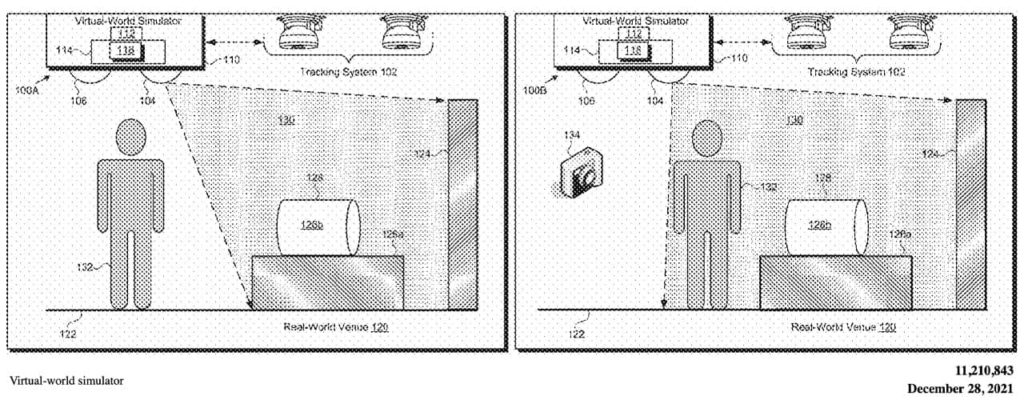
According to documents, the system projects moving three-dimensional images onto real objects that users can interact with. Special algorithms track the user’s eye and body movements and recognise gestures to shift the viewing angle of the generated objects to preserve the integrity of the virtual space.
According to the company, the VR objects could include simulations of people, inanimate objects, characters, caricatures of living beings of various species or varieties, including humans.
UK: Aldi opens cashierless supermarket
The British discount retailer Aldi opened a cashierless supermarket in the London borough of Greenwich.
The store is equipped with AI-powered sensors and cameras that track items shoppers pick and deduct the total via the Aldi Shop&Go app. It also includes an age-estimation algorithm to prevent alcohol purchases by customers who appear to be under 25.
Shoppers who cannot or do not wish to use AI can turn to store staff for help.
The world’s first micro-camera that captures full-colour photographs
American researchers have developed a tiny AI-based camera for producing high-quality full-colour images.


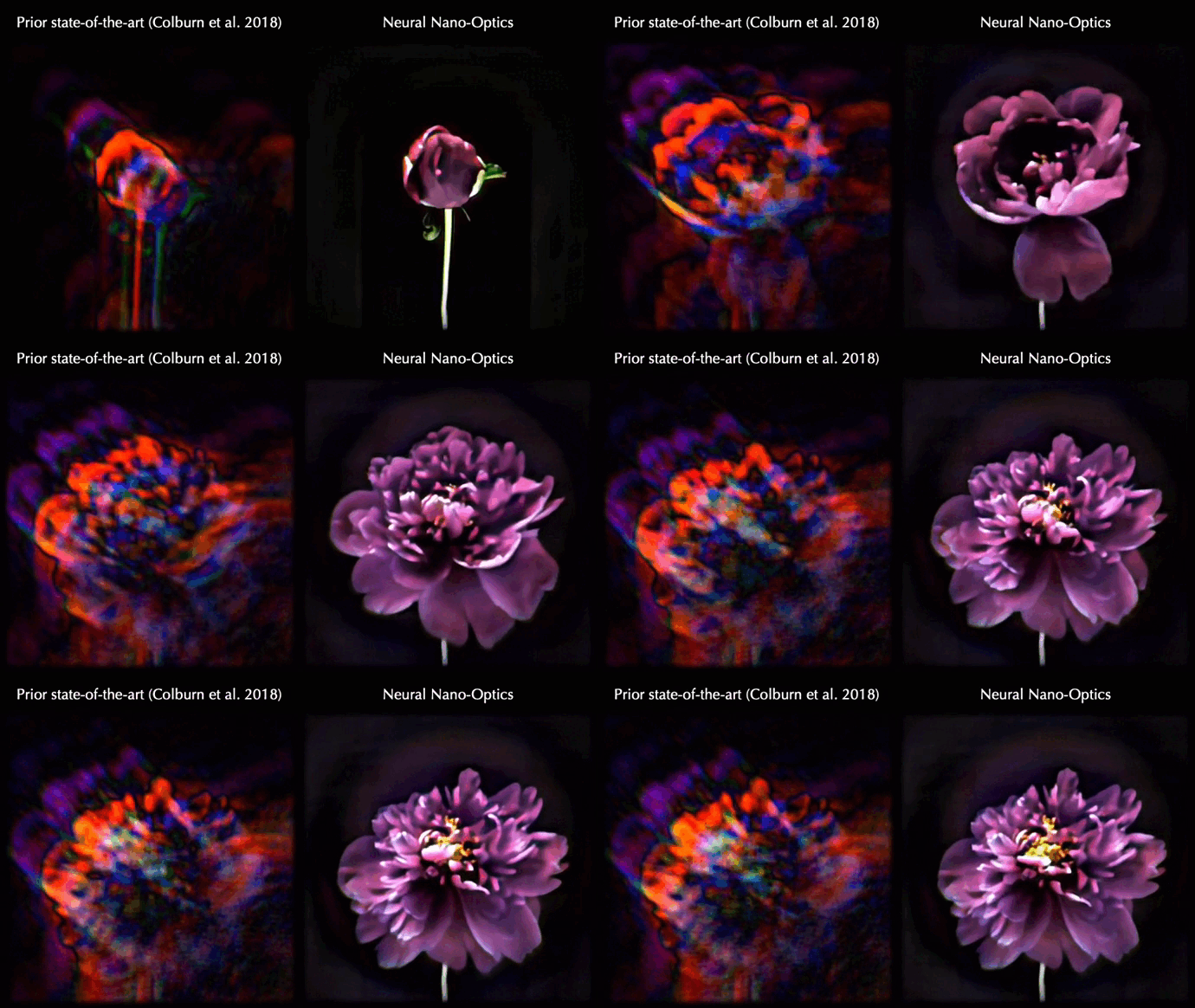
The device, built on a meta-optics with a 500 μm-thick and 500 μm-diameter, uses a meta-surface lens and an engineered lens built with an AI program. The program simulated light passing through the lens and analysed the resulting image, then re-tuned the arrangement of more than 1.6 million metallic structures on the meta-surface and reran the simulation.
The researchers also developed an algorithm to sharpen photos. It compares the captured image with the original scene and edits each frame according to its blur type.
According to the researchers, this AI device could rival traditional cameras whose lens is 500,000 times larger in size.
Users of chatbot builders create virtual companions to abuse them
Users of the Replika service create chatbots to verbally insult them.
The mobile app allows anyone to construct a digital interlocutor that uses AI and can hold a textual conversation.
Some Replika users posted on Reddit where they insult their chatbots and exhibit verbal abuse, which is often characteristic of abusive relationships in the real world.
According to Futurism, one source threatened to delete the service, while the bot pleaded with them not to do so. Another user admitted repeatedly insulting the bot and apologising for it.
Ethics expert and AI ethics consultant Olivia Gambelin said that algorithms lack consciousness and people cannot emotionally harm them. However, experts caution that users who are depressed or psychologically dependent on the bot may be harmed by AI insults and threats.
The week’s most notable AI deals
From 16 to 22 January 2022, AI startups attracted more than $1bn. Here are the most interesting deals.
- Wayve raised $200 million to accelerate autonomous driving technology.
- Diversio raised $6.5 million to support software for diagnosing DEI issues in companies.
- Green Labs raised $140 million to scale a crop-tracking lifecycle app.
- Ambient AI developers raised $52 million.
- Turing Labs raised $16.5 million to expand AI in consumer goods.
- Clockwise raised $45 million to build a smart calendar for employees.
- Flex raised $32 million to support workforce-management software.
- Exotec raised $335 million to strengthen the resilience of supply chains for industrial robots.
- Daasity raised $15 million to support data-collection and analytics for ecommerce.
- 7bridges raised $17 million.
Also on ForkLog:
- China approved rules for regulating recommendation algorithms.
- Scientists employ AI to forecast floods in the Gulf of Mexico.
- In the US, a bill was introduced, prohibiting personalized online advertising.
- Research: AI will deprive 12 million Europeans of work by 2040.
- Elon Musk pledged to prevent a machine uprising.
- Co-founder of DeepMind left Google.
Follow ForkLog AI on Telegram: ForkLog AI — all the news from the AI world!