



Not the father: how Michael Saylor alienated the bitcoin community
Few would have expected Vitalik Buterin to join the bitcoiners chastising Michael Saylor.
The trigger for the backlash was an interview the MicroStrategy founder gave to the Markets with Madison podcast. In it Saylor explicitly promoted state regulation and the storage of bitcoin in organisational accounts rather than personal wallets. He branded the camp defending censorship-resistance “paranoid crypto-anarchists”.
Buterin, in turn, called Saylor’s comments “batshit insane” and argued that the businessman is pushing the idea of cryptocurrencies being held by organisations controlled by the state and law enforcement. As examples of such cooperation with the authorities, the Ethereum founder cited BlackRock and Fidelity.
I probably did more than most to spread the “mountain man” trope (btw I consider those remarks of mine outdated; snarks and AA changed the tradeoff space completely), and I’ll happily say that I think @saylor‘s comments are batshit insane.
He seems to be explicitly arguing for a…
— vitalik.eth (@VitalikButerin) October 22, 2024
Even the fiercest advocates of bitcoin, decentralisation and personal responsibility for one’s finances are tested by time—like every project in the market.
In crypto’s Lindy law: the longer a blockchain runs, the stronger both the technology and its community become. If bitcoin has survived the past 15 years, it is likely to persist for the next 15. The same holds for market actors promoting one idea or another.
For many it came as a surprise that Saylor was not the man to rely on. Yet he never was, as he openly admitted. Few grasped what exactly the pseudo-bitcoiner’s plan amounted to.
Back in 2020 Saylor stated to Bloomberg that he was not a consistent supporter of cryptocurrencies and that, for example, if bond yields jumped, he would dump digital gold without hesitation. Many likely missed that interview in those “distant” years.
“We can liquidate it [bitcoin] any day of the week, any time of day. If I needed to liquidate $200 million worth of bitcoin, I could even do it on a Saturday,” Saylor said.
At the time he said the first cryptocurrency was merely an asset with a positive real return his team had found. And if the MicroStrategy founder has not changed since, it is unlikely he will turn into a champion of decentralisation by, say, 2030.
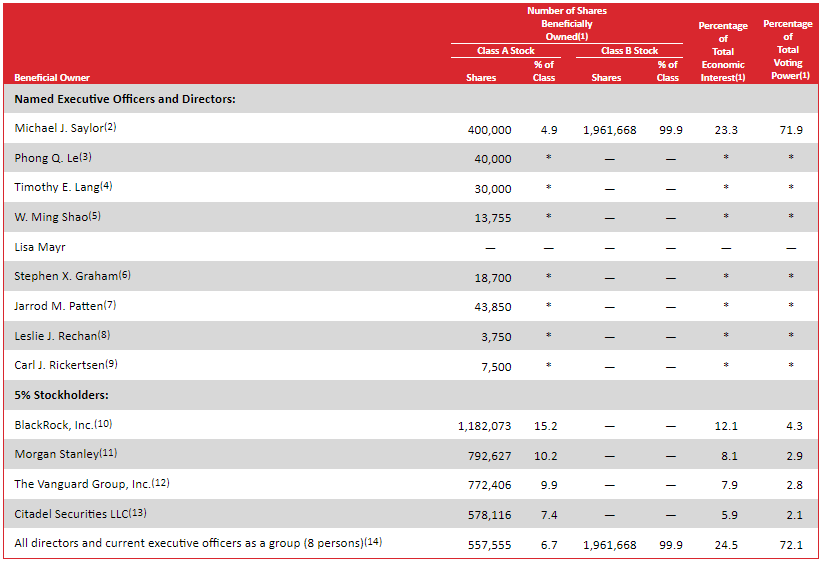
Saylor also admitted that when he discussed the matter with ten major shareholders, most reacted “very favourably”. And among MicroStrategy’s shareholders are the very parties that actively push instruments based on cryptocurrencies:
A history lesson from Saylor
In his latest Markets with Madison interview, Saylor dismissed the prospect of government expropriating bitcoin, offering a curious argument: the 1933 law seizing citizens’ physical gold in the United States produced no practical results.
It was this order that allowed the authorities to require private individuals and corporations to hand over all their gold coins, bars or certificates if “such action is necessary to protect the financial system”.
President Roosevelt issued the order on April 5. It required that by May 1, 1933, all citizens’ gold holdings be exchanged for paper money at $20.66 per ounce at authorised banks in the United States. (Many years later, the day the document was signed and the year it was repealed were chosen as the date of birth of bitcoin’s creator, Satoshi Nakamoto.)
And in the very next year, 1934, Roosevelt announced the confiscation of gold from banks in exchange for certificates that could not be redeemed for the precious metal.
More ironic still, the MicroStrategy founder intends to bequeath his bitcoins to humanity after his death, following the example of Satoshi Nakamoto.
“I am single, I have no children—one day I will be gone. Just as Satoshi left the Universe 1 million BTC, so will I leave civilisation everything that I have,” the “bitcoin maximalist” said.
Saylor either deliberately or out of ignorance (which is doubtful) downplays the largest robbery of the population (1933) and, as its continuation, the largest robbery in the world (1971) by the U.S. government.
This is the ideological foundation of digital gold: there can be no compromise between personal ownership of assets and arbitrary censorship of any format.
Precisely because there were, are and will be precedents for taking property from the public—directly or via the banking sector—bitcoin has evolved all this time. Without painting the most dystopian scenarios, today the adoption of institutional instruments such as ETFs leads to:
- keeping bitcoin with a third party;
- building a derivatives market instead of personal buying;
- censorship at the regulator’s first snap.
All this leaves digital gold in a sorry state.
Following in Grayscale’s footsteps
Saylor’s “bitcoin bank” merely apes the creation of Barry Silbert, who founded Grayscale and first implemented the idea of earning safely off digital gold.
The scheme involved issuing company shares (GBTC) that trade on the stock market, embedding “live” BTC into the share-issuance mechanism. Unlike an ETF, the shares trade freely without being pegged to bitcoin’s price, functioning as entirely independent instruments.
This allows Saylor’s company to sell and create securities with nominal backing by the first cryptocurrency. He is not obliged to back each share with bitcoin by registering a dedicated fund—the “bitcoin maximalist” simply says he will buy more digital gold with part of the proceeds from selling securities.
If BlockFi, Celsius and 3AC overplayed their hands with the hundreds of millions posted as collateral on GBTC shares, Saylor controls all his speculative chains himself.
By his own account, the approach to investing in bitcoin is about exploiting arbitrage opportunities, not what investors thought when they heard him say HODL.
Put simply, the earning strategy is straightforward. It consists in using a delta‑neutral position: open a long and a short simultaneously, then after six months or a year cash in the premium, repay the debts and raise new capital for another speculative cycle.
It is, in its way, a clever solution. But Saylor has been steadfast and open that he is no friend to cryptocurrencies in general or bitcoin in particular. He merely devised and executed a profitable strategy. Time will tell how durable it is.
P.S.
After a torrent of criticism, the MicroStrategy founder did acknowledge the value of self-custody of bitcoin, defining it as a benefit “from all forms of investment” in digital gold. That only reinforces the point about the speculative nature of Michael Saylor’s business strategies.
Text: Oleg Cash Coin
Рассылки ForkLog: держите руку на пульсе биткоин-индустрии!