



On acceleration: what e/acc is and how it could have influenced Sam Altman’s dismissal
The drama surrounding OpenAI CEO Sam Altman has given rise to various theories about the reasons for his sudden dismissal. The trigger was the company’s press release in which it was said that he “was not always candid with the board.” But what exactly?
According to data Reuters, shortly before the dismissal OpenAI researchers warned the board about a major AI breakthrough that “could threaten humanity.” In the view of many employees, the development could constitute a breakthrough in creating artificial general intelligence (AGI).
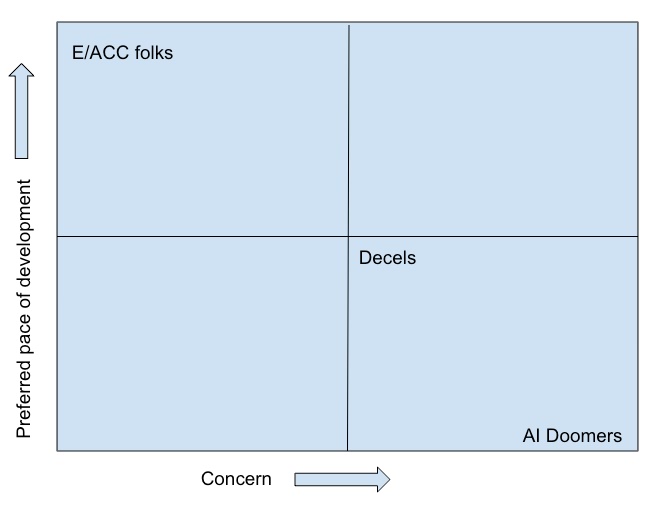
The speculation shed light on the divergent views within the AI community. Essentially, it split into opposing camps: proponents of effective accelerationism and supporters of deceleration — “decels.” Alex Wilhelm from TechCrunch also highlights AI doomers.
Speed and concern
The views of accelerationists, decels, and AI doomers lie on two planes:
- speed — how quickly AI technologies are developing;
- worries about their potential to develop too quickly; as a result, one should be very careful about how people use and deploy AI.
e/acc and a16z
Effective accelerationism is an ideology and movement grounded in the theory of accelerationism, tracing back to the work of French post-structuralists Gilles Deleuze and Félix Guattari. Advocates of this concept, as a rule, sit at the extremes of the usual political spectrum. Thus, accelerationist theory has been actively pushed by British philosopher Nick Land since the 1990s, who chose the term “Dark Enlightenment to describe his views.
In the name e/acc one can also read a nod to “effective altruism” (EA), whose popularity rose and fell along with former FTX CEO Sam Bankman-Fried. The idea of EA is to “find the best ways to help others and apply them in practice.”
In the recently published “The Techno-Optimist Manifesto” by a16z co-founder Marc Andreessen, one can find this definition:
“We believe in accelerationism — a conscious and purposeful stimulation of technological development to ensure the law of accelerating returns is fulfilled. So that the spiral of technocapital growth continues indefinitely.”
The manifesto also states:
“We have enemies. Our enemies are not bad people, but rather bad ideas. Our modern society for six decades has been subjected to mass demoralisation — against technology and against life — under various names: ‘existential risk’, ‘resilience’, ‘ESG’, ‘sustainable development goals’, ‘corporate social responsibility’, ‘stakeholder capitalism’, ‘the precautionary principle’, ‘trust and safety’, ‘technoethics’, ‘risk management’, ‘anti-growth’, ‘limits to growth’.”
These excerpts help summarise the core ideas and values of e/acc. Its supporters advocate deliberately pushing society forward through aggressive technological innovation, unrestrained by concerns about potential negative effects.
The central argument of e/acc is that new technologies can lead to radical social changes, and the long-term benefits from this are so large that potential risks can be ignored.
In the “Techno-Optimist Manifesto” the decels are also described:
“Our enemy is deceleration, anti-growth, depopulation — a nihilistic desire that is all the rage among our elite: to have fewer people, less energy, more suffering and death.”
Decels and doomers
Decels continue to advocate AI development, just with greater caution on this issue. Among them are many technologists such as co-founder of MIRI Eliezer Yudkowsky.
Also in early 2023, more than a hundred scientists, independent researchers and businesspeople, including Elon Musk and Steve Wozniak, signed an open letter proposing a six-month pause on training language models more powerful than GPT-4:
“Powerful AI systems should be developed only when we are confident that their effects will be positive and the risks manageable,” the statement said.
AI doomers argue that humanity is digging its own grave with the help of new AI technologies.
“But since doomism doesn’t earn much money (aside from writing good science fiction), it’s more of an academic position than the stance of tech companies.” “As far as I can tell, e/acc is winning the current debate largely due to rapidly advancing AI technologies and the fact that a large portion of the economy wants to use them to save money and do more,” says Alex Wilhelm of TechCrunch.
Thus today, a tailwind from capitalism is blowing in behind e/acc supporters.
Conclusion
One can suppose that it was the decels who attempted to remove Altman from his post at OpenAI, which enraged Microsoft CEO Satya Nadella. His company has invested $10 bn in OpenAI, and Altman returned to the role of CEO with a new board of directors.
If his dismissal is viewed as a coup and a bid to “build safe AI or do nothing,” it has effectively failed.
Рассылки ForkLog: держите руку на пульсе биткоин-индустрии!