




In October, Polkadot developers announced the launch of the first parachain-slot auctions. The community has shown considerable interest in the forthcoming event — the ambitious project led by Gavin Wood and its ecosystem is developing rapidly, attracting multi-million-dollar investments.
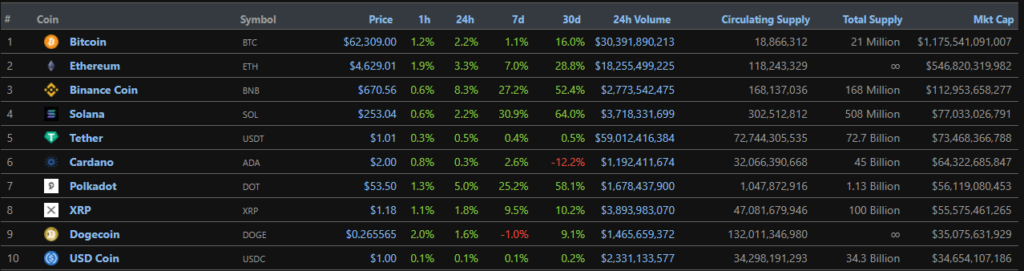
As of writing, Polkadot sits seventh in the market capitalization of crypto assets.


Recently Binance announced a week-long promo ahead of the launch of the Polkadot parachain-slot auction, with rewards amounting to $30 million. This further stoked community interest.
ForkLog explains what parachain auctions are and how to earn from them.
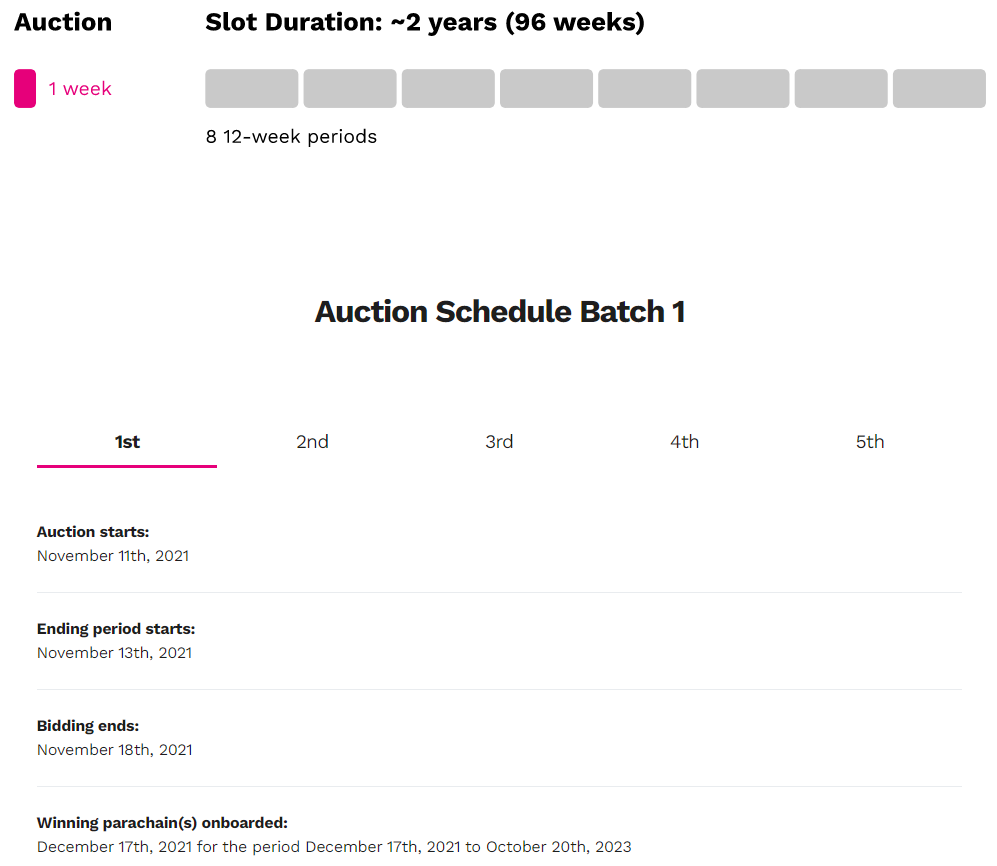
- The first DOT parachain-slot auction starts on November 11. Afterward, the winning projects will enter the slot rental period — it will run from December 17, 2021 to October 20, 2023.
- Potential rewards for participants can be substantial, given the results of similar auctions in the Kusama experimental network. Binance is also distributing $30 million in rewards ahead of the auction launch.
- Parachain auctions are a new and quite interesting model for supporting projects. Unlike ICOs, the blocked assets are returned to participants after some time, and the projects do not have access to them.
What’s special about Polkadot?
Polkadot is a technology designed to improve interoperability among disparate blockchains, for example Bitcoin and Ethereum, and unite them within a single multi-chain framework.
In other words — it is a system that connects blockchains into a single space. The technology enables safe processing and exchange of data across networks. One of the main features is seamless upgrades that do not require hard forks.
Developers implemented the ability to create networks of other projects based on Polkadot — parachains. They are independent blockchains with their own token and the ability to tailor functionality to specific tasks and needs.
Parachains carry all the advantages of Polkadot and can interact with other projects in the ecosystem.
The number of parachain slots in the Polkadot network is limited (about 100). They are allocated through auctions in which DOT holders vote for projects to be connected to the relay chain. The relay chain is the main network where transactions settle.
Polkadot tokens serve not only as a medium of exchange, but also perform the following functions:
- Governance: voting in parachain auctions and on project development questions.
- Operations: DOT underpins the basic consensus mechanism. Token holders must be active participants and stake their coins to counteract violations of consensus rules.
- Rewards: tokens are distributed to active participants in the network.
Given these features and significant potential for scaling, some have dubbed Polkadot the ‘Ethereum killer’.
To delve deeper into the project’s history and technical details, see our cards.
Note that there is also the experimental Kusama network. The developers emphasise that it is viable and independent from the main Polkadot network.
“Kusama will exist as long as the community supports it, and we expect it to host new, early-stage, high-risk features and projects preparing for development and deployment on Polkadot,” — says the project’s blog.
In Kusama there is a native token KSM, performing roughly the same functions as DOT.
What are parachain auctions?
As noted, the number of slots in Polkadot is limited. To rent a slot for hosting a parachain, a candidate project must win an auction. This requires collateral in the form of DOT tokens. The DOT can be acquired or borrowed from the community via crowdloan (crowdloan) — an alternative to ICO.
Parachain auctions in Polkadot proceed similarly to Kusama’s canary-network auctions. The main difference is the duration of the slot period — in Kusama it is shorter, 48 weeks (eight lease periods of six weeks each).
“Parachains connect to Polkadot by renting a slot on the Relay Chain for up to 96 weeks, with a possibility of renewal. Parachain slots are allocated based on the on-chain auction results, the winners locking DOT bonds for the rental period,” — as stated on the project site.
Polkadot schedules eight periods of 12 weeks each.


DOT holders can lock assets in favour of the project they believe should receive a parachain slot. In return, the project distributes its tokens among supporters or offers other rewards.
If a project participant wins a slot, the DOT are locked and kept in a special vault until the end of the rental period. They are then returned to the owners.
But if the project does not win, the tokens are returned roughly a month after the auction ends. Thus, DOT does not disappear; they are simply blocked for a period depending on the voting outcome.
One can draw a parallel between crowdloans and ICOs, but it is important to understand that during the auction users do not hand over their assets to the project team or any third party. Delegated DOTs are locked in the Relay Chain, and parachain teams have no access to them.
During an ICO, user funds go to the project team for use at its discretion. In parachain auctions, the coins are returned to the user if the project loses or if the campaign ends. If the project wins, the coins are returned after the parachain slot expires.
Any project can acquire a slot on the secondary market from one of the auction winners.
To randomise the moment of winner determination for parachain auctions, a mechanism known as a candle auction is used.
The first candle auctions began in the 16th century during ship sales. A candle was lit, and the winner was the participant who placed the highest bid before it burned out.
Similarly, parachain auctions allocate a defined period during which participants can bid on projects. To keep the process fair, the winner-determination time is chosen at random.
Winners are the projects with the strongest backing in the form of blocked DOT at the moment the auction ends. Despite the officially set end time, the winner is determined after a random snapshot just before the campaign ends.
Rewards for participation can be generous. The table below shows the reward rankings for the Kusama network.


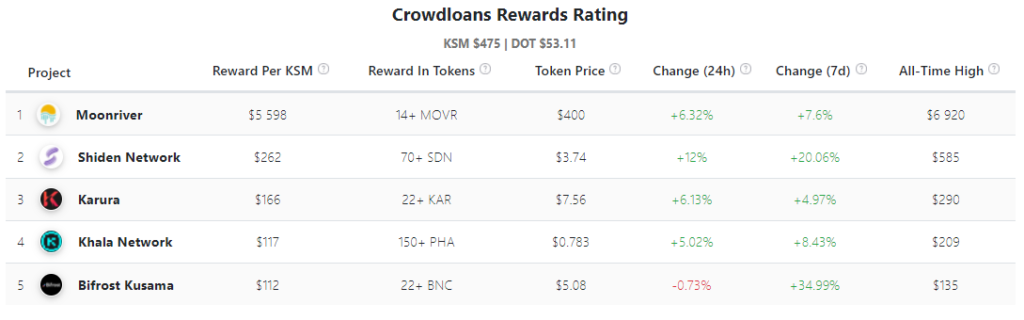
As seen, for 1 locked KSM worth about $475, the native-token rewards amounted to:
- 14 MOVR from Moonriver ($5,598 at token price of $400).
- 70 SDN from Shiden Network ($262).
- 22 KAR from Karura ($166).
- 150 PHA from Khala Network ($117).
- 22 BNB from Bitfrost Kusama ($112).
DOT and KSM tokens held by auction participants can be viewed as bonds, where a substantial coupon is paid in the native tokens of parachain projects, and participants retrieve their assets after a fixed period. Risks relate to the opportunity cost of locking DOT during the rental period and to potential declines in token price.
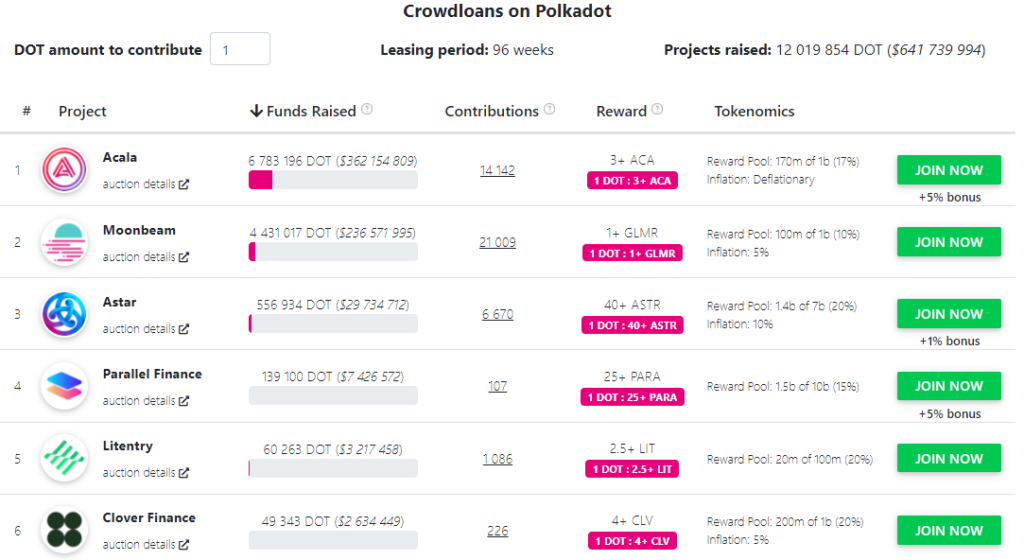
The first five Polkadot auctions will run from 11 November to 16 December 2021. The table below lists some current participants (as of 7 Nov 2021).


Projects can raise funds through a variety of tools:
- Polkadot JS Portal;
- mobile wallet Polkawallet;
- exchanges;
- their own platforms.
Let us consider a relatively simple way to participate with a low entry threshold using Binance as an example.
Binance-specific features of parachain auctions
On 4 November Binance started a week-long promo ahead of the launch of the slot auctions, promising to share among participants rewards totaling $30 million.
“Users will receive a bonus on the slot auction page every hour. Rewards totaling $30 million will be paid out during the promo period,” — says the exchange blog.
The promo ends on 11 November at 15:59 MSK. Immediately after this the slot auction will begin on the platform.
Representatives from Binance noted that assets placed in staking will be locked for the duration of the campaign.
“If the project you choose wins, your DOT will be locked for 96 weeks. In return you will receive staking rewards from the chosen project. If it fails during the slot auction trading, your stake in DOT will be returned to your spot wallet on 18.12.2021.”
The auction period is divided into five weekly rounds. The results of the final (fifth) round are expected to be announced around 16 December.
After that, the winning projects begin the slot rental period — it will run from 17 December 2021 to 20 October 2023.
Other aspects of the DOT slot auction, including Binance-specifics:
- Minimum participation amount: 0.0001 DOT.
- Rewards per hour are calculated according to each user’s share of the total DOT among all participants. Users may receive rewards hourly or as they accrue.
- Binance will offer a liquidity solution — BDOT. Users can convert the DOT involved to BDOT at 1:1. After the parachain slot rental period ends, DOT can be redeemed for BDOT at 1:1.
- Users will be able to freely trade DOT and BDOT, with BDOT available for trading on Binance.
Thus, there are three types of rewards:
- The promo bonus ahead of the launch — $30 million;
- Rewards during the slot auction period;
- Staking rewards during the rental period for winning projects.
The exchange promises to payout 100% of the rewards due to users.
“Binance will fully integrate the networks and distribute rewards after the winners of trades launch the corresponding parachains. Some of the tokens earned as rewards will become withdrawable later,” said Binance representatives.
If users sell BDOT after trading begins, they will continue to receive tokens from the winning projects for two years. Users who buy BDOT will not receive rewards.
Binance noted that before listing and trading on Binance, parachain projects participating in the Polkadot slot auctions (DOT) will undergo checks similar to other tokens.
“Support for the Polkadot slot auction does not guarantee token listing. Under Binance’s internal policy, listings are not guaranteed. If project representatives disseminate information about a forthcoming listing during checks, the project will be disqualified,” reads the disclaimer.
How to earn on parachain auctions via Binance
We decided to lock a small amount of DOT for several parachain projects.
On the slot auction page you will find the campaign’s core details:


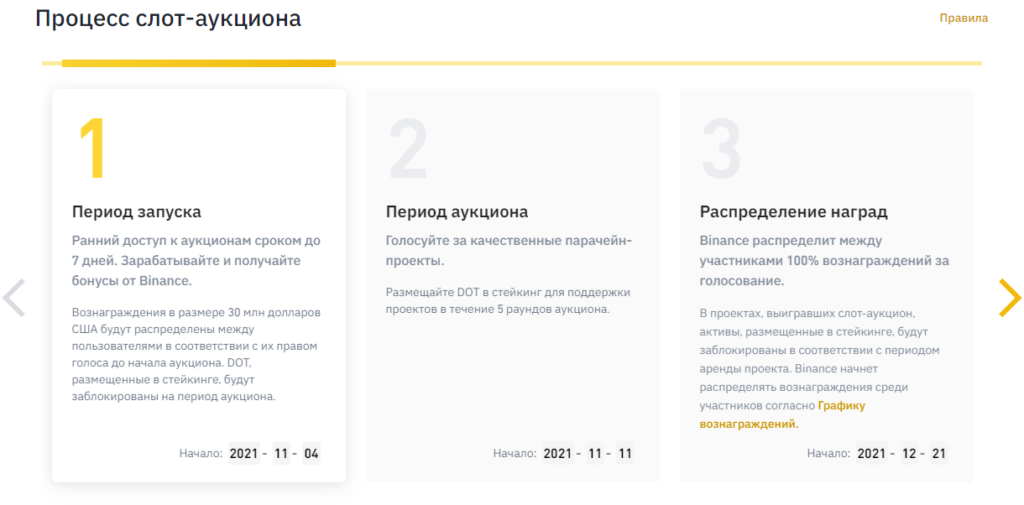
Below is a list of participating projects:


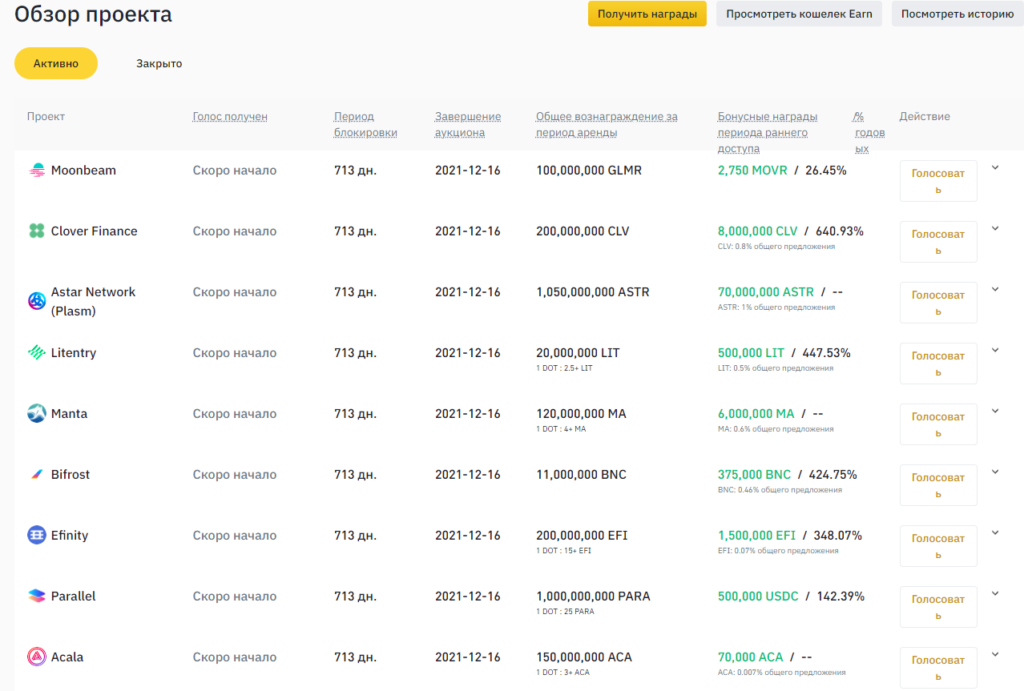
Clicking the arrow on the right reveals additional information.


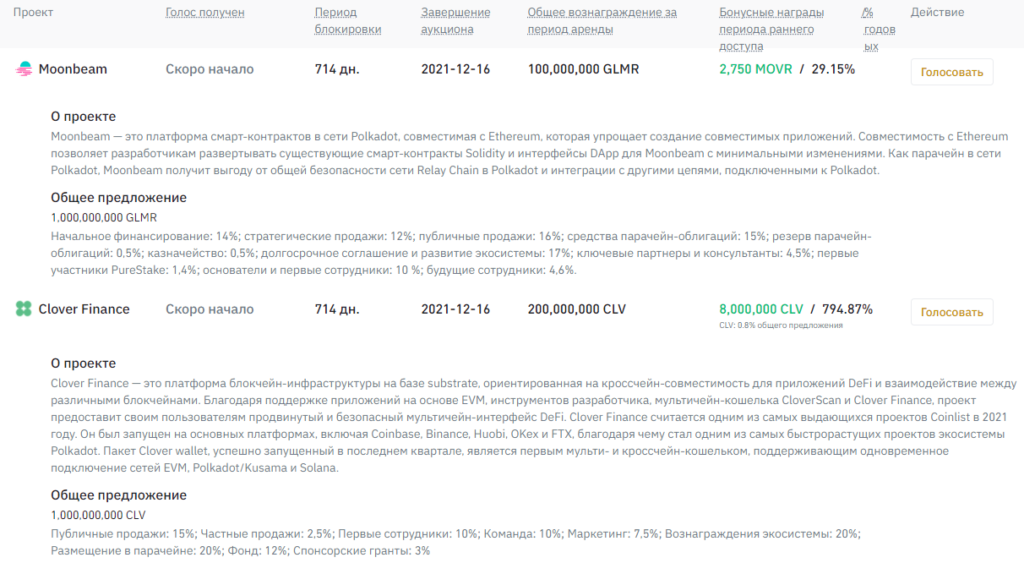
As shown, Clover Finance has a relatively high reward distribution rate. We decided to vote for it by locking 2 DOT.
After clicking Vote a confirmation window appears.


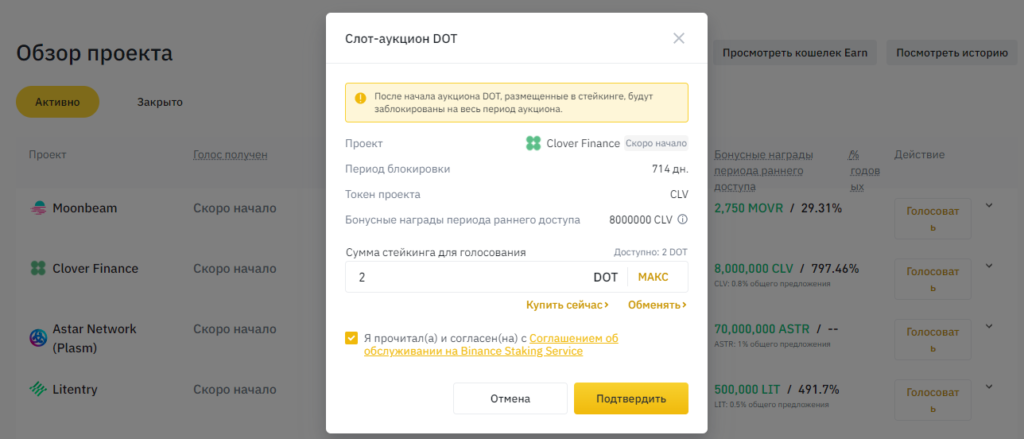
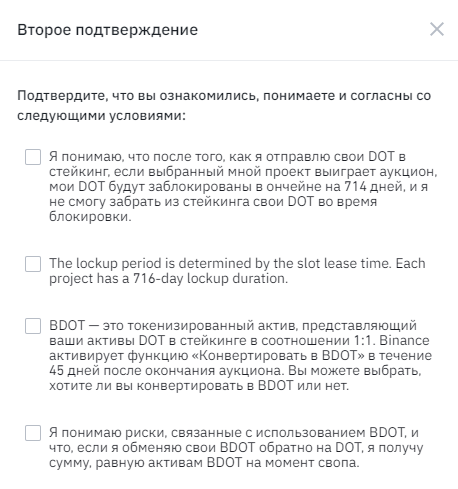
Then comes a second confirmation, where you must check four boxes.


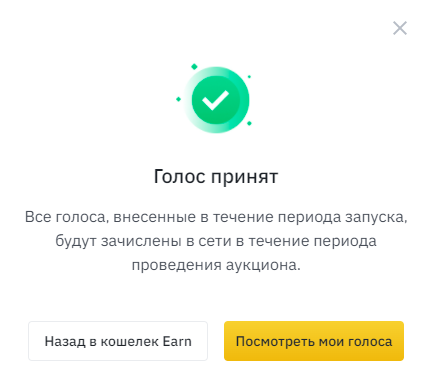
After this the system signals that your vote has been recorded.


Then you can periodically collect rewards in the Earn section by going to Fixed Staking and selecting DOT Slot Auction.


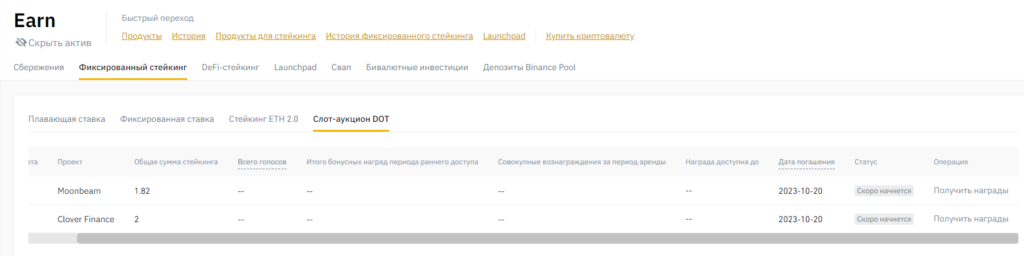
As shown in the screenshot above, we also locked 1.82 DOT to support the Moonbeam project.


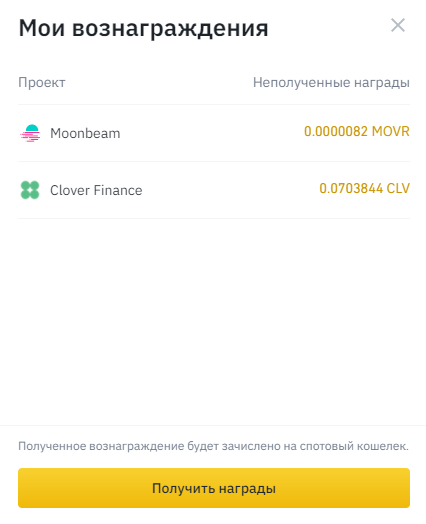
After clicking Get rewards, the funds will be transferred to your spot wallet.
Just over a day later, the accumulated reward for locking DOT in support of Clover Finance stood at 1.54 CLV — a little over $2. Also 0.00020407 MOVR was credited, which is not yet listed on Binance.
The practical aspects of participation are intuitive. Before staking DOT, carefully analyse the projects, examining their technical features, monetary policy and other aspects.
***
Parachain auctions are a new and fairly interesting tool to support projects. The Polkadot project itself is notable, and many in the community place high hopes on it.
Whether the crowdloan model will catch on and whether the label pointing to Polkadot as the “Ethereum killer” is justified remains to be seen. Whether to participate in parachain auctions is up to you.
Subscribe to ForkLog’s YouTube channel: YouTube!