


Proton Introduces Its Own Bitcoin Wallet
Proton, the company behind the eponymous email client, VPN, and cloud service, has launched the open-source Proton Wallet.
“Centralised custodial solutions expose you to the risk of losing bitcoins due to hacks (Mt.Gox), poor management (FTX), or even regulatory or legal actions. These services are generally not designed for transactions with the first cryptocurrency and are legally required to monitor your financial activities,” the company noted.
Thus, the developers decided to create a self-custody wallet as “the most independent and trust-minimising solution.”
Proton Wallet employs end-to-end encryption for storing keys and metadata. This means that even if desired, the company cannot confiscate a user’s assets or track their actions.
Proton’s servers use an “enhanced version” of the Secure Remote Password protocol for authorisation to ensure the security of personal information.
A wallet user can have multiple addresses, so the application automatically generates a key for each one. This key is then used to encrypt and decrypt any confidential data that needs to be stored on Proton’s servers.
“The server does not have access to the wallet keys, as they are encrypted on the client side using the user’s key,” the blog states.
Proton Wallet also supports the feature of sending bitcoins via email address “with minimal effort and maximum privacy.”
This is achieved using the encrypted Proton Mail system, which has served over 100 million accounts since 2014. The service thus generates a pool of unused addresses for each wallet with the email transaction option enabled.
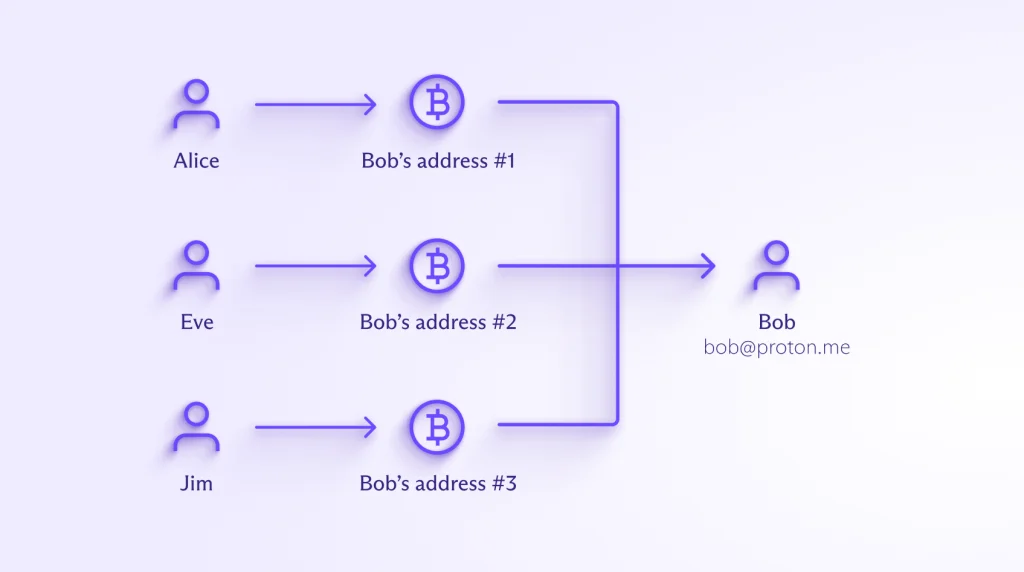
“For example, if an attacker, Eve, tries to send BTC to bob@gmail.com, she will receive a new empty address from Bob’s pool, which is different from the one Alice used. Thus, Eve learns nothing about Bob’s previous transactions,” the developers explained.
Since Proton is not entitled to store user assets, the team reminded users of the importance of recording seed phrases.
Proton Wallet will initially be available to a limited number of Proton Visionary users. Those interested in testing the application can sign up for pre-registration.
In June, hardware wallet manufacturer Trezor introduced its new flagship, the Safe 5.
In July, Tangem released a digital asset storage device in the form of the Tangem Ring.
Рассылки ForkLog: держите руку на пульсе биткоин-индустрии!